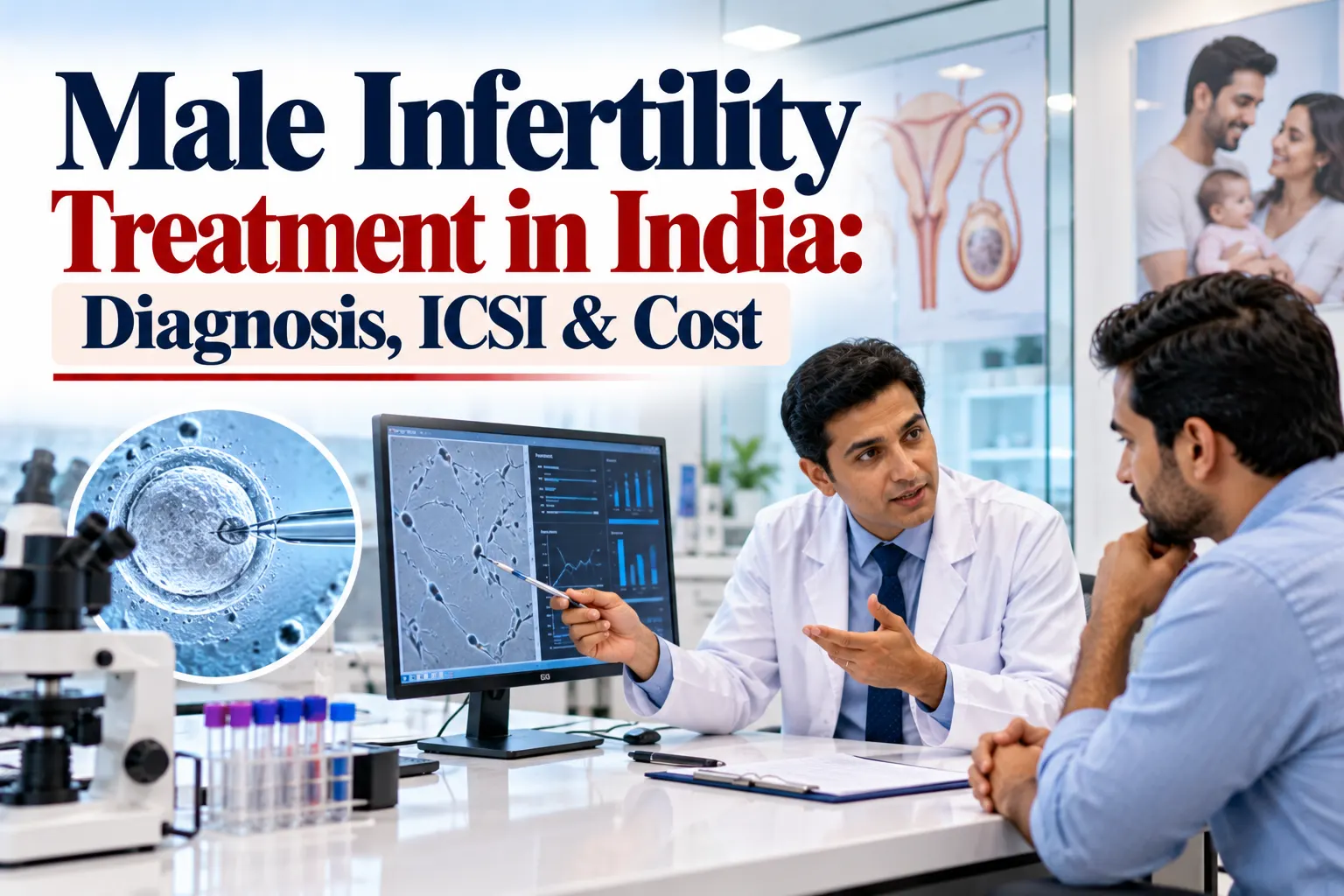
Male Infertility Treatment in India: Diagnosis, ICSI & Surgical Options
Male infertility is a common reason couples have difficulty conceiving, but it does not always mean that natural conception is impossible. Male infertility treatment in India depends on the underlying cause, which may involve low sperm count, poor sperm movement, abnormal sperm shape, hormonal problems, a blockage in the reproductive tract or an inability to produce sperm in the ejaculate. For couples considering infertility treatment in India, the first step is a proper evaluation of both partners rather than starting IVF without understanding the diagnosis.
Treatment can range from medication and correction of a medical condition to surgical sperm retrieval, intrauterine insemination (IUI), in vitro fertilisation (IVF) or intracytoplasmic sperm injection (ICSI). Men with no sperm in their semen may still have options, depending on whether sperm production is impaired or a blockage is preventing sperm from reaching the ejaculate.
India has fertility centres offering male reproductive evaluation, assisted reproductive techniques and selected surgical procedures. Choosing the right approach requires a review of medical records, semen analysis, hormone levels and, when indicated, genetic testing.
What Is Male Infertility?
Male infertility refers to a man's reduced ability to contribute to conception. It may result from a low number of sperm, poor sperm motility, abnormal sperm morphology, problems with sperm production or difficulties with sperm delivery.
Some men have several abnormalities at the same time, while others have normal semen parameters but still experience fertility problems. A semen analysis alone cannot explain every case.
Male infertility can be associated with:
- Varicocele, or enlarged veins around the testicle.
- Hormonal disorders affecting sperm production.
- Previous infections or inflammation.
- Blockages in the reproductive tract.
- Genetic conditions.
- Undescended testes or previous testicular injury.
- Certain medicines, chemotherapy or radiation treatment.
- Erectile or ejaculatory difficulties.
- Unexplained abnormalities in sperm function.
In some cases, no clear cause is identified despite appropriate investigations.
Infertility is not a measure of masculinity or general physical strength. Many causes are treatable, and others can be managed with assisted reproductive techniques.
What Are the Signs and Causes of Male Infertility?
Difficulty conceiving is often the only noticeable sign of male infertility. A man may have normal sexual function, libido and ejaculation while having a low sperm count or poor sperm motility.
Other findings may point towards an underlying medical condition.
Common signs that need medical assessment
- Difficulty achieving a pregnancy after regular, unprotected intercourse.
- A previous semen analysis showing abnormal results.
- Reduced sexual desire or erectile difficulties.
- Pain, swelling or a lump in the testicular area.
- A history of undescended testes or testicular surgery.
- Very low semen volume or difficulty ejaculating.
- A history of chemotherapy, radiation or reproductive tract infection.
These signs do not confirm infertility by themselves. A doctor needs to assess the history and perform the appropriate tests.
Common causes of male infertility
- Low sperm count: Fewer sperm in the semen can reduce the chance of fertilisation. The cause may involve hormonal, genetic, testicular or other medical factors.
- Poor sperm motility: Sperm need adequate movement to reach and fertilise an egg. Reduced motility may affect the likelihood of natural conception.
- Abnormal sperm morphology: Changes in sperm shape can be associated with fertility problems, although morphology should not be interpreted in isolation.
- Varicocele: Enlarged veins around the testicle may affect sperm production or quality in some men. Treatment depends on the clinical findings and fertility goals.
- Hormonal problems: Conditions affecting the pituitary gland, hypothalamus or testicular hormone production can interfere with sperm development.
- Obstruction: A blockage in the reproductive tract may prevent sperm from entering the semen even when sperm production continues inside the testicles.
- Azoospermia: This means that sperm are absent from the ejaculate, including after appropriate laboratory examination. It may result from a blockage or impaired sperm production.
- Ejaculatory disorders: Retrograde ejaculation, in which semen enters the bladder, or other ejaculation problems may interfere with sperm delivery.
Which Male Infertility Diagnostic Tests Are Required?
Male infertility diagnostic tests help identify the cause of the problem and determine whether medication, surgery or assisted reproduction is appropriate. Not every patient needs every test. The investigation plan should follow the medical history, examination and initial results.
1. Semen analysis
Semen analysis is generally the first laboratory investigation. It assesses several characteristics of the ejaculate, including:
- Semen volume.
- Sperm concentration.
- Total sperm number.
- Sperm motility.
- Sperm morphology.
- Other findings when clinically relevant.
An abnormal result does not automatically mean that natural conception is impossible. Semen parameters can vary between samples, which is why a doctor may recommend repeat testing.
Patients should follow the laboratory's instructions about abstinence before providing a sample. The report should be interpreted by a qualified specialist rather than judged by one number alone.
2. Physical examination
A urologist or andrologist may examine the testicles, epididymides and vas deferens. The examination can help identify varicocele, testicular size changes, absent reproductive structures or other findings that require further assessment.
The doctor may also ask about previous operations, infections, medication use and the timing of puberty.
3. Hormone testing
Blood tests may include follicle-stimulating hormone (FSH) and testosterone. Luteinising hormone (LH), prolactin and other investigations may be recommended when the history or initial results indicate a hormonal problem.
Hormone tests are particularly relevant for men with very low sperm counts, azoospermia, reduced libido, erectile difficulties or signs of impaired testicular function.
4. Genetic testing
Genetic investigations may be recommended for selected men with azoospermia or severe oligozoospermia, especially when impaired sperm production is suspected.
Depending on the findings, tests may include a karyotype, Y-chromosome microdeletion analysis or specific gene testing. Men with certain reproductive tract abnormalities may need additional genetic assessment.
Genetic results can affect treatment decisions and may have implications for future children. Genetic counselling should be considered when an inherited condition is identified or suspected.
5. Scans and specialised investigations
Ultrasound or other imaging may be appropriate when a doctor suspects a structural problem, a mass, an obstruction or another condition that requires further assessment.
Advanced tests, including sperm DNA fragmentation testing, are not necessary for every man during the initial evaluation. They should be considered only when the clinical situation supports their use.
The aim of testing is to identify treatable conditions, understand the likely cause and choose an appropriate treatment plan without ordering unnecessary investigations.
What Are the Treatment Options for Male Infertility?
The right treatment depends on the diagnosis. A man with a hormone deficiency may need a different approach from someone with a blocked reproductive tract or severe impairment of sperm production.
| Treatment option | When it may be considered |
|---|---|
| Medication or hormonal treatment | Selected hormonal conditions or specific medical causes |
| Varicocele repair | Clinically significant varicocele in an appropriately selected patient |
| Reconstructive surgery | Certain blockages in the reproductive tract |
| IUI | Selected cases with sufficient usable sperm and suitable female-partner factors |
| IVF with ICSI | Significant sperm abnormalities or certain other fertility indications |
| Surgical sperm retrieval | Azoospermia or selected problems with sperm delivery |
| Donor sperm | When using the man's sperm is not possible or is not chosen |
Medical treatment
Medication may help when infertility is associated with a treatable hormonal disorder, infection or another medical condition. The choice depends on the diagnosis.
For example, men with hypogonadotropic hypogonadism may benefit from specialist-directed hormonal treatment that stimulates sperm production. The response varies, and treatment may take months.
Antibiotics are appropriate for specific infections, not for every abnormal semen report. Hormonal medication should also not be prescribed simply because sperm count is low.
Important: Testosterone injections, gels and anabolic steroids can suppress the hormonal signals required for sperm production. Men trying to conceive should not start testosterone treatment without discussing its effect on fertility with a qualified doctor.
Varicocele treatment
A varicocele is an enlargement of veins around the testicle. It may be associated with impaired sperm production in some men.
A specialist may consider repair when the varicocele is clinically significant, the couple is experiencing infertility and semen results are abnormal. The decision also depends on the female partner's fertility, the duration of infertility and the couple's treatment goals.
Varicocele surgery does not guarantee improved sperm quality or pregnancy. Some patients may still need IVF or ICSI after treatment.
Reconstructive surgery
Certain blockages can sometimes be corrected surgically. For appropriately selected men, microsurgical reconstruction may allow sperm to return to the ejaculate and create the possibility of natural conception.
The suitability of reconstruction depends on the site and cause of the blockage, the duration of obstruction, the woman's fertility and the time available for treatment.
In some cases, sperm retrieval with ICSI may be more suitable. The surgeon should explain the likely benefits, risks and alternatives before a decision is made.
What Is ICSI Treatment for Male Infertility?
ICSI treatment for male infertility stands for intracytoplasmic sperm injection. It is a specialised IVF laboratory procedure in which an embryologist injects a single sperm directly into an egg.
ICSI may be recommended when sperm count is very low, sperm motility is poor, surgically retrieved sperm are being used or previous fertilisation results indicate that the technique may be beneficial.
How does ICSI work?
- The female partner undergoes ovarian stimulation and egg collection as part of an IVF cycle.
- The embryology team prepares the eggs and identifies sperm suitable for injection.
- A single sperm is injected into each mature egg selected for ICSI.
- The laboratory checks whether fertilisation occurs.
- Developing embryos are monitored.
- A suitable embryo may be transferred to the uterus or frozen for later use.
ICSI can overcome some barriers associated with sperm reaching or penetrating an egg. However, it does not correct every underlying problem affecting sperm quality, embryo development or pregnancy.
Who may benefit from ICSI?
ICSI may be considered for men with:
- Very low sperm concentration.
- Poor sperm motility in circumstances where conventional IVF may be unsuitable.
- Certain sperm morphology abnormalities.
- Azoospermia requiring surgical sperm retrieval.
- Previous fertilisation failure during IVF.
- Other specific indications identified by the fertility specialist.
ICSI is not necessary for every couple undergoing IVF. The decision should reflect the sperm findings, previous treatment history and laboratory assessment.
What Is Sperm Retrieval Surgery in India?
Sperm retrieval surgery in India refers to procedures used to collect sperm directly from the reproductive tract or testicle when usable sperm are not present in the ejaculate or cannot be obtained through ejaculation.
The collected sperm may be used for ICSI. The appropriate procedure depends on whether the problem involves a blockage, impaired sperm production or an ejaculation disorder.
Common procedures include:
PESA: Percutaneous Epididymal Sperm Aspiration
PESA involves using a needle to collect sperm from the epididymis, the structure where sperm mature and are stored.
It may be considered in selected men with obstructive azoospermia. The procedure is less invasive than open surgical retrieval, but sperm collection is not always successful.
TESA: Testicular Sperm Aspiration
TESA uses a needle to obtain sperm-containing material directly from the testicle. It may be used in selected cases, depending on the diagnosis and the specialist's judgement.
It is not the preferred procedure for every type of azoospermia, particularly when sperm production is severely impaired.
TESE: Testicular Sperm Extraction
TESE involves obtaining a small sample of testicular tissue to search for sperm. It may be considered when sperm cannot be found in the ejaculate or when other retrieval approaches are unsuitable.
The procedure and expected results depend on whether the problem is obstructive or related to sperm production.
Micro-TESE in India
Micro-TESE in India refers to microdissection testicular sperm extraction. It is a specialised surgical procedure used mainly for selected men with non-obstructive azoospermia, a condition in which sperm production is severely impaired and no sperm are found in the ejaculate.
During micro-TESE, the surgeon uses an operating microscope to examine the testicular tissue and identify areas that may contain sperm-producing tubules. Tissue samples are collected and examined by the embryology laboratory.
Micro-TESE may be considered when:
- Semen testing confirms azoospermia.
- Investigations suggest impaired sperm production rather than a simple blockage.
- A specialist believes that surgical sperm retrieval may be appropriate.
- The couple is considering ICSI using retrieved sperm.
Micro-TESE can sometimes find sperm when they are produced only in small areas of the testicle. However, sperm retrieval is not guaranteed. The result depends on the underlying condition and other clinical factors.
Possible complications include pain, bleeding, infection and a reduction in testosterone production. Patients should ask about the surgeon's experience, the possibility of a failed retrieval and the plan if no sperm are found.
How are these sperm retrieval procedures different?
| Procedure | Collection method | Typical consideration |
|---|---|---|
| PESA | Needle aspiration from the epididymis | Selected cases of obstructive azoospermia |
| TESA | Needle aspiration from the testicle | Selected cases requiring testicular sperm |
| TESE | Surgical removal of a small tissue sample | Cases requiring testicular tissue examination |
| Micro-TESE | Microsurgical examination and sampling of testicular tissue | Selected men with non-obstructive azoospermia |
The procedures are not interchangeable. A reproductive urologist should recommend the technique based on the diagnosis and the likelihood of finding usable sperm.
What Is the Difference Between Obstructive and Non-Obstructive Azoospermia?
Azoospermia means that sperm are absent from the ejaculate after appropriate laboratory examination. Identifying the type is important because it changes the treatment approach.
Obstructive azoospermia occurs when sperm are produced but a blockage prevents them from entering the semen. Possible options include reconstructive surgery or sperm retrieval followed by ICSI.
Non-obstructive azoospermia occurs when sperm production is severely impaired. The cause may involve genetic factors, testicular damage, hormonal conditions or other disorders. Selected patients may be offered micro-TESE, but the likelihood of finding sperm varies.
| Feature | Obstructive azoospermia | Non-obstructive azoospermia |
|---|---|---|
| Main problem | Blockage in the reproductive tract | Impaired sperm production |
| Testicular sperm production | May be preserved | Reduced or absent in parts of the testicle |
| Possible treatment | Reconstruction or sperm retrieval | Specialist assessment and possible micro-TESE |
| ICSI | May use retrieved sperm | May use retrieved sperm if retrieval succeeds |
| Expected outcome | Depends on the cause and treatment | Depends on the underlying condition and retrieval findings |
Azoospermia does not automatically mean that biological fatherhood is impossible. However, the options must be assessed individually, and no procedure can guarantee that sperm will be found.
What Is the Cost of Male Infertility Treatment in India?
The cost of male infertility treatment in India varies considerably because treatment can involve anything from a few diagnostic tests to hormonal therapy, surgery or a complete IVF-ICSI cycle.
The following table identifies the main cost components rather than assigning unsupported fixed prices.
| Treatment or service | What affects the cost |
|---|---|
| Initial consultation | Specialist, hospital and appointment type |
| Semen analysis | Laboratory and any additional testing |
| Hormone tests | Number and type of blood tests |
| Genetic investigations | Specific tests required and laboratory charges |
| Ultrasound or other imaging | Type of scan and clinical indication |
| Varicocele repair | Surgical technique, anaesthesia and hospital stay |
| Sperm retrieval surgery | PESA, TESA, TESE or micro-TESE and operating facilities |
| IVF with ICSI | Medication, egg retrieval, laboratory procedures and embryo transfer |
| Sperm freezing and storage | Laboratory processing and storage duration |
| Additional treatment | Repeat procedures, further investigations or another IVF cycle |
Resource: Obtain a current, itemised estimate from the selected hospital and fertility laboratory. Ask whether consultation, investigations, anaesthesia, surgery, sperm processing, freezing, ICSI and embryo transfer are included.
What can increase the total treatment cost?
Several factors can affect the final bill:
- The number of investigations required to establish the diagnosis.
- Whether hormonal treatment or surgery is recommended.
- The type of sperm retrieval procedure.
- Whether the retrieved sperm can be frozen successfully.
- The need for IVF and ICSI.
- The number of treatment cycles required.
- Medication, storage and follow-up charges.
- Travel and accommodation expenses for international patients.
Before treatment, request a written estimate that separates the cost of diagnosing the problem from the cost of treating it. This is particularly important if surgery and IVF are planned together.
Price disclaimer: Any price information used in this article is based on previous-year data and should be treated as indicative rather than a current quotation. Actual charges may change according to the hospital, surgeon, laboratory and treatment plan. For exact and updated pricing, call or email Healthroop or request a written estimate from the selected hospital before starting treatment.
How to Choose Male Infertility Specialists in India
Choosing the right doctor matters because male infertility can involve several medical specialties. Some patients need a reproductive urologist or andrologist, while others require a fertility specialist, endocrinologist, genetic counsellor or embryology team.
When comparing male infertility specialists in India, check whether the doctor has experience with the specific problem being investigated.
Ask these questions before confirming treatment:
- Does the doctor regularly evaluate male infertility?
- Is the diagnosis based on repeat semen analysis and appropriate investigations?
- Is there a clear reason for the proposed medication or surgery?
- Does the centre have experience with the recommended sperm retrieval technique?
- Is an embryology laboratory available to process retrieved sperm?
- What happens if sperm retrieval is unsuccessful?
- Are the risks and alternatives explained before consent?
- Is the treatment estimate provided in writing?
- Will the female partner's fertility assessment be considered when planning treatment?
The best choice is not necessarily the hospital with the largest advertising budget or the lowest quoted price. It is the centre that can explain the diagnosis, offer an appropriate treatment plan and provide realistic expectations.
Hospitals to Consider for Male Infertility Treatment in India
The Healthroop hospital directory includes the following hospitals with relevant broader fertility, IVF or urology services. Their inclusion does not confirm that every branch offers micro-TESE or every type of male infertility surgery. Patients should confirm the exact service directly with the intended location.
1. Apollo Hospitals
The network lists IVF among its specialties. Ask the relevant branch whether it offers male fertility assessment, ICSI and surgical sperm retrieval, and whether a reproductive urologist is available.
2. Fortis Healthcare
The hospital network lists urology services. Contact the specific facility to confirm whether its urology and fertility teams can coordinate the investigations and treatment required for your case.
3. Manipal Hospitals
The Healthroop directory lists fertility and IVF services. Ask whether the selected location provides ICSI, male infertility investigations and access to surgical sperm retrieval.
4. Max Healthcare
The network lists IVF and urology among its specialties. Confirm the availability of a male reproductive specialist, the relevant procedure and the associated laboratory services at the chosen branch.
5. Medanta – The Medicity
The directory lists kidney and urology services. Patients should enquire about the availability of a reproductive urologist and coordination with a fertility laboratory for cases requiring sperm retrieval and ICSI.
Hospital directory: https://healthroop.com/hospitals.php
These hospitals are starting points for further enquiries, not a ranking of male infertility centres. Ask about the individual doctor's experience and the specific services available before deciding where to receive treatment.
How Healthroop Helps You Find the Right Male Infertility Treatment in India
Healthroop helps patients explore male infertility treatment options in India by connecting them with relevant hospitals and assisting with treatment enquiries. Whether you need diagnostic testing, a consultation with a male fertility specialist, or information about ICSI and surgical sperm retrieval, Healthroop can help you understand the available options and coordinate the next steps. The diagnosis and treatment plan are determined by the treating medical team after reviewing your reports and medical history.
Healthroop can assist you with:
- Hospital Selection: Explore hospitals from the Healthroop network and enquire about male infertility services, including ICSI and sperm retrieval procedures.
- Specialist Consultations: Get assistance with arranging consultations with relevant fertility or urology specialists, subject to availability.
- Medical Report Coordination: Organise semen analysis reports, hormone test results and previous treatment records for the hospital's review.
- Treatment Cost Estimates: Request a detailed quotation covering diagnostic tests, consultations, surgery and IVF-related procedures.
- Treatment Planning: Understand the expected steps, required investigations and practical arrangements before travelling for treatment.
- International Patient Assistance: Get help with treatment-related coordination and travel arrangements, depending on the services available for your case.
To enquire about male infertility treatment options and hospital availability, visit Healthroop and share your medical requirements.
Final Thoughts
Male infertility treatment in India should begin with identifying the cause of the problem. Semen analysis, medical history, physical examination and selected hormone or genetic tests help determine whether medication, surgery, sperm retrieval or assisted reproduction is appropriate.
ICSI can help in cases involving significant sperm abnormalities, while PESA, TESA, TESE and micro-TESE provide different options for obtaining sperm when it is not available in the ejaculate. The choice depends on the diagnosis, and no procedure guarantees successful sperm retrieval or pregnancy.
Before selecting a hospital, ask the specialist to explain the expected benefit, risks, alternatives and complete cost. A well-planned evaluation gives couples a clearer understanding of their options and helps them make decisions based on medical findings rather than assumptions.
Frequently Asked Questions
Answers on male infertility treatment, diagnosis, ICSI, and cost in India.
Yes, many causes of male infertility can be treated or managed. Options include medication for selected hormonal conditions, varicocele repair, reconstructive surgery, sperm retrieval and assisted reproductive techniques. The appropriate treatment depends on the cause, sperm findings and the fertility goals of both partners.
Semen analysis is usually the initial test. A specialist may also recommend a physical examination, hormone tests, genetic investigations or imaging depending on the results. Not every man needs every test. The investigation plan should be based on medical history and the suspected cause.
ICSI is an IVF laboratory procedure in which a single sperm is injected directly into a mature egg. It may be recommended for severe sperm abnormalities, surgically retrieved sperm or previous fertilisation problems. ICSI can help achieve fertilisation but does not guarantee embryo development or pregnancy.
Micro-TESE is a specialised surgical procedure used mainly for selected men with non-obstructive azoospermia. A surgeon uses an operating microscope to identify testicular tissue that may contain sperm. Retrieval is not guaranteed, and patients should discuss the potential risks and alternatives before surgery.
Some men with azoospermia can have a biological child if sperm can be retrieved from the reproductive tract or testicles and used for assisted reproduction. The options depend on whether the cause is obstruction or impaired sperm production. A specialist must assess the individual case.
The cost depends on the investigations, medicines, surgery and fertility procedures required. A diagnostic workup will usually cost less than a plan involving surgical sperm retrieval and IVF with ICSI. Request an itemised estimate from the hospital after the medical assessment.
A reproductive urologist or andrologist is often appropriate for male infertility assessment, particularly when surgery or sperm retrieval may be required. A fertility specialist and embryology team may also be involved if IVF or ICSI is planned. The choice depends on the diagnosis.
Sperm retrieval procedures are performed using appropriate anaesthesia or pain control, depending on the technique. Some soreness, swelling or discomfort may occur during recovery. The duration and risks vary between procedures, so patients should follow the surgeon's instructions and seek advice if symptoms worsen.
No. Treatment depends on the sperm count, motility, underlying cause and the female partner's fertility. Some men may benefit from treating a medical condition or undergoing selected surgery. IUI, IVF or ICSI may be considered when clinically appropriate.
Look for a hospital with relevant urology or reproductive medicine expertise and access to the required fertility laboratory. Confirm the doctor's experience with your condition, the availability of the recommended procedure, the risks and the complete cost. Ask for a written treatment plan before proceeding.
Latest Articles
