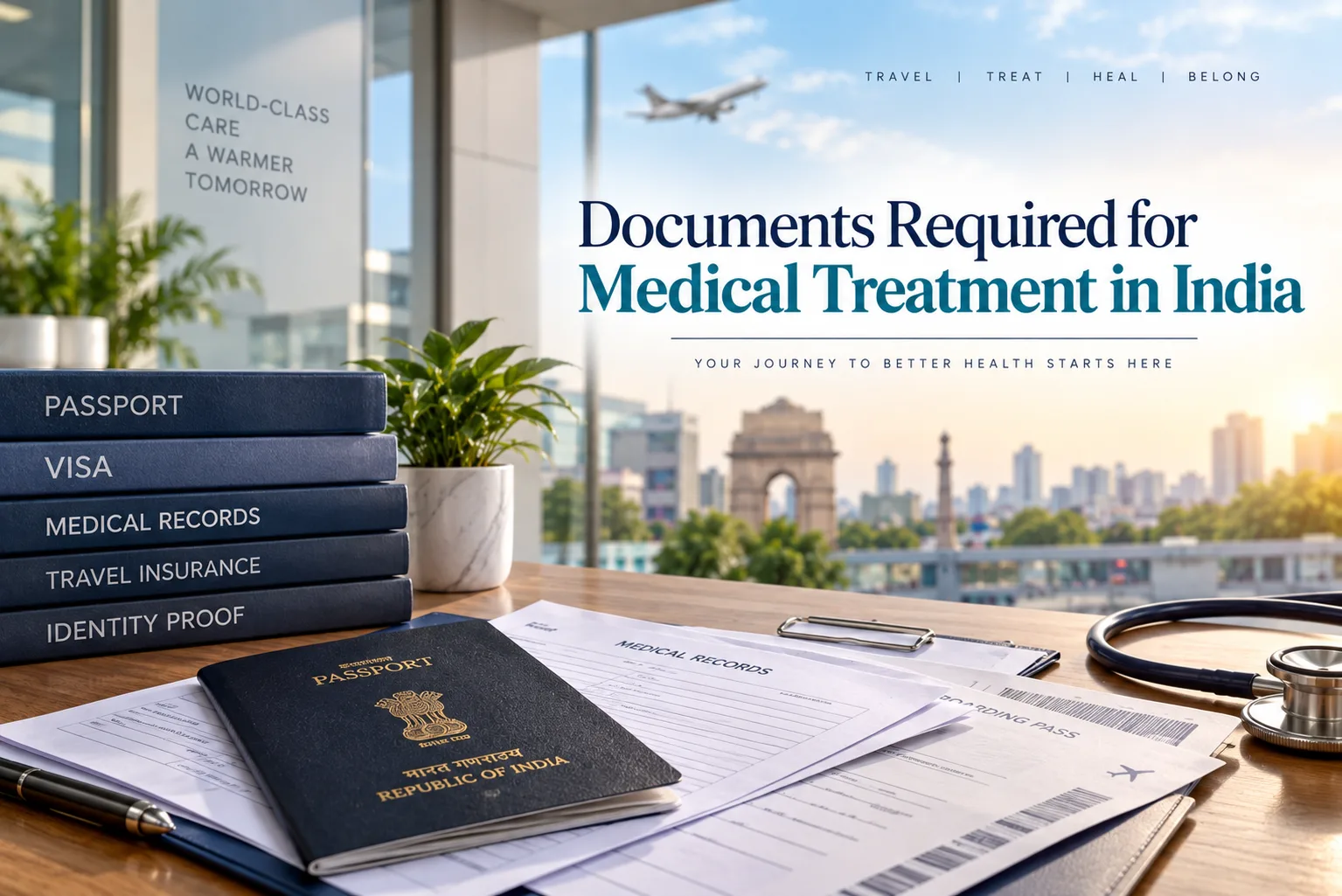
What Documents Are Required for Medical Treatment in India? International Patient Guide
Missing paperwork is one of the most common reasons international patients face delays at Indian hospitals or during medical visa processing. The documents required for medical treatment in India fall into four categories: medical records, identity documents, visa paperwork, and financial documents. Get any one of these wrong and you're looking at a delayed appointment, a rejected visa application, or a hospital that won't confirm your admission date.
This guide lists exactly what to prepare, in what format, and why each document matters, so you can put together a complete file before you book a flight.
What Documents Are Required for Medical Treatment in India?
At a minimum, international patients need: previous medical records and diagnostic reports, a valid passport, a medical visa (obtained using a hospital invitation letter), a treatment cost estimate from the hospital, and proof of funds if the hospital or visa office requests it. Everything else in this guide builds on these five core items.
Important note: A tourist visa cannot be used for treatment in India, even for a minor procedure. If the actual purpose of your trip is medical care, you need a Medical Visa, not a standard e-Visa or tourist visa, regardless of how long you plan to stay.
Medical Visa vs e-Tourist Visa vs Regular Tourist Visa
| Visa Type | Valid for Treatment? | Requires Hospital Letter? | Typical Duration |
|---|---|---|---|
| Medical Visa | Yes | Yes | Up to 1 year, multiple entries (case-dependent) |
| e-Tourist Visa | No | No | 30–90 days, leisure only |
| Regular Tourist Visa | No | No | Varies by country of issue |
Applying under the wrong visa category is one of the fastest ways to have a hospital admission delayed or refused, since some hospitals check visa type before confirming your appointment.
Medical Documents You Should Prepare Before Traveling to India
Hospitals cannot give you an accurate treatment plan or cost estimate without seeing your existing medical history. This is also the step patients most often shortcut, and it's the one that causes the most delay later.
Previous Medical Reports and Records
Bring every report related to your current condition, not just the most recent one. A cardiologist reviewing six months of reports can spot a trend a single report won't show.
Doctor's Prescription or Referral Letter
A referral letter from your treating doctor back home gives the Indian specialist useful context on what's already been tried and ruled out.
Diagnostic Test Reports
Blood work, biopsy results, ECGs, and any lab panel relevant to your condition should be included, ideally with reference ranges from the lab that ran them.
Imaging Reports and Scans
X-rays, MRIs, CT scans, and ultrasounds should be carried both as printed reports and as digital files wherever possible. A written report alone is less useful to a surgeon than the actual scan images, since the radiologist's summary doesn't always capture every detail a specialist wants to check personally.
Quick tip: CDs and USB drives are becoming less reliable for this since many newer laptops don't have optical drives, and hospital computers don't always accept unknown USB devices for security reasons. A cloud folder link (Google Drive, Dropbox) or a PDF export of the imaging emailed directly to the hospital's international patient coordinator tends to work more reliably in practice.
Medication List and Current Prescriptions
List every medication you're currently taking, including dosage and frequency. This matters for anaesthesia planning and for avoiding drug interactions with anything prescribed in India.
Previous Surgery or Hospitalization Records
If you've had related surgery before, discharge summaries and operative notes help the new surgical team understand exactly what was done.
Medical History and Allergies
A written summary of chronic conditions, past illnesses, and known allergies (medication, food, or otherwise) should travel with you even if it feels repetitive with your other reports.
Identity Documents Required for International Patients
Valid Passport
Your passport must have at least six months of validity remaining from your date of travel, and it's the single document every other step depends on.
Passport-Size Photographs
Carry 6–8 recent passport-size photographs (white background, per Indian visa photo specifications) for visa applications and hospital registration.
Proof of Identity
A national ID card or driving licence as secondary identification is useful, particularly if the hospital's registration process asks for more than one form of ID.
Contact and Emergency Contact Details
Have a written list of emergency contacts, including someone in your home country and someone accompanying you in India, if applicable.
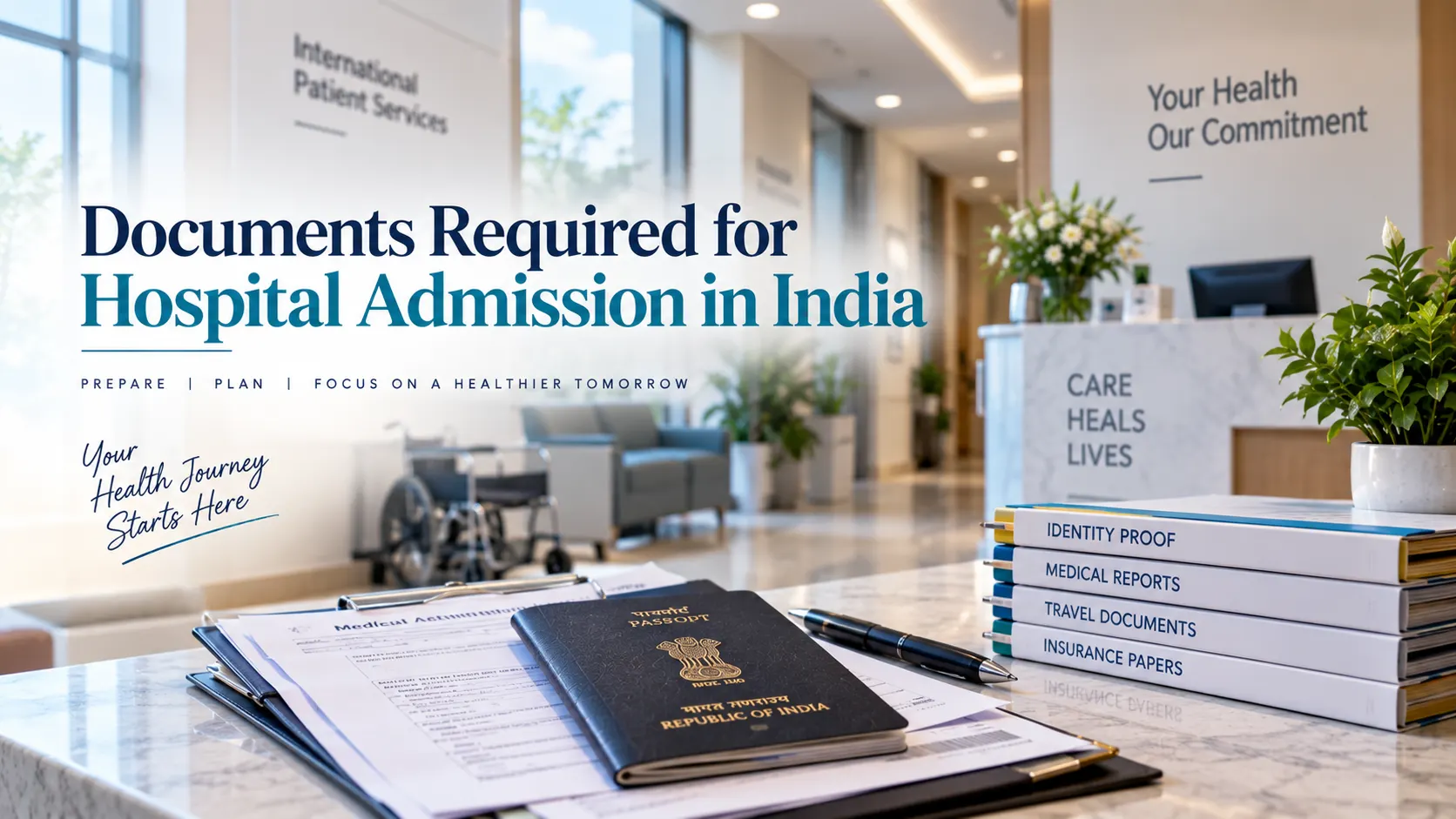
Documents Required for Hospital Admission in India
Hospital Appointment or Confirmation Letter
Most hospitals issue a written appointment confirmation once your medical reports have been reviewed. Carry a printed copy, since not every admission desk can pull it up digitally on the spot.
Medical Reports Submitted to the Hospital
Bring the same reports you submitted for the initial review, in physical form, even if you already emailed them.
Patient Identification Documents
Passport and photographs, as covered above, are required again at the admission desk.
Doctor Referral, If Applicable
If your treatment involves a referral between specialists, carry that referral in writing.
Insurance or Payment-Related Documents
If you're using travel or health insurance that covers treatment abroad, bring the policy document and pre-authorization letter, if your insurer requires one.
Emergency Contact Information
Hospitals will ask for a local or international emergency contact at the time of admission, separate from what you may have listed on your visa application.
Documents Required for a Medical Visa to India
Valid Passport
Same six-month validity requirement applies here as for general travel.
Medical Visa Application
Completed through India's official visa application portal for the applicable visa category.
Recent Photograph
A recent passport-style photograph meeting the visa portal's specific size and background requirements.
Hospital/Medical Institution Invitation or Acceptance Letter
This is the document that separates a medical visa application from a tourist visa. The hospital's international patient department typically issues this once they've reviewed your case and confirmed they can treat you.
Relevant Medical Records
A summary of your condition and the reports supporting the diagnosis, usually the same set submitted to the hospital for the initial review.
Proof of Treatment
Some visa applications ask for a letter confirming the treatment plan and expected duration of stay, which the hospital again provides.
Financial/Travel Supporting Documents
Bank statements or proof of funds may be requested depending on your nationality and the visa office processing your application. Visa fee amounts and current documentation requirements change periodically, so confirm the latest checklist directly on India's official visa application portal before you apply, rather than relying on a fixed figure from any third-party guide, including this one.
Documents Required for a Medical Attendant Visa
Who Can Travel as a Medical Attendant?
Typically, one immediate family member can accompany the patient on a Medical Attendant Visa, linked to the patient's own medical visa application.
Passport and Identity Documents
The attendant needs their own valid passport with the same six-month validity requirement.
Medical Attendant Visa Application
A separate application form, filed alongside or shortly after the patient's medical visa application.
Patient's Medical Visa/Treatment Documents
The attendant's visa is dependent on the patient's approved medical visa, so copies of the patient's documentation are required.
Hospital or Medical Institution Documents
The same hospital invitation letter often names the accompanying attendant, so confirm this is included when the hospital issues it.
Other Supporting Documents
Proof of relationship to the patient (marriage certificate, birth certificate) may be requested depending on the visa office.
Financial Documents for Medical Treatment in India
Hospitals in India generally confirm an admission date only after receiving a deposit or written payment commitment, since scheduling operating room time and specialist availability against an unconfirmed booking creates problems on their end too. Having your financial documents ready before you start visa paperwork, rather than scrambling for them afterward, keeps the whole timeline shorter.
Treatment Cost Estimate
A written estimate from the hospital, broken down by surgeon fee, hospital stay, tests, and medication, not a single lump-sum number.
Hospital Quotation
Some hospitals issue a formal quotation letter separate from the general cost estimate, particularly for visa purposes.
Proof of Funds, Where Required
Certain visa categories or hospitals request proof you can cover the estimated treatment cost. Requirements vary by nationality, so check with the specific visa office handling your application.
Insurance Documents
If applicable, your insurance policy and any pre-approval or claim documents relevant to treatment abroad.
Payment/Deposit Confirmation
Most hospitals require an advance deposit before confirming your admission date. Keep the payment confirmation or transaction receipt with your other documents.
Bank or Financial Documents, If Applicable
Bank statements showing sufficient funds may be requested by either the hospital or the visa office, depending on your case.
Travel Documents International Patients Should Carry
Flight Tickets
Both outbound and return tickets, or at minimum a confirmed outbound ticket if your return date depends on the treatment timeline.
Visa Documents
Your approved medical visa and, if applicable, your attendant's approved medical attendant visa.
Passport Copies
Carry photocopies of your passport's data page separately from the original, in case the original is misplaced.
Hospital Appointment Details
Printed confirmation of your appointment date, hospital address, and the name of your assigned coordinator or doctor.
Accommodation Confirmation
Booking confirmation for wherever you're staying before or after your hospital stay.
Airport Transfer Details
Confirmation of who is picking you up, if arranged, along with a contact number for that driver or service.
Emergency Contact Information
A physical copy, not just a phone contact, in case your phone isn't accessible on arrival.
Should You Translate Your Medical Documents Before Traveling to India?
When Medical Document Translation May Be Necessary
If your original reports aren't in English, translation is worth doing before you travel rather than after, since it can otherwise delay the hospital's initial review.
Which Documents Should Be Translated?
Diagnosis summaries, operative notes, and any report the treating doctor will need to read in detail are the priority. Raw lab values with standard units usually don't need translation.
Keeping Original and Translated Copies
Carry both versions. Some hospitals or visa offices want to see the original alongside the translation, not the translation alone.
Language Considerations for International Patients
Most major Indian hospitals treating international patients operate primarily in English for clinical documentation, regardless of the regional language spoken locally. Where a patient doesn't speak English well, the gap is usually handled through an in-person or phone interpreter during consultations, not through translating every single document, which would slow things down without adding much benefit for routine paperwork like admission forms.
How Many Copies of Your Medical Documents Should You Carry?
Carry at least two physical sets: one for the hospital and one to keep with you. A third set left with a family member back home is worth doing too, since it means someone can email or courier a replacement if your originals go missing mid-trip. A digital backup, either emailed to yourself or stored in a cloud folder you can access without your original device, covers you if paperwork is lost in transit, which happens more often than patients expect, particularly with connecting flights and layovers.
If you're travelling with a medical attendant, keep at least one full set of your documents with them as well, separate from your own bag. It's a basic precaution, but it's the kind of thing patients only think about after something goes wrong the first time.
Document Checklist Before Traveling to India
Use this as a final pass before you leave for the airport, not as your first planning list. By the time you reach this stage, most items should already be sorted; this is about catching anything left behind.
- Passport (6+ months validity) and passport photos
- Approved medical visa (and attendant visa, if applicable)
- All previous medical reports, test results, and imaging (physical and digital)
- Current medication list
- Hospital invitation/appointment confirmation letter
- Treatment cost estimate or hospital quotation
- Payment/deposit confirmation
- Insurance documents, if applicable
- Flight tickets and accommodation confirmation
- Emergency contact list (written copy)
What Happens After You Submit Your Medical Documents?
Knowing this sequence in advance helps you plan travel dates realistically, instead of guessing how long the process will take.
Medical Report Review
The hospital's specialist team reviews your reports to confirm they can treat your condition and to flag any additional tests needed.
Specialist/Hospital Selection
Based on the review, you're matched to the right specialist, not just a generalist at the hospital.
Treatment Plan
A written treatment plan outlining the recommended procedure, expected hospital stay, and recovery timeline.
Estimated Treatment Cost
An itemised cost estimate follows the treatment plan, usually within 24–48 hours of report submission.
Hospital Appointment
Once you confirm, the hospital issues a formal appointment date and invitation letter for your visa application.
Visa and Travel Preparation
With the invitation letter in hand, you apply for the medical visa and arrange travel around the confirmed appointment date.
Arrival and Hospital Admission
On arrival, you complete hospital registration using the documents in the admission checklist above.
How HealthRoop Helps International Patients Prepare for Treatment in India
Assembling this paperwork correctly the first time is what actually saves time, not rushing through the visa application. Here's how HealthRoop supports patients through this process at no extra cost, since the facilitator fee comes from hospital partnerships rather than the patient.
- Medical Report Review. Reports are reviewed before submission to hospitals, so nothing critical is missing when the specialist team looks at your case.
- Hospital and Doctor Selection. Recommendations are matched to your specific diagnosis rather than a single default hospital.
- Treatment Cost Estimate. A detailed, itemised estimate is shared before you commit to any travel or visa application.
- Medical Visa Assistance. Help with the hospital invitation letter and the documentation checklist required for the visa application.
- Airport Pickup and Accommodation. Coordination for transfer and accommodation suited to your treatment length.
- Local Transportation. Transport between accommodation, hospital, and follow-up appointments during your stay.
- International Patient Coordination. A single point of contact for questions that come up between report submission and arrival, rather than juggling multiple hospital departments directly.
- Post-Treatment Follow-Up. Support in getting discharge summaries and reports back to your home-country doctor after you return.
Common Mistakes International Patients Should Avoid
- Submitting only the most recent medical report. A single report gives a specialist a snapshot, not a trend, and it's the trend that often shapes the treatment plan.
- Applying for a tourist visa instead of a medical visa. This is the single most common paperwork error, and it can result in a hospital refusing admission or a visa office rejecting the application outright.
- Carrying printed reports without digital copies of scans. A printed radiology summary doesn't substitute for the actual imaging files a surgeon needs to review.
- Waiting until arrival to ask about attendant visa requirements. This should be sorted alongside the patient's own visa application, not after landing.
- Treating a verbal cost estimate as final. Get every estimate in writing and itemised before you commit to travel dates.
- Booking flights before the hospital confirms an admission date. Hospitals sometimes need additional tests reviewed before confirming, and a fixed flight date can force a rushed decision.
Patients who want a broader view of what treatment involves before assembling paperwork can also check HealthRoop's specialties page to see the departments and specialists available across partner hospitals.
Ready to start your documentation checklist? Share your medical reports with HealthRoop and get a written treatment estimate before you begin visa paperwork. Learn more at healthroop.com.
Frequently Asked Questions
Answers on medical, visa and travel documents needed for treatment in India.
Previous medical records, diagnostic and imaging reports, a valid passport, a medical visa with hospital invitation letter, and a treatment cost estimate are the core documents every international patient needs.
A valid passport, visa application, recent photograph, hospital invitation letter, relevant medical records, and financial supporting documents where requested by the visa office.
Yes. Hospitals need existing reports to confirm they can treat the condition and to give an accurate treatment plan and cost estimate before you travel.
Your appointment confirmation letter, passport and photographs, submitted medical reports, and any insurance or payment documents relevant to your admission.
Yes, India treats a large number of international patients each year, and most major hospitals have a dedicated international patient department to handle their documentation and care.
A valid passport, a separate attendant visa application, proof of relationship to the patient, and documents linking the attendant's application to the patient's approved medical visa.
If your original reports aren't in English, translating the diagnosis summary and key clinical notes before travel is worth doing, since it prevents delays during the hospital's initial review.
Some visa categories and hospitals request proof of funds depending on your nationality and treatment cost. Check the specific requirement with your visa office or hospital coordinator before applying.
Yes, our team reviews medical reports, helps prepare the hospital invitation letter needed for the visa application, and coordinates the rest of the documentation process before you travel.
Submit your medical reports to the hospital or a facilitator like HealthRoop, and you'll typically receive a written, itemised cost estimate within 24–48 hours.
