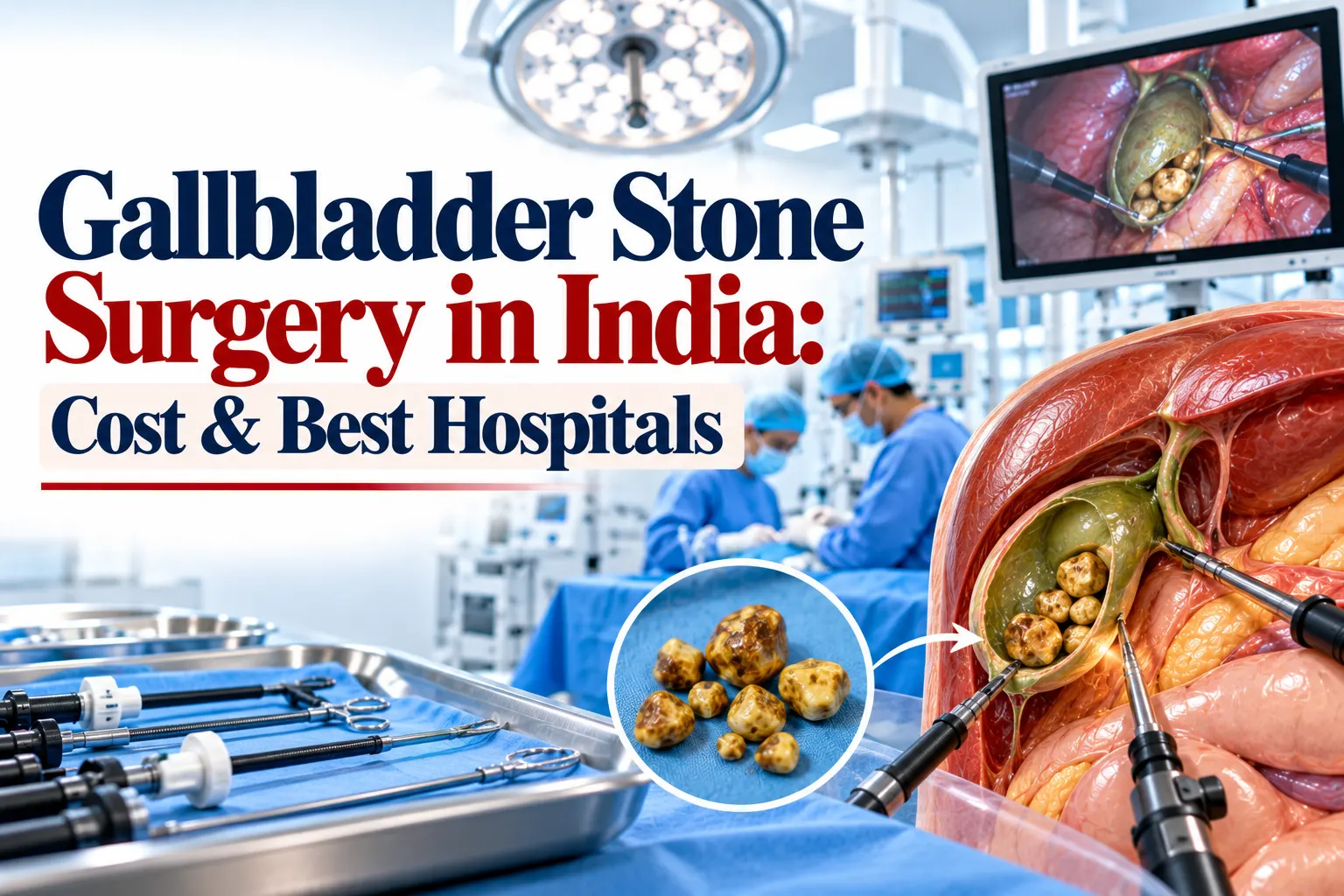
Gallbladder Stone Surgery in India: Cost and Best Hospitals
Gallbladder stone surgery in India is a common treatment option for patients experiencing repeated abdominal pain, gallbladder inflammation or complications caused by gallstones. The procedure, medically known as cholecystectomy, involves removing the gallbladder, usually through small abdominal incisions. Patients considering general and laparoscopic surgery should first undergo a medical assessment to determine whether surgery is necessary and which approach is appropriate.
Laparoscopic gallbladder removal is the usual surgical approach for symptomatic gallstones. Many patients leave the hospital on the day of surgery or after an overnight stay, although recovery depends on their condition and the complexity of the operation. Published 2025 Indian cost estimates commonly place laparoscopic cholecystectomy between ₹50,000 and ₹1,50,000. These figures are for planning purposes, not confirmed hospital quotations.
For international patients, the decision involves more than comparing surgery prices. The surgeon's experience, hospital facilities, the possibility of complications and the arrangements for follow-up care all matter. Patients travelling from Oman, Bangladesh, Nepal, Nigeria, Ethiopia and other countries should also plan their stay in India carefully.
What Are Gallbladder Stones?
Gallstones are hardened deposits that develop inside the gallbladder, a small organ located beneath the liver. The gallbladder stores bile, a digestive fluid produced by the liver that helps break down fats.
Gallstones can develop when substances in bile, including cholesterol or bilirubin, form solid particles. Some people have one large stone, while others develop multiple smaller stones.
Not everyone with gallstones needs treatment. Stones are sometimes found during an ultrasound performed for an unrelated medical concern. If they cause no symptoms, doctors may recommend observation rather than surgery.
Problems arise when a stone blocks the normal flow of bile or triggers inflammation.
Common symptoms of gallstones
Patients may experience:
- Sudden or recurring pain in the upper-right abdomen.
- Pain in the upper-middle abdomen, sometimes after meals.
- Pain extending towards the back or right shoulder.
- Nausea or vomiting during painful episodes.
- Abdominal tenderness associated with inflammation.
- Fever or chills if an infection develops.
- Yellowing of the skin or eyes due to bile duct obstruction.
Severe or persistent abdominal pain, fever, jaundice or repeated vomiting requires prompt medical assessment. These symptoms may indicate acute cholecystitis, bile duct obstruction, cholangitis or pancreatitis. Patients experiencing these symptoms should seek medical attention instead of delaying care to arrange international travel.
When Is Gallbladder Stone Surgery Necessary?
Doctors do not recommend gallbladder removal simply because an ultrasound shows stones. The decision depends on the patient's symptoms, examination findings, imaging results and the risk of complications.
Surgery is commonly considered for recurring gallstone pain or complications related to gallstones.
Conditions that may require surgery
- Symptomatic gallstones: Repeated episodes of biliary pain may interfere with daily activities and increase the risk of further problems.
- Acute cholecystitis: Inflammation of the gallbladder, often caused by a stone blocking the cystic duct, may require hospital treatment and early surgery.
- Gallstone pancreatitis: A stone passing through the bile ducts can obstruct pancreatic drainage and cause inflammation of the pancreas. The timing of gallbladder removal depends on the severity of the attack.
- Bile duct complications: Stones in the common bile duct may require additional treatment, such as endoscopic removal, before or around the time of gallbladder surgery.
- Selected high-risk gallbladder conditions: Certain complications or suspicious abnormalities may require surgery following specialist assessment.
Patients with incidentally detected gallstones and no symptoms often do not need immediate treatment. The decision should be made with a qualified doctor after reviewing the clinical findings.
What Types of Gallbladder Stone Surgery Are Available in India?
The main surgical approaches are laparoscopic cholecystectomy and open cholecystectomy. Robotic-assisted surgery is available at selected hospitals but is not necessary for every patient.
1. Laparoscopic cholecystectomy
Laparoscopic cholecystectomy is a minimally invasive operation in which the surgeon removes the gallbladder through several small abdominal incisions.
A camera provides a magnified view of the surgical area while specialised instruments are used to separate and remove the gallbladder.
The procedure is performed under general anaesthesia.
Its main advantages include:
- Smaller incisions.
- Generally less post-operative pain.
- Shorter hospital stays.
- Faster return to routine activities.
- Smaller scars compared with open surgery.
However, laparoscopy may be difficult in patients with severe inflammation, extensive adhesions or unclear anatomy. The surgeon may recommend open surgery or convert to an open procedure if that is safer.
2. Open cholecystectomy
Open surgery involves removing the gallbladder through a larger abdominal incision.
It may be necessary when severe inflammation, scarring, bleeding or other technical difficulties prevent safe laparoscopic removal.
Recovery generally takes longer, and patients may need several days in hospital. Converting from laparoscopic to open surgery can be an important safety decision rather than a surgical failure.
3. Robotic-assisted gallbladder surgery
Some hospitals offer robot-assisted gallbladder removal. The surgeon controls robotic instruments while viewing the operating area through a specialised system.
This technique may be considered in selected cases, but robotic surgery is not automatically better than conventional laparoscopy for routine gallbladder removal.
Patients should ask whether robotic assistance offers a meaningful clinical benefit in their situation and how it changes the total cost.
Laparoscopic vs Open Gallbladder Surgery
| Feature | Laparoscopic surgery | Open surgery |
|---|---|---|
| Incisions | Several small incisions | One larger incision |
| Anaesthesia | General | General |
| Hospital stay | Often same day or overnight | Usually several days |
| Recovery | Often 1–2 weeks for routine activities | Commonly 4–6 weeks or longer |
| Post-operative pain | Generally less | Generally more |
| Scarring | Smaller scars | Larger scar |
| Common use | Most routine gallbladder removals | Complex cases or when laparoscopy is unsuitable |
These recovery periods are general estimates. Actual recovery depends on the patient's health, the complexity of surgery and the surgeon's instructions.
How Much Does Gallbladder Stone Surgery Cost in India?
The gallbladder stone surgery in India cost depends on the surgical approach, hospital, surgeon's fees, patient's condition and additional treatment requirements.
Patients travelling from overseas should compare complete hospital estimates rather than relying on an advertised starting price.
Estimated gallbladder surgery cost in India
The following figures are indicative planning estimates based on previously published 2025 pricing information.
| Surgery Type | Cost in India (INR) | Estimated Cost (USD) |
|---|---|---|
| Laparoscopic cholecystectomy | ₹50,000–₹1,50,000 | 575–1,725 |
| Open cholecystectomy | ₹50,000–₹1,50,000 | 575–1,725 |
| Robotic-assisted cholecystectomy | Individual quotation required | Individual quotation required |
Resource: ImpactGuru, “Laparoscopic Cholecystectomy Cost in India,” published pricing information from 2025.
What is included in gallbladder surgery charges?
A hospital package may include the surgeon's fee, anaesthesia, operating theatre, routine medicines and a standard period of hospitalisation.
However, patients should confirm these inclusions in writing.
Additional charges may arise from:
- Pre-operative blood tests and imaging.
- Gastroenterology or anaesthesia consultations.
- Magnetic resonance cholangiopancreatography (MRCP).
- Endoscopic retrograde cholangiopancreatography (ERCP).
- Additional hospital days or intensive care.
- Treatment of infection or other complications.
- Post-operative medicines and follow-up visits.
ERCP is an endoscopic procedure used to manage certain bile duct problems. It is not a replacement for gallbladder removal when cholecystectomy is indicated.
Why do gallbladder surgery prices differ?
A patient with uncomplicated gallstones may need a straightforward operation. Someone with acute inflammation, previous abdominal surgery or suspected bile duct stones may need additional investigations and treatment.
The final bill may also depend on the selected room category and whether the hospital charges separately for consumables, imaging or post-operative care.
Practical advice: Ask for an itemised estimate that explains what happens financially if the surgeon needs to convert laparoscopic surgery to an open procedure.
Which Are the Best Hospitals for Gallstone Surgery in India?
Choosing the best hospital for gallstone surgery requires attention to the surgical team, anaesthesia support, emergency facilities and the hospital's ability to manage bile duct complications.
The hospitals below are options to enquire with through the Healthroop hospital network. This is not a ranking of surgical outcomes. Patients must confirm that the selected branch offers the required procedure and has an available surgeon.
1. Apollo Hospitals
Location: Chennai and other Indian cities.
Apollo Hospitals operates a network of multispecialty facilities. Patients can enquire about laparoscopic cholecystectomy, the experience of the treating surgeon and arrangements for international patients.
2. Medanta – The Medicity
Location: Gurugram, Haryana.
Patients with gallstones and suspected bile duct complications can enquire about surgical and gastroenterology services. Confirm the availability of the appropriate specialist and any additional investigations required.
3. Manipal Hospitals
Location: Bengaluru and other Indian cities.
Patients can ask about laparoscopic gallbladder removal, pre-operative investigations, expected hospital stay and arrangements for post-operative review.
4. Max Healthcare
Location: New Delhi and other locations.
Patients considering treatment can enquire about the relevant surgical team, biliary evaluation services and support available for international patients.
5. Fortis Healthcare
Location: Gurugram and other Indian cities.
Patients can request information about laparoscopic cholecystectomy, the treating surgeon's experience and the hospital's approach to managing surgical complications.
Hospital selection should be based on the relevant branch's capabilities, the surgeon's experience and the patient's medical requirements rather than the hospital's name alone.
What should foreign patients ask before choosing a hospital?
- How frequently does the surgeon perform laparoscopic cholecystectomy?
- Does the hospital offer ERCP if bile duct stones are suspected?
- What facilities are available for managing bile duct injuries or other complications?
- Is the quoted price fixed, or could it change after examination?
- How long should the patient remain near the hospital after discharge?
- Will the hospital provide medical reports in English?
- Can the surgeon arrange follow-up consultations after the patient returns home?
How Is Gallbladder Stone Surgery Performed?
A routine laparoscopic cholecystectomy commonly takes around one to two hours, although complicated cases may require more time.
Step 1: Pre-operative evaluation
The surgeon reviews the patient's symptoms, medical history and imaging results. An abdominal ultrasound is usually the first imaging test.
Other investigations may include:
- Complete blood count.
- Liver function tests.
- Kidney function tests.
- Blood clotting assessment.
- ECG when indicated.
- MRCP if bile duct stones are suspected.
The anaesthetist also evaluates the patient's fitness for general anaesthesia.
Step 2: Anaesthesia and incisions
The patient receives general anaesthesia. The surgeon makes several small abdominal incisions and introduces carbon dioxide gas to create space for the instruments.
Step 3: Gallbladder removal
Using the laparoscopic camera, the surgeon identifies the relevant anatomy, safely secures and divides the cystic duct and artery, and separates the gallbladder from the liver.
The gallbladder, including the stones inside it, is removed through an incision.
Step 4: Recovery and discharge
The patient is monitored for pain, nausea, bleeding and other early complications. Once clinically stable, they can begin drinking and eating as advised.
Discharge may occur on the same day or the following day after uncomplicated laparoscopic surgery. Patients needing open surgery or treatment for complications generally stay longer.
How Long Does Recovery Take After Gallbladder Surgery?
Recovery after gallbladder stone surgery in India is usually faster with a laparoscopic approach than with open surgery.
Most patients can begin gentle walking soon after their operation. Returning to work, exercise and travel depends on the type of surgery and individual healing.
| Recovery milestone | Typical expectation after uncomplicated laparoscopy |
|---|---|
| Walking | Usually within hours, with assistance if needed |
| Hospital discharge | Same day or after an overnight stay |
| Light daily activities | Gradually over the first few days |
| Desk-based work | Often within 1–2 weeks |
| Heavy lifting or strenuous exercise | Only after surgical clearance |
| International air travel | Based on medical assessment and airline requirements |
The NHS advises that patients may be able to return to work within one to two weeks, depending on their occupation and recovery.
Resource: NHS, “Gallbladder Removal – Recovery.”
What should patients eat after gallbladder removal?
The liver continues producing bile after the gallbladder is removed. Instead of being stored in the gallbladder, bile flows directly into the small intestine.
Most patients can return to a normal, balanced diet.
During early recovery, smaller meals may be easier to tolerate. Patients may also find it helpful to limit large, high-fat meals if these cause discomfort or diarrhoea.
Good food choices include vegetables, fruits, whole grains, lean protein and moderate amounts of healthy fats.
A strict lifelong fat-free diet is generally unnecessary unless a clinician recommends specific dietary restrictions.
What symptoms require medical attention after surgery?
Seek urgent medical advice for:
- Increasing abdominal pain.
- Persistent vomiting.
- Fever or chills.
- Yellowing of the skin or eyes.
- Wound discharge or spreading redness.
- Worsening abdominal swelling.
Chest pain, breathlessness or painful swelling in a leg also requires urgent assessment because these symptoms may indicate serious complications, including blood clots.
What Are the Risks of Gallbladder Removal Surgery?
Cholecystectomy is commonly performed, but it remains an abdominal operation under general anaesthesia.
Potential complications include:
- Bleeding or wound infection.
- Injury to the bile duct.
- Bile leakage.
- Injury to nearby organs or blood vessels.
- Blood clots.
- Complications related to anaesthesia.
- Retained stones in the bile duct.
- Persistent digestive symptoms after surgery.
The surgeon may recommend additional treatment if a bile duct stone or complication is identified.
Can gallstones return after gallbladder removal?
Gallstones cannot recur inside a gallbladder that has been completely removed. However, stones may occasionally remain in or develop within the bile ducts.
Patients who develop pain or jaundice after surgery should be assessed rather than assuming the symptoms are part of normal recovery.
Is Gallbladder Surgery Safe for Foreign Patients in India?
Gallbladder surgery for foreigners can be arranged at Indian hospitals with appropriate surgical, anaesthesia and post-operative facilities. The clinical risks depend mainly on the patient's health and the complexity of the condition, not their nationality.
International patients should pay particular attention to continuity of care and the possibility that surgery may be delayed or the treatment plan may change.
Medical travel checklist
- Obtain an ultrasound report and relevant blood test results before contacting hospitals.
- Share information about previous surgeries, allergies, medications and existing medical conditions.
- Request a written assessment from the treating surgeon.
- Confirm the hospital's admission and discharge arrangements.
- Check the applicable Indian visa requirements.
- Arrange accommodation near the hospital for the recommended recovery period.
- Ask the surgeon about blood clot risks during long-distance travel.
- Obtain medical clearance before returning home.
Patients should avoid booking a return flight immediately after surgery without consulting their treating team. The surgeon should decide when flying is appropriate based on recovery, complications and the length of the journey.
How Healthroop Helps International Patients
Healthroop assists overseas patients with hospital enquiries, treatment coordination and practical arrangements for medical travel in India. Patients considering gallbladder removal can share their reports and request information about suitable hospitals, surgical consultations and estimated charges before making travel commitments.
Support may include:
- Medical report coordination: Helping patients submit ultrasound scans, prescriptions and previous medical records.
- Hospital comparison: Assisting with enquiries to hospitals offering relevant surgical services.
- Treatment estimates: Coordinating requests for itemised quotations and clarifying package inclusions.
- Medical visa guidance: Providing assistance with the documentation process where required.
- Travel arrangements: Helping organise airport transfers, accommodation and local transport.
- Language assistance: Coordinating interpreter support when needed.
- Follow-up planning: Helping patients obtain discharge documents and arrange communication after returning home.
Patients should confirm the exact services and charges included in their arrangements before proceeding. Clinical decisions remain the responsibility of the treating hospital and surgeon.
Final Thoughts
Gallbladder stone surgery in India is an option for international patients who need treatment for symptomatic gallstones or related complications. Laparoscopic cholecystectomy is commonly used because it generally allows shorter hospital stays and faster recovery than open surgery.
However, the appropriate treatment depends on the patient's symptoms, test results and surgical assessment. Not all gallstones require removal, and some patients need urgent medical attention rather than a planned medical trip.
Before choosing a hospital, compare the surgeon's experience, treatment facilities, complete costs and follow-up arrangements. Patients should collect their medical reports and obtain a written estimate before confirming their travel plans.
Frequently Asked Questions
Answers on gallbladder surgery cost, recovery, and planning care in India.
The gallbladder stone surgery in India cost for laparoscopic removal was commonly estimated at ₹50,000–₹1,50,000 in published 2025 pricing information. Actual charges vary by hospital, surgeon, procedure complexity and package inclusions. Patients should obtain a current quotation covering investigations, anaesthesia, hospitalisation and follow-up.
The best hospital for gallstone surgery depends on the patient's condition and the surgeon's experience. Apollo, Medanta, Manipal, Max and Fortis are hospital networks patients may consider. Confirm the specific branch's surgical facilities, surgeon availability, complication management and international patient services before making a decision.
Laparoscopic cholecystectomy is a commonly performed operation and is generally safe for appropriately selected patients. However, bleeding, infection, bile duct injury and anaesthesia-related complications can occur. The surgeon should explain individual risks, particularly when the patient has severe inflammation, previous abdominal surgery or other medical conditions.
The necessary stay depends on the procedure and recovery. Patients may leave the hospital within a day after uncomplicated laparoscopic surgery, but international travel requires separate medical clearance. Ask the surgeon how long to remain nearby for follow-up and whether long-distance flying introduces additional risks.
Yes. Most people can live normally without a gallbladder because the liver continues producing bile for digestion. Some experience temporary loose stools or discomfort after fatty meals. A balanced diet and gradual return to normal eating are usually sufficient, although persistent symptoms should be discussed with a doctor.
Laparoscopic surgery is generally preferred for routine gallbladder removal because it usually causes less wound pain and allows faster recovery. Open surgery remains important when severe inflammation, scarring or difficult anatomy makes laparoscopy unsafe. The surgeon should select the approach based on clinical findings rather than patient preference alone.
For most patients needing surgery for symptomatic gallstones, doctors remove the gallbladder rather than extracting only the stones. Removing stones while leaving the gallbladder can allow further stones to form. Certain medicines may be considered in selected cases, but they are not suitable for everyone and treatment can take a long time.
Yes. Gallbladder surgery for foreigners can be arranged through hospitals accepting international patients. Patients should share their medical reports, obtain a specialist assessment and confirm the treatment estimate before travelling. Visa requirements depend on nationality and travel purpose, while the hospital determines medical eligibility and the surgical schedule.
An uncomplicated laparoscopic cholecystectomy commonly takes about one to two hours, although operating time varies. Severe inflammation, adhesions or difficult anatomy may extend the procedure. Patients also need time for preparation, anaesthesia and post-operative monitoring, so the total time spent in the hospital is considerably longer.
A stone blocking the common bile duct can cause pain, jaundice, infection or pancreatitis. Doctors may recommend blood tests, ultrasound, MRCP or ERCP depending on the findings. Some patients require endoscopic removal of the duct stone before or around the time of gallbladder surgery.
