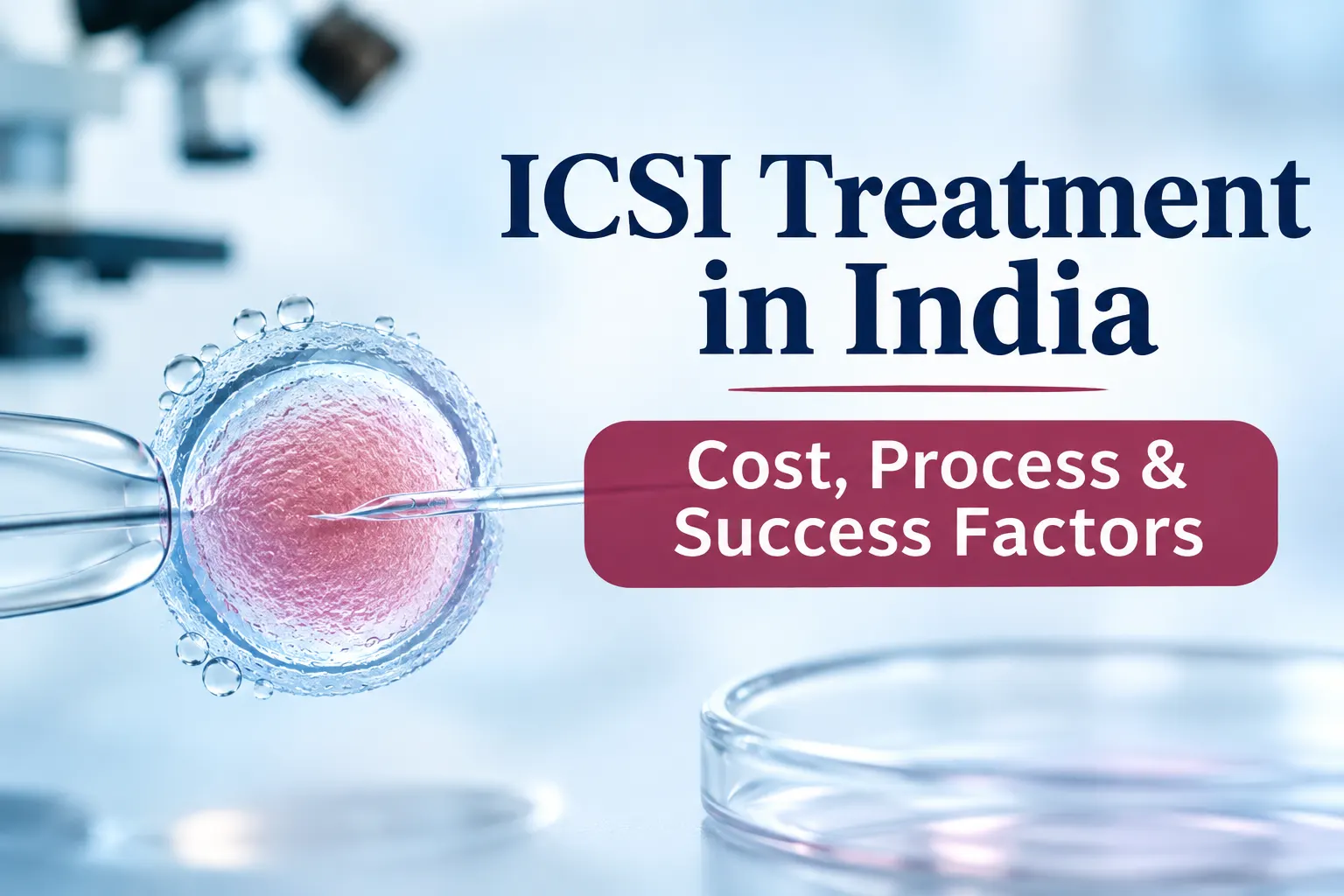
ICSI Treatment in India: Cost, Process & Success Factors
ICSI treatment in India is an advanced fertility procedure used to address specific fertilisation problems, particularly those associated with male infertility. It involves injecting a single selected sperm directly into a mature egg in a laboratory. The procedure is performed as part of an In Vitro Fertilisation (IVF) cycle and may be recommended when sperm count, movement or quality affects natural fertilisation. Couples considering infertility treatment in India can access fertility assessments, experienced reproductive specialists and IVF laboratories at hospitals across the country.
India is an option for couples seeking fertility care because of its range of reproductive medicine facilities and comparatively accessible treatment costs. However, choosing ICSI requires more than comparing hospital prices. The woman's age, ovarian reserve, sperm quality, previous fertility treatment and embryology laboratory standards all influence the treatment plan and its potential outcome.
This guide explains the ICSI procedure, eligibility requirements, estimated treatment expenses, success factors and hospital selection considerations. It also covers important information for international patients planning to travel to India for fertility treatment.
In this guide
- What Is ICSI Treatment?
- ICSI vs Conventional IVF: What Is the Difference?
- Who Is Eligible for ICSI Treatment in India?
- What Tests Are Required Before ICSI Treatment?
- What Are the ICSI Procedure Steps?
- What Is the Cost of ICSI Treatment in India?
- What Factors Affect ICSI Treatment Success Rates?
- What Is the Success Rate of ICSI Treatment in India?
- What Are the Benefits and Risks of ICSI Treatment?
- Which Hospitals in India Offer Fertility and ICSI-Related Services?
- Why Do International Patients Consider ICSI Treatment in India?
- ICSI Treatment for Overseas Patients: What Should You Prepare?
- How HealthRoop Helps Patients Plan ICSI Treatment in India
- Conclusion
- Latest Articles
- FAQs
What Is ICSI Treatment?
ICSI stands for Intracytoplasmic Sperm Injection. It is a specialised fertilisation technique used during IVF in which an embryologist injects one selected sperm directly into the cytoplasm of a mature egg using a fine glass needle.
In conventional IVF, eggs and prepared sperm are placed together in a laboratory dish. Fertilisation occurs when a sperm successfully penetrates an egg. With ICSI, the embryologist performs the injection directly, reducing the need for sperm to travel to and penetrate the egg independently.
ICSI is primarily recommended for couples experiencing male-factor infertility or previous fertilisation difficulties.
Why Is ICSI Performed?
A fertility specialist may recommend this procedure for several reasons:
- Low sperm count: When the semen sample contains very few sperm.
- Poor sperm motility: When sperm have difficulty moving effectively.
- Abnormal sperm morphology: When sperm shape or structure may affect fertilisation.
- Previous IVF fertilisation failure: When few or no eggs were fertilised during an earlier conventional IVF cycle.
- Surgically retrieved sperm: When sperm are collected directly from the testicles or epididymis.
- Frozen sperm samples: In selected cases where sperm availability or quality makes ICSI appropriate.
- Certain genetic testing plans: When the fertility team recommends ICSI as part of a specific preimplantation genetic testing protocol.
ICSI addresses the fertilisation stage. It does not correct every cause of infertility or guarantee that a fertilised egg will develop into a healthy embryo.
ICSI vs Conventional IVF: What Is the Difference?
Both procedures involve ovarian stimulation, egg retrieval, laboratory fertilisation, embryo development and embryo transfer. The main difference is how fertilisation takes place.
| Comparison | Conventional IVF | ICSI |
|---|---|---|
| Fertilisation method | Eggs and sperm are placed together in a laboratory dish | One sperm is injected directly into each selected mature egg |
| Sperm requirement | Requires sperm to penetrate the egg independently | Requires an embryologist to select and inject sperm |
| Common indication | Several types of female-factor and unexplained infertility | Specific male-factor infertility and previous fertilisation failure |
| Laboratory technique | Standard IVF fertilisation | Micromanipulation and sperm injection |
| Additional laboratory expense | Usually lower | Usually higher |
| Egg collection | Required | Required |
| Embryo transfer | Performed if a suitable embryo develops | Performed if a suitable embryo develops |
Is ICSI Better Than Conventional IVF?
ICSI is not automatically better than conventional IVF. It is more appropriate when there is a specific fertilisation problem that the technique is designed to address.
For example, couples with severe male-factor infertility may benefit from ICSI because the procedure bypasses some of the barriers involved in natural sperm penetration.
However, for couples with normal sperm parameters and no previous fertilisation problems, routine ICSI has not consistently demonstrated better pregnancy or live-birth outcomes than conventional IVF.
A specialist should recommend the fertilisation method based on medical findings rather than assuming that a more technically advanced procedure will produce a better result.
Who Is Eligible for ICSI Treatment in India?
ICSI eligibility depends on the fertility history of both partners, sperm analysis results, ovarian reserve, previous IVF outcomes and other medical conditions.
A fertility specialist normally evaluates both partners before recommending treatment.
1. Men With Low Sperm Count
A low sperm concentration can reduce the likelihood of successful natural fertilisation. ICSI may be recommended when the sperm count is severely reduced and conventional IVF is considered less suitable.
2. Men With Poor Sperm Motility
Sperm motility refers to the ability of sperm to move effectively. Poor movement may prevent sperm from reaching or penetrating an egg.
ICSI can help overcome this particular fertilisation barrier by allowing the embryologist to inject a selected sperm directly into the egg.
3. Men With Abnormal Sperm Morphology
Morphology describes the size and shape of sperm. Significant abnormalities may be associated with male infertility.
However, morphology should not be assessed in isolation. A specialist considers sperm concentration, movement, medical history and other findings before deciding whether ICSI is appropriate.
4. Couples With Previous IVF Fertilisation Failure
If a previous IVF cycle resulted in very few fertilised eggs or complete fertilisation failure, the fertility specialist may consider ICSI in a subsequent cycle.
The reason for the earlier failure should be investigated before changing the fertilisation technique.
5. Men Requiring Surgical Sperm Retrieval
Some men produce sperm inside the testicles but have no sperm in their ejaculated semen because of a blockage or impaired sperm production.
In selected cases, sperm can be retrieved surgically and used for ICSI.
6. Couples With Certain Genetic Testing Requirements
ICSI may be considered in selected cases involving preimplantation genetic testing, depending on the laboratory protocol and clinical indication.
Genetic testing is not necessary for every couple undergoing fertility treatment.
What Tests Are Required Before ICSI Treatment?
Before starting an ICSI cycle, doctors assess both partners to understand the cause of infertility and determine whether the procedure is suitable.
The investigations may include:
| Test | Purpose |
|---|---|
| Semen analysis | Checks sperm concentration, movement and morphology |
| AMH test | Helps assess ovarian reserve |
| FSH and LH | Evaluates relevant reproductive hormone levels |
| Estradiol test | Assesses hormonal activity during the menstrual cycle |
| Pelvic ultrasound | Examines the ovaries and uterus |
| Antral follicle count | Estimates the number of visible developing follicles |
| Infectious disease screening | Checks for infections relevant to fertility treatment |
| Genetic testing | Recommended in selected cases based on medical findings |
| Additional uterine assessment | Checks the uterine cavity when clinically indicated |
Not every patient requires every investigation. The doctor selects tests according to the couple's medical history and initial findings.
Why Is Male Fertility Assessment Important?
An abnormal semen analysis does not always explain the underlying cause of male infertility.
Depending on the results, a reproductive urologist or andrologist may recommend:
- Repeat semen analysis.
- Hormone testing.
- Physical examination.
- Genetic investigations.
- Ultrasound or other imaging.
- Assessment for varicocele or reproductive tract obstruction.
- Evaluation for sperm retrieval when sperm are absent from the semen.
Understanding the cause can help doctors determine whether medication, surgery, sperm retrieval or IVF with ICSI is the most suitable option.
For more information, read our guide to male infertility treatment in India.
What Are the ICSI Procedure Steps?
The ICSI procedure steps are similar to those of a conventional IVF cycle, except for the fertilisation technique used in the embryology laboratory.
A typical treatment cycle takes approximately four to six weeks from the start of ovarian stimulation to the pregnancy test. The exact timeline varies according to the treatment protocol.
Step 1: Initial Fertility Consultation
The first step involves reviewing both partners' medical histories and fertility reports.
The specialist assesses:
- Duration of infertility.
- Previous pregnancy history.
- Previous IVF or ICSI attempts.
- Semen analysis results.
- Ovarian reserve.
- Existing medical conditions.
- Previous surgeries and medications.
The doctor then determines whether ICSI is suitable and discusses alternative treatment options.
Step 2: Ovarian Stimulation
The female partner receives prescribed hormonal injections to encourage the ovaries to develop multiple mature follicles.
In a natural menstrual cycle, usually one egg matures. During IVF and ICSI, ovarian stimulation aims to produce several eggs so that multiple fertilisation opportunities may be available.
The stimulation phase generally lasts around 8–12 days, although individual protocols vary.
During this period, doctors monitor follicle growth through:
- Ultrasound examinations.
- Hormone blood tests.
- Assessment of ovarian response.
Medication doses may be adjusted according to the monitoring results.
Step 3: Trigger Injection
Once the follicles reach an appropriate stage of development, the doctor prescribes a trigger injection to complete the final maturation process of the eggs.
Egg retrieval is generally scheduled approximately 34–36 hours after the trigger injection.
Following the timing instructions is important because premature or delayed egg collection can affect the number and maturity of eggs retrieved.
Step 4: Egg Retrieval
Egg retrieval, also called ovum pick-up, is performed under appropriate sedation or anaesthesia.
A specialist uses an ultrasound-guided needle to collect eggs from the ovarian follicles.
The procedure generally takes around 15–30 minutes, depending on the individual case.
After collection, the eggs are transferred to the embryology laboratory for assessment.
Step 5: Sperm Collection and Preparation
The male partner usually provides a semen sample on the day of egg retrieval.
The laboratory processes the sample to identify sperm suitable for injection.
If sperm are absent from the semen or cannot be obtained through ejaculation, the doctor may recommend surgical retrieval procedures such as:
- PESA (Percutaneous Epididymal Sperm Aspiration).
- TESA (Testicular Sperm Aspiration).
- TESE (Testicular Sperm Extraction).
- Micro-TESE (Microsurgical Testicular Sperm Extraction).
The appropriate technique depends on the underlying cause of infertility.
Step 6: ICSI Fertilisation
This is the main stage that distinguishes ICSI from conventional IVF.
The embryologist:
- Examines the mature eggs under a microscope.
- Selects an individual sperm for each mature egg.
- Holds the egg in position using a specialised instrument.
- Uses a fine injection pipette to introduce the sperm into the egg.
- Transfers the injected eggs to controlled laboratory conditions.
The procedure requires specialised equipment and trained embryology professionals.
Not every injected egg will fertilise successfully. The laboratory checks the eggs after the injection to determine which have undergone normal fertilisation.
Step 7: Embryo Development
Fertilised eggs are monitored in the laboratory as they develop.
Embryos may be assessed at different stages:
- Day 1: Confirmation of fertilisation.
- Day 2–3: Early cell division.
- Day 5–6: Development towards the blastocyst stage.
Not every fertilised egg develops into a suitable embryo. The embryology team evaluates development and quality before recommending transfer or freezing.
Step 8: Embryo Transfer
A suitable embryo is transferred into the uterus using a thin catheter.
The procedure generally does not require general anaesthesia.
The number of embryos transferred depends on the patient's age, embryo quality, medical history and applicable clinical guidelines.
Single embryo transfer may be recommended to reduce the risks associated with multiple pregnancies.
Step 9: Pregnancy Test
A blood beta-hCG test is generally performed around 12–14 days after embryo transfer, according to the clinic's protocol.
A positive result indicates that pregnancy hormone is present, but further assessment is required to confirm pregnancy development.
An ultrasound is usually arranged later to assess the pregnancy location and development.
What Is the Cost of ICSI Treatment in India?
The ICSI treatment cost in India generally ranges from approximately ₹1,20,000 to ₹2,50,000 for a complete cycle at many private fertility centres. The final amount depends on the hospital, city, medication requirements, laboratory charges and additional procedures.
The ICSI treatment cost India estimate should be evaluated carefully because some hospitals quote only the IVF package, while others include the ICSI laboratory procedure and certain medications.
Estimated ICSI Treatment Cost Breakdown
| Treatment Component | Estimated Cost (INR) | Estimated Cost (USD) |
|---|---|---|
| Initial consultation and fertility assessment | ₹2,000–₹8,000 | $22–$86 |
| Diagnostic tests and ultrasound | ₹5,000–₹15,000 | $54–$161 |
| Ovarian stimulation medication | ₹25,000–₹75,000 | $269–$807 |
| Egg retrieval and associated charges | ₹20,000–₹40,000 | $215–$430 |
| Additional ICSI laboratory procedure | ₹20,000–₹50,000 | $215–$538 |
| Embryo culture and laboratory monitoring | ₹15,000–₹30,000 | $161–$323 |
| Embryo transfer | ₹10,000–₹20,000 | $108–$215 |
| Progesterone and post-transfer medication | ₹3,000–₹8,000 | $32–$86 |
Estimated complete cycle: ₹1,20,000–₹2,50,000 ($1,291–$2,690) or more.
USD amounts are approximate conversions at about ₹93 per USD.
Important: The figures are indicative planning estimates. They are not a fixed hospital tariff, and individual components may already be included in a clinic's package. Do not add every row to the package price without checking for overlapping charges.
Resource: Published fertility centre pricing and treatment estimates, including Cloudnine Fertility's ICSI cost information and Indira IVF's ICSI pricing. Actual hospital quotations may differ.
ICSI With IVF Cost: What Is Included?
The ICSI with IVF cost covers the combined treatment cycle rather than just the sperm injection.
A standard package may include:
- Fertility specialist consultation.
- Ovarian stimulation monitoring.
- Egg retrieval.
- IVF laboratory services.
- ICSI fertilisation.
- Embryo culture.
- Fresh embryo transfer.
However, the exact inclusions differ between fertility centres.
Some packages exclude medication, advanced laboratory procedures, embryo freezing, storage, surgical sperm retrieval and additional embryo transfers.
Always request a written quotation that separates included services from additional charges.
What Is the Intracytoplasmic Sperm Injection Cost?
The intracytoplasmic sperm injection cost is generally the additional laboratory expense associated with performing the sperm injection during an IVF cycle.
It is not the full cost of fertility treatment.
The total expense also includes ovarian stimulation, egg collection, laboratory monitoring, embryo development and transfer.
Couples should therefore compare complete IVF-ICSI package prices rather than comparing only the ICSI procedure fee.
ICSI Medication Cost in India
The ICSI medication cost depends mainly on the woman's ovarian reserve, age, previous response to fertility drugs and prescribed stimulation protocol.
Medication expenses may include:
- Gonadotropin injections for ovarian stimulation.
- Medication to prevent premature ovulation.
- Trigger injections.
- Progesterone support after embryo transfer.
- Other medicines prescribed according to the patient's condition.
Patients with a lower ovarian response or more complex treatment requirements may need different medication doses.
Before starting treatment, ask whether the quoted package includes all prescribed injections or whether pharmacy purchases are billed separately.
Additional Costs That May Increase the Budget
Certain procedures can increase the overall treatment expense.
| Additional Procedure | Estimated Cost (INR) | Estimated Cost (USD) |
|---|---|---|
| Frozen embryo transfer | ₹35,000–₹60,000 | $377–$646 |
| PESA | ₹35,000–₹50,000 | $377–$538 |
| TESA | ₹35,000–₹40,000 | $377–$430 |
| Micro-TESE | ₹1,50,000–₹1,70,000 | $1,614–$1,829 |
| Embryo freezing and storage | Depends on duration and laboratory | Depends on duration and laboratory |
| Preimplantation genetic testing | Depends on test type and number of embryos | Depends on test type and number of embryos |
Resource: Cloudnine Fertility – ICSI treatment cost and procedure.
Important: The sperm retrieval procedures listed above are not required for every ICSI patient. They are considered only when the medical evaluation indicates a need for surgical sperm collection.
What Factors Affect ICSI Treatment Success Rates?
ICSI can improve the chances of fertilisation in cases involving specific sperm-related problems. However, fertilisation and pregnancy are different outcomes.
A successful injection does not guarantee normal embryo development, implantation or live birth.
The following factors influence treatment outcomes.
1. Woman's Age
Female age is one of the most important factors affecting IVF and ICSI outcomes.
As age increases, ovarian reserve and egg quality may decline. The risk of chromosomal abnormalities in eggs also increases.
Younger patients generally have better reproductive outcomes, although individual results vary considerably.
2. Egg Quality and Ovarian Reserve
The number of eggs collected is not the only measure of treatment potential.
Egg maturity and quality are important because ICSI requires mature eggs suitable for injection.
AMH levels and antral follicle count help doctors estimate ovarian reserve and plan stimulation. However, these tests cannot independently predict whether a particular cycle will result in a pregnancy.
3. Sperm Quality
Sperm concentration, motility, morphology and other characteristics can influence treatment planning.
ICSI allows an embryologist to select and inject an individual sperm, but it cannot remove every possible genetic or functional problem associated with sperm.
4. Embryology Laboratory Standards
The laboratory plays an important role because ICSI is a technically specialised procedure.
Important considerations include:
- Qualified embryologists.
- Micromanipulation equipment.
- Controlled temperature and laboratory conditions.
- Quality control procedures.
- Embryo monitoring systems.
- Appropriate sample identification and handling protocols.
Patients should ask about the laboratory's experience and quality management practices.
5. Uterine Health
Even when fertilisation occurs successfully, the embryo must implant in the uterus.
Conditions such as uterine abnormalities, certain fibroids, polyps and endometrial problems may affect implantation.
Doctors may recommend additional investigations when symptoms or previous treatment outcomes indicate a possible uterine issue.
6. Underlying Medical Conditions
Thyroid disorders, diabetes, hormonal imbalances and certain other medical conditions may influence reproductive health.
Managing these conditions before treatment can help improve general health and support pregnancy planning.
7. Previous Fertility Treatment
A history of failed IVF or ICSI cycles can provide useful information for future treatment planning.
Doctors may review:
- Number of eggs collected.
- Number of mature eggs.
- Fertilisation results.
- Embryo development.
- Embryo quality.
- Previous transfer outcomes.
The next treatment cycle may be adjusted according to these findings.
What Is the Success Rate of ICSI Treatment in India?
There is no single success rate that applies to every patient undergoing ICSI.
ICSI fertilisation rates, pregnancy rates and live-birth rates measure different stages of treatment.
For example:
- Fertilisation rate measures how many injected mature eggs fertilise normally.
- Clinical pregnancy rate measures pregnancies confirmed through ultrasound.
- Live-birth rate measures cycles or transfers resulting in a live birth.
A clinic may report a high fertilisation rate without having the same percentage of successful pregnancies.
Some clinical information sources report fertilisation in approximately 70–85% of injected mature eggs, but the actual result depends on egg maturity, sperm characteristics and laboratory performance.
The pregnancy outcome also depends on female age, embryo development and uterine factors.
Questions to Ask About Success Rates
Before selecting a fertility centre, ask:
- What is the live-birth rate for patients in my age group?
- Are the results reported per cycle started or per embryo transfer?
- Are the figures specific to ICSI patients?
- How many patients have a similar diagnosis?
- Are results separated by fresh and frozen embryo transfers?
- What happens if fertilisation does not occur?
Comparing similar patient groups gives a more meaningful understanding than relying on a single advertised success percentage.
What Are the Benefits and Risks of ICSI Treatment?
ICSI provides an additional fertilisation option for couples facing specific sperm-related problems.
However, it also involves laboratory manipulation and the usual medical considerations associated with IVF.
Benefits of ICSI
- Allows fertilisation when sperm count is extremely low.
- Can be used with selected surgically retrieved sperm samples.
- May help couples with previous conventional IVF fertilisation failure.
- Reduces the need for sperm to penetrate the egg independently.
- Allows fertilisation of individual mature eggs in the laboratory.
- Can be combined with embryo freezing and selected genetic testing protocols.
Risks and Limitations of ICSI
- Not every injected egg will fertilise.
- Some eggs may be damaged during injection.
- Fertilised eggs may stop developing.
- Embryos may not implant.
- Multiple treatment cycles may be required.
- Ovarian stimulation can cause side effects and, rarely, ovarian hyperstimulation syndrome.
- Egg retrieval involves procedural risks.
- Some male infertility conditions may have genetic implications for offspring.
The risk of inherited conditions depends on the underlying diagnosis. Genetic counselling may be recommended when a genetic cause of male infertility is suspected.
ICSI should be recommended when there is a clear medical reason. It should not be selected solely because it is considered a more advanced option.
Which Hospitals in India Offer Fertility and ICSI-Related Services?
Choosing a suitable fertility hospital involves checking its IVF facilities, embryology laboratory, reproductive medicine specialists and experience with male-factor infertility.
The following hospitals appear in the HealthRoop hospital directory and have relevant fertility or IVF services listed.
1. Apollo Hospitals
Apollo Hospitals is a multi-specialty hospital network with facilities across several Indian cities.
Its HealthRoop hospital listing includes IVF among its specialties. Patients can enquire about fertility consultations, IVF-ICSI services and the availability of specialists for male infertility.
Before selecting a branch, confirm that the required fertility procedure is available at that specific location.
2. Manipal Hospitals
Manipal Hospitals has a multi-specialty network with fertility and IVF services listed in the HealthRoop directory.
Patients can enquire about reproductive medicine consultations, IVF laboratory facilities, ICSI procedures and the management of male-factor infertility.
The exact treatment availability should be confirmed with the chosen centre.
3. Max Healthcare
Max Healthcare is another hospital network listed by HealthRoop with IVF among its specialties.
Patients considering treatment can ask about fertility specialist consultations, embryology services, treatment packages and the availability of procedures relevant to their diagnosis.
4. Fortis Healthcare
Fortis Healthcare is included in the HealthRoop hospital network. Its listed specialties include several medical and surgical disciplines.
Patients interested in ICSI should first confirm whether the selected Fortis facility has an active fertility programme and the required embryology services.
Important: Hospital network listings do not establish that every branch performs every fertility procedure. Confirm the specific ICSI service, treating specialist and laboratory availability before making travel or treatment arrangements.
For more hospital information, visit the HealthRoop hospital page.
Why Do International Patients Consider ICSI Treatment in India?
India receives patients from different countries for fertility consultations and assisted reproductive procedures.
For overseas couples, the decision involves medical suitability, treatment cost, travel planning and the ability to coordinate care between the home country and the Indian hospital.
Some important considerations include:
Access to Fertility Specialists
Patients can seek consultations with reproductive medicine specialists, urologists and embryologists depending on the diagnosis.
A coordinated medical assessment helps determine whether ICSI, conventional IVF or another treatment is appropriate.
Treatment Cost
The ICSI treatment cost in India may be lower than comparable private fertility treatment in several Western countries and some other international markets.
However, the final comparison should include medication, investigations, hospital charges, embryo transfer and travel expenses.
International Patient Services
Some hospitals provide dedicated international patient departments that assist with:
- Appointment scheduling.
- Medical visa invitation letters, where applicable.
- Treatment estimates.
- Airport transfers.
- Language assistance.
- Accommodation coordination.
- Medical record management.
- Follow-up consultations.
The services available depend on the hospital and the patient's country of residence.
ICSI Treatment for Overseas Patients: What Should You Prepare?
ICSI treatment for overseas patients requires medical preparation before travelling to India.
Couples should share their previous fertility reports with the hospital so that specialists can assess the case before arranging appointments.
Medical Documents to Carry
Prepare the following documents wherever applicable:
- Previous semen analysis reports.
- AMH, FSH and other hormone test results.
- Pelvic ultrasound reports.
- Previous IVF or ICSI cycle summaries.
- Embryo development and transfer records.
- Medical history and current medication details.
- Previous surgical reports.
- Genetic test reports, if available.
- Passport and relevant travel documents.
The hospital may request additional tests after reviewing the records.
How Long Should International Patients Stay in India?
A typical fresh IVF-ICSI cycle may require approximately three to four weeks in India, although the exact duration depends on the stimulation protocol, monitoring requirements and treatment schedule.
Some couples may need a longer stay if surgical sperm retrieval, additional investigations or other procedures are required.
In selected cases, patients may complete egg retrieval and embryo freezing during one visit and return later for frozen embryo transfer.
The treating fertility team should provide a personalised travel schedule before flights and accommodation are booked.
Can the First Consultation Take Place Online?
Many fertility centres offer remote consultations or medical report reviews.
An online consultation can help doctors understand the patient's history, review existing reports and explain the likely treatment pathway.
However, some investigations and clinical examinations must be completed in person before treatment can begin.
How HealthRoop Helps Patients Plan ICSI Treatment in India
HealthRoop assists patients from India and overseas in connecting with hospitals and specialists for fertility care. Patients can share their medical reports, discuss their treatment requirements and request information about suitable hospital options before travelling. The medical team can help coordinate the initial consultation and treatment-related arrangements.
Our assistance includes:
- Hospital Selection: Assistance in identifying hospitals from the network that offer relevant fertility and IVF services.
- Specialist Consultation: Coordination of appointments with fertility specialists and relevant doctors, subject to availability.
- Medical Report Review: Help organising previous IVF reports, semen analysis and diagnostic investigations for specialist assessment.
- Treatment Cost Estimates: Assistance in obtaining treatment quotations and understanding the services included in the proposed package.
- International Patient Coordination: Support with appointments, travel-related information and hospital communication.
- Visa Assistance: Coordination of medical visa documentation where applicable and subject to the relevant authorities.
- Travel and Accommodation: Assistance with airport transfers and accommodation arrangements, depending on the patient's requirements.
- Follow-up Coordination: Help arranging communication with the treating hospital after patients return to their home country.
The final diagnosis, treatment recommendation and medical decisions remain with the treating fertility specialist and hospital.
Conclusion
ICSI treatment in India offers an established fertility option for couples experiencing specific fertilisation problems, particularly those associated with male infertility. The procedure allows an embryologist to inject a selected sperm directly into a mature egg, helping overcome certain difficulties associated with conventional fertilisation.
The overall treatment plan involves much more than the injection itself. Ovarian stimulation, egg retrieval, sperm preparation, embryo development and transfer all contribute to the outcome and final expense.
Before beginning treatment, couples should review their medical history, understand the reason for ICSI, compare complete hospital quotations and discuss realistic success expectations with a fertility specialist.
For overseas patients, reviewing medical reports and obtaining a treatment estimate before travelling can make planning easier. HealthRoop can assist with hospital selection, consultation coordination and treatment-related arrangements for patients considering fertility care in India.
Medical Disclaimer: The treatment costs and estimates mentioned in this article are indicative and based on published fertility centre information. They are provided for general information and may differ from current hospital quotations. Actual expenses depend on the hospital, medication, treatment protocol, laboratory requirements and additional procedures. For exact and updated pricing and treatment information, please call +91 96023 62831 or email healthroop@gmail.com. ICSI treatment should only be started after consultation with a qualified fertility specialist.
Latest Articles
Frequently Asked Questions
Answers on ICSI treatment cost, procedure, success rates and hospitals in India.
The average cost of ICSI treatment in India ranges from approximately ₹1,20,000 to ₹2,50,000 per cycle. The final expense depends on medication, egg retrieval, laboratory charges, embryo transfer and additional procedures. Surgical sperm retrieval and embryo freezing may increase the total cost.
ICSI may be recommended for men with very low sperm counts, poor sperm motility, certain sperm abnormalities or azoospermia requiring surgical sperm retrieval. It may also be considered when previous conventional IVF cycles have resulted in fertilisation failure.
A complete ICSI treatment cycle generally takes around four to six weeks, starting with ovarian stimulation and ending with the pregnancy test. The exact duration depends on the patient's response to medication, egg retrieval schedule, embryo development and transfer plan.
ICSI fertilisation rates are often reported at approximately 70–85% of injected mature eggs, although results vary. Pregnancy and live-birth rates depend on female age, egg quality, sperm characteristics, embryo development and uterine health. Fertilisation success does not guarantee pregnancy.
ICSI may be more suitable for couples with severe male-factor infertility or previous fertilisation failure. Conventional IVF remains appropriate for many other fertility conditions. Neither technique is universally better, and the choice should depend on the couple's medical findings and specialist recommendations.
Yes. ICSI can be performed using a limited number of suitable sperm because one sperm is injected into each mature egg. If sperm are absent from the semen, selected patients may undergo surgical sperm retrieval before the ICSI procedure.
The sperm injection itself takes place in the laboratory and does not cause pain to the patient. Egg retrieval involves sedation or anaesthesia. Some women experience mild abdominal discomfort, bloating or cramping afterwards. Embryo transfer is generally a short procedure without general anaesthesia.
Yes. International patients can seek fertility consultations and ICSI treatment at Indian fertility centres, subject to medical eligibility and applicable regulations. Patients should share previous reports, obtain a treatment estimate and confirm the required length of stay before arranging travel.
No. ICSI improves fertilisation opportunities in appropriately selected cases, but it cannot guarantee pregnancy or live birth. Egg quality, embryo development, uterine health and female age remain important factors. Some couples may require more than one treatment cycle.
Check the fertility specialist's experience, embryology laboratory facilities, availability of surgical sperm retrieval, treatment package inclusions and reported outcomes for patients with similar diagnoses. Request a written cost estimate and discuss possible complications and alternative treatments before starting.
