Liver Transplant in India for UAE Patients
Somewhere between the first ultrasound showing cirrhosis and the specialist finally saying "transplant," most UAE families spend weeks quietly researching where this can actually get done. Local private hospitals in Dubai and Abu Dhabi do handle some liver cases, but living-donor liver transplant at real scale, with the surgical repetition that keeps outcomes stable, is something India has been doing for longer and more often than almost anywhere else in the world.
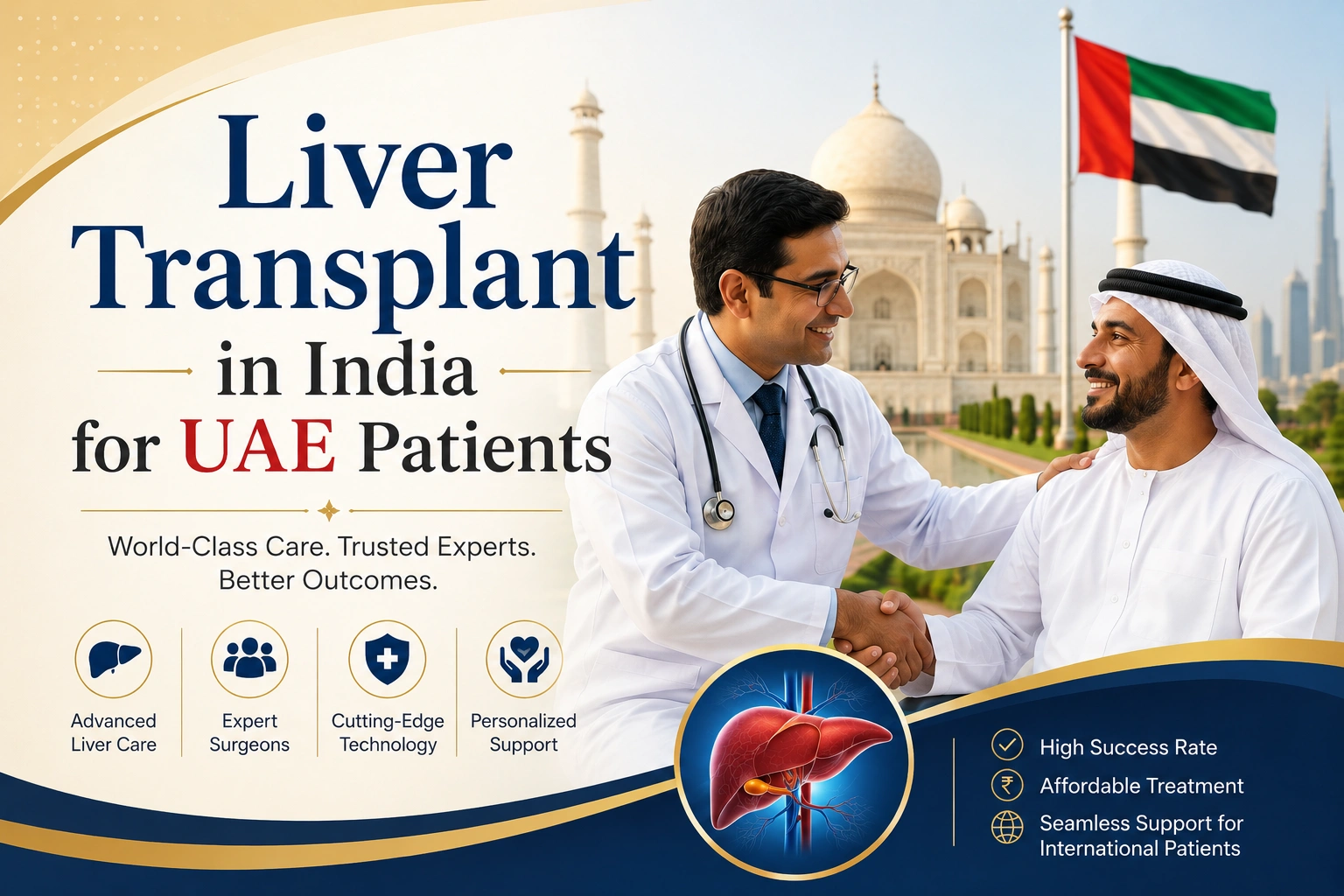
That's really the core reason liver transplant in India for UAE patients keep coming up in these searches. It's not just the price. It's that India's transplant law actually permits a close relative to donate part of their liver to a foreign national, which isn't the case everywhere, and its top centers run through this exact scenario often enough that surprises during surgery are rare.
A liver transplant isn't a solo trip. Two people fly out, a patient and a donor, and both go through their own workup, their own surgery, and their own recovery timeline. That changes how the whole trip needs to be planned, from how long you're away from work in the UAE to how the hospital handles two patients under one family case file.
What Makes This Different from Other Medical Travel Decisions?
It also means the diagnosis itself matters a lot for planning. Someone with decompensated cirrhosis is a different case than someone with early-stage liver cancer being evaluated for transplant within Milan criteria, and the hospital, the surgical approach, and even the cost band can shift depending on which one it is.
So the first real step is getting an Indian hepatologist to actually look at the existing UAE medical records, lab reports, imaging, and any biopsy results already done in Dubai or Abu Dhabi, before anything else gets planned.
The UAE to India Route: How This Actually Works
Getting from "the doctor mentioned transplant" to "surgery is scheduled" usually follows a fairly predictable sequence, even though every case has its own detours.
It typically starts with sharing existing reports, liver function tests, imaging, and any biopsy results already done in Dubai or Abu Dhabi, with an Indian hepatologist over a video consultation. That call alone often clarifies whether this is heading toward transplant or whether other treatment is still on the table.
If transplant is confirmed, the recipient and the proposed donor both start parallel testing once they land in India, usually Delhi, Mumbai, or Chennai, all roughly three to three and a half hours from Dubai. Donor compatibility, liver volume assessment, and the hospital's ethics committee approval all need to be closed out before a surgery date gets locked in.
Why this route works better for UAE patients than waiting locally:
- India permits living-donor transplants for foreign nationals with close relative donors, an option not every private UAE hospital can offer at the same volume
- Surgery can often be scheduled within weeks of clearance, not years on a deceased-donor list
- Post-transplant ICU protocols at top Indian centers are built specifically around high case volume
- Overall cost, even with two people traveling and staying for months, stays well below Western or UAE private pricing
- Arabic-speaking coordinators are standard at most major transplant units
Liver Transplant Hospital in India, Top Options
Pulled directly from HealthRoop's hospital network (healthroop.com/hospitals), specifically the ones listing liver transplant or organ transplant as a specialty.
Medanta, The Medicity, Gurugram — 4.7 rating, 2,600+ beds, JCI and NABH accredited. Built by Dr. Naresh Trehan across 43 acres with 20+ super-specialty institutes, Medanta runs Liver Transplant as its own dedicated department, not folded into general surgery, and provides visa letter issuance, airport pick-up, and interpreter support for families flying in from the UAE.
Fortis Healthcare, Gurugram — 4.6 rating, 4,000+ beds, JCI and NABH accredited. Across its 27+ hospitals, Fortis runs Liver Transplant alongside Renal Sciences as core specialties, with dedicated relationship managers and translation support built into its international patient services.
Max Healthcare, New Delhi — 4.6 rating, 3,400+ beds, JCI and NABH accredited. Max operates a specific Liver & Biliary Sciences programme across its 17 North India facilities, and its International Patient Division handles everything from visa invitation letters to guest house accommodation for the accompanying donor.
Apollo Hospitals, Chennai (HQ) — 4.7 rating, 10,000+ beds, JCI and NABH accredited. As part of a 70+ hospital network treating patients from 140+ countries, Apollo's Organ Transplant programme sits alongside its Cardiac Sciences and Oncology institutes, giving it deep infrastructure for complex, multi-team cases.
Manipal Hospitals, Bangalore (HQ) — 4.6 rating, 7,600+ beds, JCI and NABH accredited. Across 30+ hospitals, Manipal lists Organ Transplant among its core specialties, backed by a dedicated International Patient Care desk and travel coordination team.
Narayana Health, Bangalore (HQ) — 4.5 rating, 6,200+ beds, NABH accredited. Founded by Dr. Devi Shetty on a high-volume, lower-cost care model, Narayana Health runs organ transplants alongside Nephrology and Oncology, with an International Patient Desk built for exactly this kind of overseas coordination.
Bed count is a weak signal on its own for a transplant decision. What actually matters is how many living-donor liver transplants that specific surgical team does in a year, and it's worth asking that question directly rather than assuming from hospital size.
Who Can Legally Donate a Liver
This is the part of the process that trips up families the most, mostly because they assume any willing relative qualifies. Indian law is narrower than that.
Eligible donors. For a foreign recipient, Indian regulations restrict living donation to a spouse or close blood relative, parent, child, or sibling. A close friend or distant relative, however willing, doesn't qualify without special government clearance that's rarely granted to foreign nationals.
What the donor goes through. Liver function panels, cross-sectional imaging to map liver volume and vascular anatomy, a full cardiac workup, and a psychiatric evaluation confirming the decision to donate is voluntary and informed.
Proving the relationship. Hospitals ask for documentary proof, marriage certificates, birth certificates, sometimes notarized affidavits, which then goes to the hospital's transplant authorization committee for sign-off.
How long does this take? Realistically one to three weeks once paperwork is submitted, though incomplete documentation is the single biggest cause of delay here, so it's worth starting this before booking flights, not after.
Step by Step: Liver Transplant Surgery in India
Workup phase. Recipients and donors are evaluated in parallel for blood type and tissue compatibility, liver function, imaging, and infection screening on both sides.
The surgery itself. The donor and recipient go into the operating theatre on the same day. The donor's partial liver is removed and transplanted into the recipient, a combined process that generally runs six to twelve hours given the vascular reconstruction involved.
First two weeks. Both patients are in intensive care initially, with the recipient watched closely for organ rejection, bile duct complications, or bleeding, the period during which complications, if any, tend to show up.
Regeneration phase. Liver tissue in both the donor and the recipient regrows toward near-normal volume over the following weeks, tracked through repeat imaging before either patient is cleared for long-distance travel.
Liver Transplant Cost in India for UAE Patients
Rough USD ranges for UAE patients, actual cost depends heavily on case complexity and hospital chosen:
| Component | Cost Range (USD) |
|---|---|
| Standard living-donor liver transplant | $28,000 – $40,000 |
| Complex case (liver cancer, redo surgery, high MELD score) | $40,000 – $55,000 |
| Donor evaluation and partial liver removal | Bundled into package |
| Pre-transplant workup, recipient and donor combined | $1,000 – $2,000 |
| Immunosuppressants, first three months | $700 – $1,500 |
| Extended ICU stay beyond standard protocol | Billed separately |
Disclaimer: These figures are indicative estimates drawn from general market research and published benchmarks, meant to give a rough starting point, not a quote. Final pricing depends on the hospital, surgeon, donor-recipient match, and how the case unfolds, and can only be confirmed after formal evaluation. HealthRoop doesn't set hospital pricing and always recommends verifying final costs directly with the treating hospital before committing financially.
Private liver transplant in the UAE itself typically runs well above this range, and US pricing for the same surgery can cross $500,000, which is the real context behind why this comparison gets searched so often from Dubai and Abu Dhabi.
Factors that swing the price the most:
- Case complexity, a straightforward cirrhosis case versus one involving liver cancer or a prior failed transplant
- How long both donor and recipient stay in ICU
- Which hospital and surgical team is chosen
- Any complications requiring extended monitoring
- Long-term immunosuppressant brand and dosage
No hospital will lock in a final number before the donor-recipient evaluation is done, since the surgical plan itself depends on those results.
What Recovery Actually Looks Like
India's leading transplant units report one-year survival rates for living-donor liver transplant generally in the 85 to 90% range for planned, non-emergency cases, broadly comparable to major transplant centers elsewhere.
A realistic recovery timeline:
- Week 1: both patients in ICU, liver function checked daily
- Week 2: shift to general ward, short walks begin
- Weeks 3 to 4: recipient typically discharged from hospital, though still in India
- Weeks 4 to 8: outpatient visits continue; medication doses get fine-tuned
- Months 2 to 3: cleared to fly home, handed off to a hepatologist in the UAE for ongoing care
What happens after month three, back in the UAE, matters just as much as the surgery. Skipped follow-ups or inconsistent medication is where long-term outcomes tend to fall apart, not the surgery itself.
Getting the Medical Visa Sorted from the UAE
Both the recipient and donor need documentation in place:
- Passports valid for at least six months, both parties
- Invitation letter from the treating Indian hospital
- Existing medical records supporting the transplant recommendation
- Proof of donor-recipient relationship, birth or marriage certificates
- Passport photographs
- Proof of funds for treatment and an extended stay
- Medical attendant visa for the donor and anyone else traveling with them
Since this trip runs months rather than weeks, it's worth applying for both visas together and confirming with the hospital how long their authorization committee typically takes, that timeline directly affects when the invitation letter can be issued.
How HealthRoop Fits Into This
HealthRoop works specifically with the documentation and coordination load this kind of transplant creates, which is heavier than most medical travel cases involving just one patient.
Where HealthRoop helps:
- Matching the case to the right hospital and transplant team based on the recipient's diagnosis
- Setting up video consultations with Indian hepatologists before any flight is booked
- Walking families through donor eligibility documentation before it becomes a bottleneck
- Getting cost estimates from multiple transplant centers for comparison
- Handling visa invitation letters for both recipient and donor
- Arranging flights and accommodation for an extended stay
- Providing Arabic interpretation during hospital visits
- Assigning one patient relationship manager for the full journey
- Coordinating post-transplant follow-up and medication logistics
- Staying reachable around the clock for patients traveling from the UAE
Frequently Asked Questions
UAE private hospitals do perform liver transplants, but at a far lower volume than India's top centers, which do hundreds of living-donor cases a year. That repetition is what tends to translate into more predictable outcomes for complex cases.
Only a spouse or close blood relative, parent, child, or sibling, under current Indian regulation for foreign nationals. Anyone outside that circle needs special government approval, which is rarely granted.
Expect a couple of weeks for evaluation and committee clearance, then another two to three months in India post-surgery before the transplant team is comfortable clearing the flight home.
It varies significantly by policy and provider, some do cover overseas transplant care, many don't. This is worth confirming directly with the insurer before any bookings are made, not after.
It's a common scenario surgeons plan for during evaluation, not a dealbreaker. The liver's regenerative capacity means both donor and recipient tissue typically grows back to near-normal size within weeks of surgery.
Yes, most transplant hospitals will review existing liver function tests, imaging, and the donor's basic health profile over video call, which often shapes the final treatment plan before anyone books a flight.
The recipient's hospital stay runs three to four weeks, but factoring in pre-surgery evaluation and post-discharge monitoring, most families are looking at two to three months total in India.
Rarely, for foreign patients. India's deceased-donor liver allocation system prioritizes Indian nationals, so living-donor transplant from a close relative is almost always the realistic path for UAE patients.
Yes, and most families plan it that way. The donor has their own surgery and recovery to go through, so staying together simplifies logistics, and hospitals generally help arrange shared accommodation for this.
Lifelong immunosuppressant medication, plus regular liver function monitoring through a local hepatologist. Keeping that UAE-based doctor in direct contact with the Indian transplant team, especially through year one, tends to make this handoff far smoother.