Liver Transplant in India for Iraq Patients
For a lot of Iraqi families, the search for liver transplant options starts after local hospitals in Baghdad or Erbil have already said the same thing: the case is too complex or the transplant infrastructure simply isn't there yet to take it on. What follows is usually a scramble to find somewhere that can actually do this well, quickly, and without draining the family's entire savings in the process.
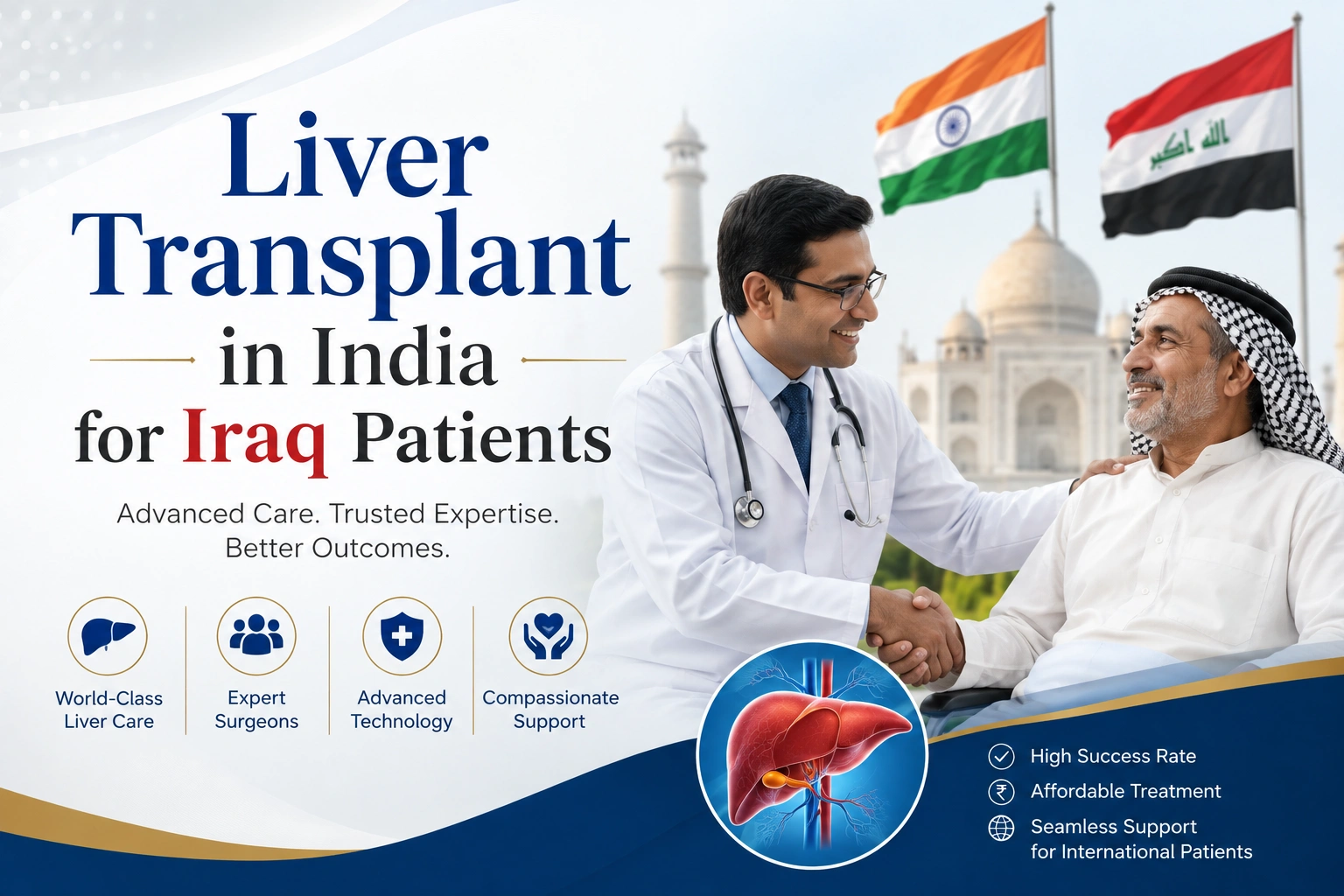
Liver transplant in India for Iraq patients has become one of the most reliable answers to that search. India performs a very high volume of living-donor liver transplants every year, its transplant law allows a close relative to donate to a foreign national, and its leading hospitals have treated Iraqi patients often enough to have systems already built around the logistics, from Arabic interpreters to visa documentation support to help with everything in between.
Part of what makes this option realistic, rather than just theoretical, is how mature the whole ecosystem around medical travel has become. Hospitals that regularly treat patients from Iraq know what questions families ask, what paperwork tends to cause delays and how to keep two people, a patient and a donor, moving through evaluation and surgery without either one falling through the cracks of a system built mainly for local patients.
Getting Your Diagnosis Reviewed Before You Travel
Not every liver failure case looks the same on paper, and this distinction matters more than most families realize going in. Someone with advanced cirrhosis from chronic hepatitis needs a different evaluation path than someone whose liver cancer has just crossed into transplant-eligible territory, and someone with acute liver failure needs an entirely different level of urgency than either of those.
Before booking any flight, it's worth having an Indian hematologist actually review the existing Iraqi medical records: lab reports, imaging, biopsy results if available, and any notes from the treating doctor in Iraq. That review is what determines the urgency, which hospital makes sense, and roughly what the case will cost once surgery is confirmed as the right path forward.
Why So Many Iraqi Families Are Choosing India
Cost is part of the pull, certainly, but for a lot of families the bigger draw is simply that the surgery can happen at all, and happen well, within a realistic timeframe.
Iraq's domestic transplant capacity remains limited, and many patients who need a living-donor liver transplant find that the option, the equipment, or the surgical experience for a case as complex as theirs just isn't reliably available at home yet. India's leading transplant centers, by contrast, perform hundreds of these surgeries annually, building a level of surgical repetition that directly affects how well a team handles complications when they arise mid-operation.
There's also the matter of timing, which tends to weigh heavily on families dealing with a deteriorating liver. A living-donor transplant sidesteps any deceased-donor waitlist entirely, meaning once a donor is confirmed compatible and cleared by the hospital's committee, surgery can typically be scheduled within a few weeks rather than sitting on an indefinite list with no clear end date.
Beyond the surgery itself, a lot of the appeal comes down to how the whole trip is handled. Hospitals used to treat patients from Iraq and the wider region tend to have Arabic-speaking staff on hand, halal food arranged as a default rather than a special request, and coordinators who understand that this isn't a routine hospital visit, it's a family relocating temporarily for a major medical event.
Why Iraqi patients are choosing India for liver transplant:
- Access to a legal, functioning living-donor transplant pathway using a close relative
- High annual surgical volume at India's top liver transplant centers
- No dependency on a deceased-donor waitlist
- A cost structure that stays manageable even with two people traveling for months
- Hospitals experienced specifically in coordinating care for Arabic-speaking patients
- Established support systems for interpretation, accommodation, and follow-up
Best Hospitals in India for Liver Transplant Surgery
Pulled directly from HealthRoop's hospital network (healthroop.com/hospitals), specifically the ones listing liver transplant or organ transplant as a core specialty.
Medanta, The Medicity, Gurugram — 4.7 rating, 2,600+ beds, JCI and NABH accredited. Built by Dr. Naresh Trehan across 43 acres, Medanta runs Liver Transplant as its own standalone department rather than folding it into general surgery. Visa letter support, airport pick-up, and interpreter services are already part of its international patient process, which matters a lot for a case involving two travelers instead of one.
Fortis Healthcare, Gurugram — 4.6 rating, 4,000+ beds, JCI and NABH accredited. Across its 27+ hospitals, Fortis treats Liver Transplant and Renal Sciences as core specialties, supported by dedicated relationship managers and translation assistance for the full duration of a patient's stay.
Max Healthcare, New Delhi — 4.6 rating, 3,400+ beds, JCI and NABH accredited. Max runs a dedicated Liver & Biliary Sciences programme, and its International Patient Division manages visa invitation letters, airport transfers, and guest house arrangements, useful given how long a donor and recipient typically need to stay.
Apollo Hospitals, Chennai (HQ) — 4.7 rating, 10,000+ beds, JCI and NABH accredited. With 70+ hospitals and patients treated from 140+ countries, Apollo's Organ Transplant programme benefits from deep multi-specialty infrastructure, useful for cases that need input from cardiology, nephrology, or oncology alongside the transplant team.
Manipal Hospitals, Bangalore (HQ) — 4.6 rating, 7,600+ beds, JCI and NABH accredited. Manipal's 30+ hospital network lists Organ Transplant among its core specialties, with a dedicated International Patient Care desk that handles travel logistics and day-to-day coordination.
Narayana Health, Bangalore (HQ) — 4.5 rating, 6,200+ beds, NABH accredited. Founded by Dr. Devi Shetty on a high-volume, affordable-care model, Narayana Health lists Organ Transplant alongside Nephrology and Oncology, with an International Patient Desk built specifically for overseas cases like this one.
Bed count on its own doesn't say much about transplant experience. What actually matters is how many living-donor liver transplants a specific surgical team performs each year, and that's a completely reasonable question to ask directly during the first consultation, before any commitment is made.
Who in Your Family Can Actually Be a Donor?
This is where a lot of Iraqi families run into their first real delay, usually from assuming any relative who's willing automatically qualifies. It's worth understanding this early, ideally before anyone starts making travel plans.
Eligible donors. Under Indian law, a foreign recipient can only receive a liver from a spouse or close blood relative, parent, child, or sibling. Anyone outside that direct circle, an in-law, a cousin, a close friend, needs special government approval, which is almost never granted for foreign nationals. It's a strict rule, and hospitals won't move forward without proper verification.
The donor's own workup. Full liver function testing, cross-sectional imaging to map liver volume and vascular structure, cardiac clearance, and a psychiatric evaluation confirming the donation is genuinely voluntary and not made under any pressure. This part protects the donor as much as it protects the transplant process.
Proving the relationship. Documentation, marriage certificates, birth certificates, sometimes notarized affidavits, goes through the hospital's transplant authorization committee before final approval is given. This is a paperwork-heavy step, and it's usually the slowest part of the whole process if documents aren't already in order.
Approval timeline. Usually one to three weeks with complete documents in hand. Incomplete paperwork is the most common reason this drags on longer, sometimes by several additional weeks, so it's worth starting this from Iraq well before travel rather than trying to sort it out after arrival in India.
What Happens During the Transplant Surgery?
Parallel testing. Recipient and donor are evaluated at the same time but separately, blood type and tissue compatibility, liver function, imaging, and infection screening for both. This usually takes a few days once both parties have arrived and are ready for testing.
Operating day. The donor's partial liver removal and the recipient's transplant happen back to back on the same day, in coordinated operating theatres, together taking roughly six to twelve hours given the complexity of the vascular reconstruction involved. This is one of the longer, more technically demanding surgeries in transplant medicine, which is exactly why surgical team experience matters so much.
The critical first two weeks. Both patients spend early days in intensive care. The recipient is watched closely for organ rejection, bile duct complications, or bleeding, since this is the window where issues, if they're going to appear, usually do. Daily blood tests and imaging track how well the new liver is settling in.
Tissue regeneration. The liver's ability to regrow is one of the more remarkable aspects of this surgery. Both donor and recipient liver tissue returns toward near-normal size over the following weeks, confirmed through repeat imaging before either patient is cleared for the long flight home.
Liver Transplant Cost in India for Iraq Patients
Approximate USD ranges, actual figures vary with case complexity and hospital chosen:
| Component | Cost Range (USD) |
|---|---|
| Standard living-donor liver transplant | $28,000 – $40,000 |
| Complex case (liver cancer, redo surgery, high MELD score) | $40,000 – $55,000 |
| Donor evaluation and partial liver removal | Bundled into package |
| Pre-transplant workup, recipient and donor combined | $1,000 – $2,000 |
| Immunosuppressants, first three months | $700 – $1,500 |
| Extended ICU stay beyond standard protocol | Billed separately |
Disclaimer: These figures are indicative estimates drawn from general market research and published benchmarks, meant only to offer a rough starting point, not a firm quote. Final pricing depends on the hospital, surgical team, donor-recipient compatibility, and how the case develops, and can only be confirmed after a formal medical evaluation. HealthRoop does not set hospital pricing and recommends verifying final costs directly with the treating hospital before making any financial commitment.
For comparison, liver transplant in the US frequently exceeds $500,000, and treatment through private international referral routes from Iraq can also run considerably higher than India, which is a big part of why this specific cost comparison gets searched so often by families weighing their options.
What actually moves the final number:
- Whether the case is straightforward or involves added complexity like cancer or a prior failed transplant
- Length of ICU stay for both donor and recipient
- Which hospital and transplant team handles the case
- Any post-surgical complications requiring extended monitoring
- Long-term immunosuppressant medication brand and dosage
- Room category chosen during the hospital stay
No hospital finalizes a quote before donor-recipient evaluation is complete, since the entire surgical plan, and therefore the cost, depends on what that evaluation shows.
What Recovery Looks Like After Surgery
India's high-volume transplant centers report one-year survival rates for living-donor liver transplant generally in the 85 to 90% range for planned, elective cases, broadly in line with major transplant programs internationally.
A realistic recovery picture, week by week:
- Week 1: both patients in ICU, liver function tracked daily, close monitoring for any early complications
- Week 2: shift to general ward, short supervised walks begin, appetite and energy slowly start returning
- Weeks 3 to 4: recipient usually discharged from hospital, though still staying nearby in India for monitoring
- Weeks 4 to 8: outpatient visits continue on a regular schedule; medication doses get fine-tuned based on blood work
- Months 2 to 3: cleared to fly home, with a formal handoff arranged to a hematologist in Iraq for ongoing care
Every patient's timeline shifts slightly based on how the body responds, some recover faster than this outline suggests, others need a bit more time before the transplant team is comfortable clearing travel.
Staying Healthy After You Return Home to Iraq
What happens after the family returns home matters just as much as the surgery itself, arguably more, since this is the phase that determines whether the transplant holds up over years rather than months.
Immunosuppressant medication becomes a daily, lifelong routine, and skipping doses or adjusting them without medical guidance is one of the leading causes of organ rejection in transplant patients generally. Regular blood tests, typically monthly at first and less frequent over time, track how well the liver is functioning and whether medication levels need adjusting.
Diet and lifestyle also shift permanently. Alcohol is off the table entirely, certain foods need more caution due to infection risk from a suppressed immune system, and regular exercise, once cleared by the doctor, actually helps rather than hinders recovery. None of this is meant to sound restrictive for its own sake, it's simply what protects the investment, both financial and physical, that the whole transplant journey represents.
Visa and Documents You Will Need From Iraq
Both recipient and donor need their paperwork in order well ahead of travel:
- Passports valid for at least six months, for both parties
- Invitation letter from the treating Indian hospital
- Existing medical records supporting the transplant recommendation
- Proof of donor-recipient relationship, birth or marriage certificates
- Passport-size photographs
- Proof of funds covering treatment and an extended stay
- Medical attendant visa for the donor and any accompanying family member
Since flight routing from Iraq to India often involves a connection, and the total trip runs a couple of months rather than a couple of weeks, applying for both visas together and confirming the hospital's committee approval timeline early helps avoid delays in getting the invitation letter issued in time.
How HealthRoop Helps You Through the Process
HealthRoop is set up specifically for the documentation and coordination load a two-patient transplant case creates, which is meaningfully heavier than most single-patient medical travel.
Where HealthRoop helps:
- Matching the case to the right hospital and transplant team based on diagnosis
- Setting up video consultations with Indian hematologists before any travel is booked
- Guiding families through donor eligibility paperwork early, before it becomes a bottleneck
- Getting comparative cost estimates from multiple transplant centers
- Managing visa invitation letters for both recipient and donor
- Arranging flights and accommodation for the extended stay
- Providing Arabic interpretation throughout hospital visits
- Assigning one dedicated relationship manager for the entire journey
- Coordinating post-transplant follow-up and medication logistics with a doctor in Iraq
- Staying reachable around the clock throughout the process, since transplant cases rarely follow a strict nine-to-five schedule
Frequently Asked Questions
Domestic transplant capacity in Iraq remains limited for complex living-donor liver cases, so India's combination of legal access and very high surgical volume ends up being the more reliable option for a lot of families.
Only a spouse or close blood relative, parent, child, or sibling, under current Indian regulation for foreign nationals. Anyone outside that circle requires special government approval, rarely granted for foreign cases.
Evaluation and committee clearance typically take a couple of weeks. After surgery, most families stay another two to three months in India before the transplant team clears them to fly home.
Coverage varies significantly and isn't something that can be assumed. It's worth checking directly with any relevant insurer or government health programme before committing to travel and hospital bookings.
This is fairly common and something surgeons plan for during evaluation, not a dealbreaker. The liver regenerates in both donor and recipient, typically reaching near-normal size within weeks after surgery.
Yes. Most transplant hospitals will review liver function tests, imaging, and the donor's basic health profile over a video consultation, and that review often shapes the treatment plan before any flight is booked.
The recipient's hospital stay typically runs three to four weeks, but factoring in pre-surgery evaluation and post-discharge monitoring, total time in India usually comes out to two to three months.
Rarely. India's deceased-donor allocation system prioritizes Indian nationals first, so a living-donor transplant from a close relative is almost always the realistic route for foreign patients.
Yes, generally. The donor has their own surgery and recovery to manage, so most families stay together for the full duration, and hospitals typically help arrange shared accommodation for this.
Lifelong immunosuppressant medication is required, along with regular liver function monitoring through a doctor in Iraq. Keeping that doctor in direct contact with the Indian transplant team, particularly through the first year, tends to make this transition considerably smoother.