Kidney Transplant in India for Saudi Arabia Patients
Looking for kidney transplant in India for Saudi Arabia patients that is legally sound, medically trusted, and priced well within what a family can actually plan for? Every year, Saudi patients with end-stage kidney disease travel to India with a family donor, drawn by a direct four-hour flight, high-volume transplant units, and a cost that sits far below private treatment inside the Kingdom.
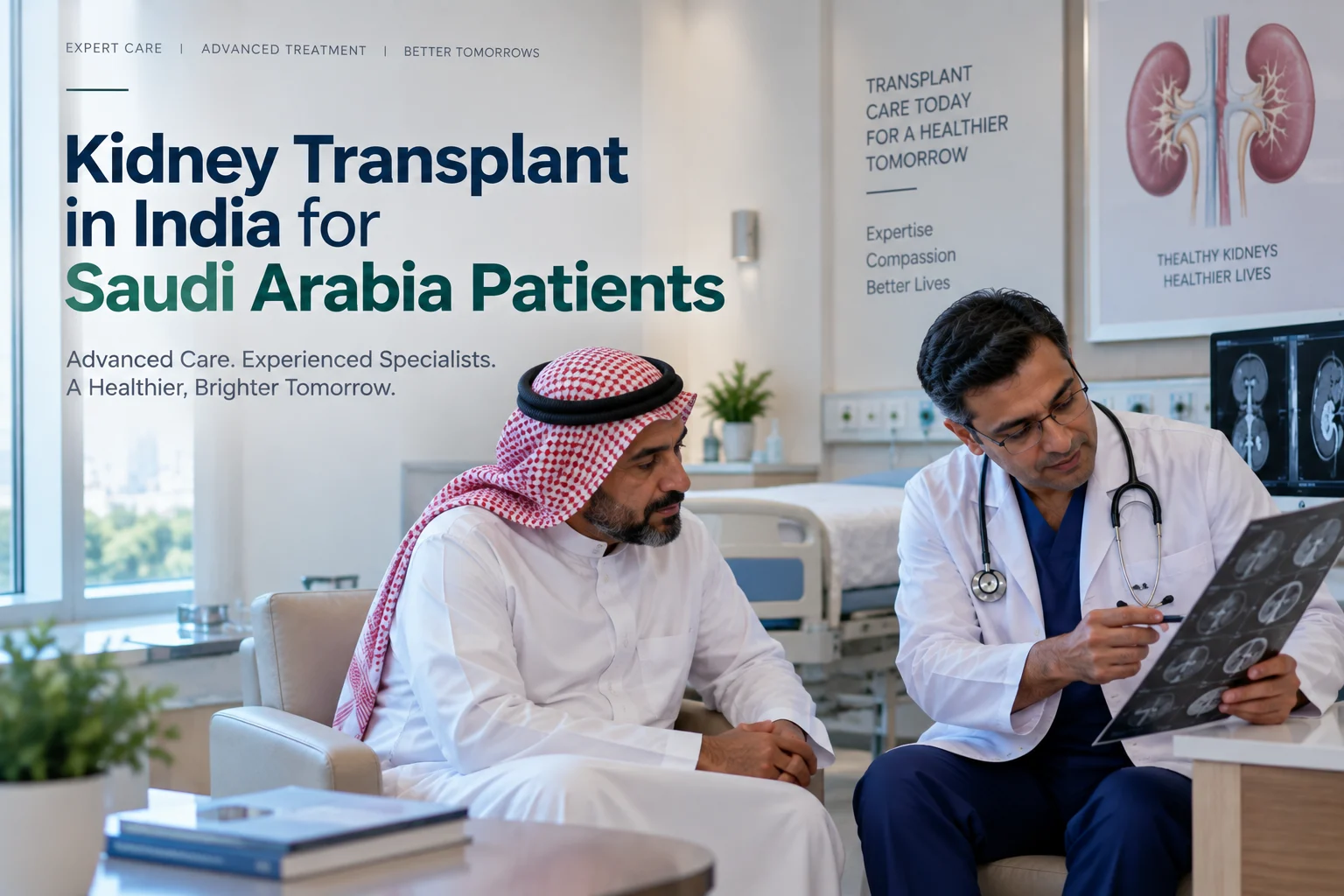
India runs the world's second-largest kidney transplant programme after the United States, with major centers in Delhi, Mumbai, Chennai, and Bengaluru performing several hundred living-donor transplants a year. That volume is what Saudi nephrologists are pointing to when they discuss options with families facing a long organ shortage at home.
Direct flights connect Riyadh with Delhi, Mumbai, and Hyderabad in roughly four hours, so evaluation, Authorisation Committee clearance, and surgery can often be planned within a single, well-organised trip rather than repeated visits.
Why Saudi Patients Choose India for Kidney Transplant
Cost is the clearest reason. Kidney transplant treatment in India for Saudi Arabia patients generally costs 70-85% less than the same surgery privately within the Kingdom or elsewhere in the Gulf.
Surgical experience runs deep, with leading Indian transplant units performing several hundred kidney transplants annually, including complex ABO-incompatible and robotic-assisted cases.
Cultural comfort matters as well. Several leading hospitals offer Arabic-speaking coordinators, halal meal options, and prayer-friendly spaces, easing what is already a demanding journey for the whole family.
Waiting time is short once donor and recipient evaluations are complete, since the surgery does not depend on a deceased-donor waiting list.
Growing government cooperation between India and Saudi Arabia on health and medical regulation has further strengthened confidence in Indian hospitals among Saudi patients and referring doctors.
Living Donor Rules Saudi Patients Need to Know
Under India's Transplantation of Human Organs Act, a foreign patient can only receive a kidney from a living donor who qualifies as a "near relative" — a spouse, parent, child over 18, sibling, or grandparent. There is no deceased-donor route open to international patients, and organ trade of any kind is a criminal offence.
The donor and recipient relationship must be proven with documents and, at most hospitals, a DNA test. Every foreign transplant case is reviewed and approved by a hospital or state-level Authorisation Committee, which interviews both patient and donor to confirm the donation is voluntary and free of financial pressure.
Patients typically also need a No Objection Certificate confirming both identities, along with registration with India's Foreigners Regional Registration Office once they arrive.
Best Kidney Transplant Hospitals in India for Saudi Patients
Medanta, The Medicity, Gurugram runs a high-volume kidney and multi-organ transplant programme, including ABO-incompatible and robotic-assisted procedures.
Apollo Hospitals performs several hundred kidney transplants a year across its network, with dedicated nephrology and urology institutes and robotic transplant capability at select centers.
Fortis Healthcare runs established transplant units with experienced nephrology and transplant surgery teams across multiple Indian cities.
Max Healthcare and Manipal Hospitals are known for managing transplant cases with co-existing conditions such as diabetes or hypertension.
P.D. Hinduja Hospital also runs a well-regarded nephrology and transplant programme with a strong track record in living-donor surgery.
Kidney Transplant Cost in India for Saudi Arabia Patients
| Procedure / Stage | Cost Range (USD) |
|---|---|
| Pre-transplant donor and recipient evaluation | 500 – 1,500 |
| Blood-group compatible living-donor transplant | 13,000 – 16,000 |
| ABO-incompatible transplant (desensitisation protocol) | 20,000 – 24,000 |
| Robotic-assisted kidney transplant | 16,000 – 19,000 |
| First year of post-transplant immunosuppressant medication | 1,200 – 2,000 |
These figures generally cover the surgical team, hospital stay, and immediate post-operative care for both patient and donor. Final pricing depends on blood group compatibility, the hospital chosen, and any pre-existing conditions, and is confirmed only after medical reports are reviewed. As a reference, the same surgery privately within Saudi Arabia is often quoted well above USD 100,000.
Recovery and Success Rates
Published data from India's leading transplant centers typically shows one-year graft survival rates above 90% for living-donor kidney transplants, broadly in line with international outcomes.
The donor is usually discharged within four to seven days after a laparoscopic nephrectomy. The recipient generally stays in hospital for ten to fourteen days, with close monitoring for early signs of organ rejection or infection.
Most Saudi patients plan for four to six weeks in India in total, covering evaluation, the Authorisation Committee process, surgery, and the initial recovery period before it is safe to fly home.
Medical Visa for Kidney Transplant in India from Saudi Arabia
Saudi-based patients apply through the Embassy of India in Riyadh or the Consulate General of India in Jeddah, or use the e-Medical Visa route where their nationality is eligible. Documents generally required include a passport valid for at least six months, a hospital invitation letter, medical reports supporting the need for transplant, and proof of the donor's relationship to the patient for the Authorisation Committee. Visa applications submitted at Riyadh and Jeddah are typically processed within three working days.
Up to two medical attendants can accompany the patient, which usually covers both the donor and a family caregiver. Hospitals help fast-track the invitation letter so that genuinely urgent transplant cases are not delayed by paperwork, and registration with the FRRO is completed soon after arrival.
How HealthRoop Supports You
Coordinating donor documentation, Authorisation Committee approval, and travel logistics on your own adds unnecessary stress to an already difficult time. HealthRoop handles this entire journey for Saudi patients and their donors, from the first call through to full recovery back home.
Services include:
- Free medical report review and treatment guidance
- Appointment booking with leading transplant hospitals
- Hospital and specialist selection based on the specific diagnosis
- Transparent cost estimates in USD and INR
- Guidance on donor documentation and Authorisation Committee paperwork
- Medical visa invitation and e-Medical Visa application assistance
- FRRO registration and visa extension support
- Travel and flight planning from Riyadh, Jeddah, and Dammam
- Halal meal and prayer-friendly accommodation arrangements
- Airport pickup and local transportation
- Hotel and recovery accommodation booking for patient and donor
- Arabic interpreter support
- Help with medical documentation and insurance coordination
- Dedicated case manager throughout
- Telemedicine follow-up after returning home
- 24x7 emergency support during the stay in India
Frequently Asked Questions
No. Indian law only permits foreign patients to receive a kidney from a living donor who is a near relative, such as a spouse, parent, child, sibling, or grandparent. There is no deceased-donor programme open to international patients.
Kidney transplant cost in India for Saudi Arabia patients typically ranges from 13,000 to 24,000 USD, compared to figures often quoted well above 100,000 USD for the same surgery privately within the Kingdom.
Non-stop flights from Riyadh to Delhi take around four hours, and to Hyderabad around three and a half to four hours. Chennai and Kolkata currently need one connection, typically through Abu Dhabi, Dubai, or Doha.
Indian medical visa rules generally allow up to two medical attendants to accompany a Saudi patient, which is usually enough to cover both the donor and a family caregiver.
Indian law defines a near relative as a spouse, parent, child over 18, sibling, or grandparent. The relationship must be proven with documents and, in most hospitals, a DNA test, and every case is reviewed by a hospital or state Authorisation Committee before surgery is approved.
Most patients and donors plan for four to six weeks in total, covering pre-transplant evaluation, Authorisation Committee clearance, the surgery itself, and the initial recovery period before discharge is considered safe.