Cardiac Surgery in India for Kuwait Patients
Looking for cardiac surgery in India for Kuwait patients that combines international accreditation with pricing that doesn't strain the family budget? A growing number of Kuwaiti patients now choose India over Europe for bypass and valve surgery, drawn by a direct four-hour flight, high surgical volumes, and transparent, upfront costs.
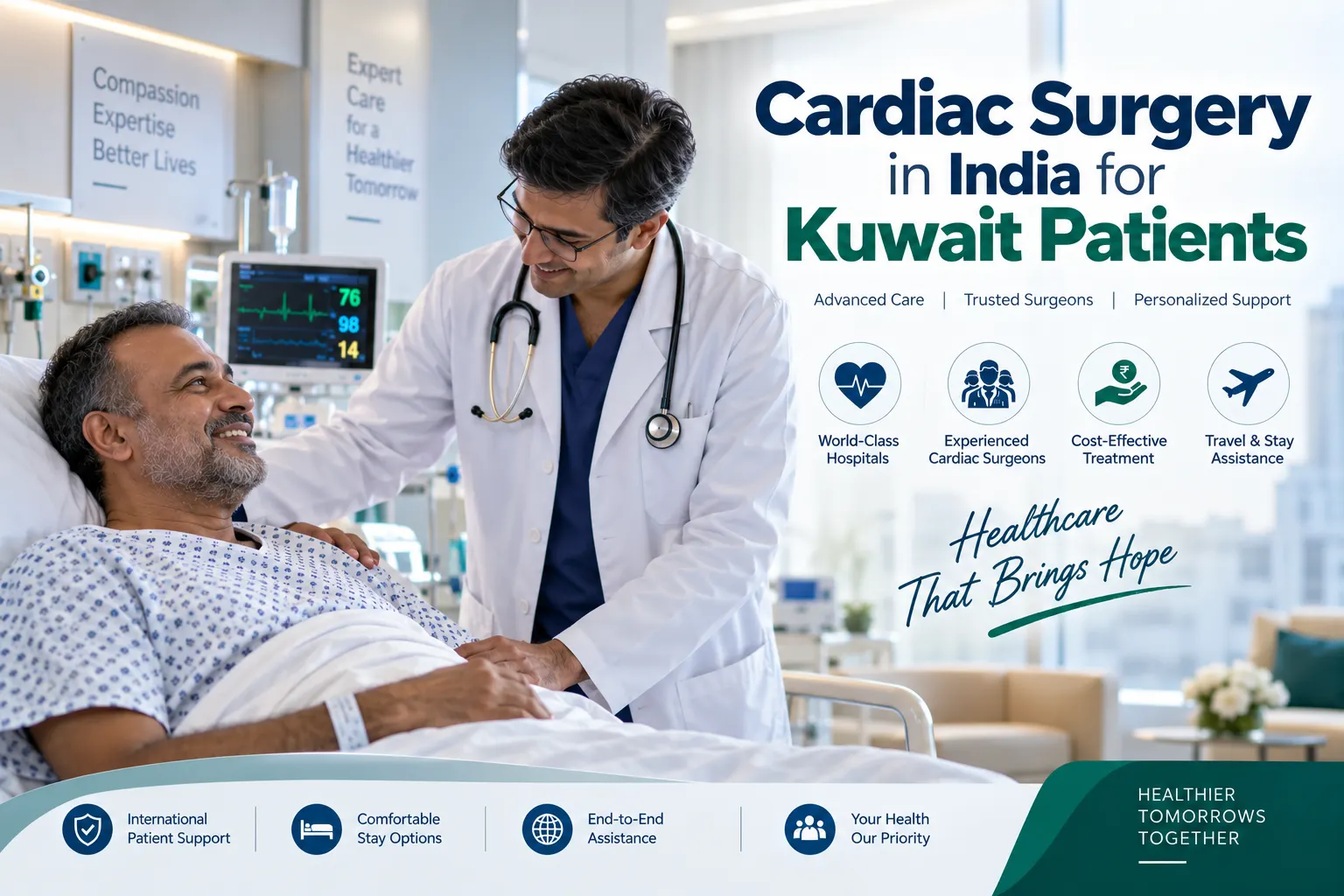
India carries out more open-heart surgeries every year than most Western countries combined, and several of its cardiac institutes rank among the busiest anywhere in the world. That kind of surgical volume is exactly what gives Kuwaiti cardiologists confidence when they refer a patient onward for a procedure that isn't readily available or affordable at home.
Direct flights connect Kuwait City with Mumbai, Delhi, Chennai, and Kochi in around four hours, so a diagnosis, second opinion, and scheduled surgery can often be arranged within the same week without a long transit.
Why Kuwaiti Patients Choose India for Cardiac Surgery
Cost remains the clearest advantage. Heart treatment in India for Kuwait patients typically runs 60-80% lower than the same procedure in Europe or the United States, without any drop in the standard of care.
Accreditation and standards line up with what patients already expect at home — many of the hospitals treating Kuwaiti patients hold NABH or JCI certification, the same benchmarks used across the Gulf.
Surgical experience runs deep. Senior cardiac surgeons at India's leading centers routinely perform several hundred bypass and valve procedures a year, giving them meaningful experience in complex and high-risk cases.
Advanced technology is widely available, including TAVI, off-pump bypass, and robotic-assisted cardiac surgery, supported by dedicated cardiac ICUs.
Waiting time is short. Once diagnostic reports are reviewed, urgent cases can often be scheduled within days rather than weeks.
Bypass and Valve Surgery Options
Coronary bypass, or CABG, is recommended when arteries are significantly blocked and a stent alone is not suitable. Traditional on-pump bypass remains the standard approach for multi-vessel disease.
Off-pump beating-heart surgery avoids the heart-lung machine for suitable cases and generally allows a somewhat faster recovery. Minimally invasive bypass is used for select single or double-vessel cases.
Valve surgery treats a narrowed or leaking heart valve. Wherever the anatomy allows, surgeons generally prefer repairing a patient's own valve over full replacement.
TAVI, a catheter-based valve replacement performed without open-heart surgery, is well suited to older or higher-risk patients who may not tolerate a full open procedure. Angioplasty and stenting remain the first option for suitable single-vessel blockages.
Best Cardiac Hospitals in India for Kuwaiti Patients
Medanta, The Medicity, Gurugram runs one of India's largest heart institutes, handling everything from routine bypass to highly complex redo cardiac surgery.
Apollo Hospitals operates one of the country's earliest and largest cardiac surgery programs, with a dedicated international patient desk experienced in coordinating for Gulf patients.
Fortis Healthcare, including the well-known Fortis Escorts Heart Institute in Delhi, runs dedicated cardiac units with strong volumes in bypass, valve, and interventional cardiology.
Max Healthcare and Manipal Hospitals are known for managing cardiac cases with co-existing conditions such as diabetes, alongside experienced surgical teams.
P.D. Hinduja Hospital also runs a well-established cardiac program with a strong track record in complex valve surgery.
Cardiac Surgery Cost in India for Kuwaiti Patients
| Procedure | Cost Range (USD) |
|---|---|
| Coronary angioplasty with stent (single vessel) | 3,000 – 6,000 |
| Bypass surgery (CABG), standard case | 5,000 – 8,000 |
| Off-pump or minimally invasive bypass | 7,000 – 10,000 |
| Valve repair or replacement (single valve) | 7,000 – 10,000 |
| TAVI (transcatheter valve replacement) | 15,000 – 22,000 |
| Combined valve and bypass surgery | 10,000 – 15,000 |
These figures generally cover the surgical team, hospital stay, standard implants or grafts, and immediate ICU care. Final pricing depends on the number of grafts, valve type used, and length of ICU stay, and is confirmed only once angiogram results are reviewed.
Recovery and Success Rates
Published data from India's leading cardiac centers typically shows bypass surgery success rates above 95%. Valve surgery sits in a broadly similar range for elective cases.
The first one to two days after surgery are spent in the cardiac ICU with gradual movement. Days three to five involve the general ward with assisted walking and breathing exercises.
Discharge usually happens around the two-week mark, with cardiac rehab starting soon after. Most Kuwaiti patients are close to their normal activity levels by the third month home.
Medical Visa for Cardiac Surgery in India from Kuwait
Kuwaiti patients apply for an Indian medical visa through the Embassy of India in Kuwait or its authorised visa centre. Documents generally required include a passport valid for at least six months, a referral letter or preliminary medical advice from a Kuwait hospital, relevant medical reports, and an invitation letter from the treating Indian hospital, with the case registered through the Indian FRRO medical value travel portal.
The medical visa is typically granted for the duration of treatment or up to one year, whichever is shorter, and attendants accompanying the patient are granted a corresponding visa. Hospitals help fast-track the invitation letter so that genuinely urgent cardiac cases are not delayed by paperwork.
How HealthRoop Supports You
Managing hospital selection, visa paperwork, and travel logistics on your own adds unnecessary stress to an already difficult decision. HealthRoop handles this entire journey for Kuwaiti patients, from the first call through to full recovery back home.
Services include:
- Free medical report review and treatment guidance
- Appointment booking with leading cardiac hospitals
- Hospital and specialist selection based on the specific diagnosis
- Transparent cost estimates in USD and INR
- Second opinion from Indian cardiologists
- Medical visa invitation and FRRO registration assistance
- Visa extension support if the recovery runs longer
- Travel and flight planning from Kuwait City
- Currency exchange and local SIM assistance
- Airport pickup and local transportation
- Hotel and recovery accommodation booking
- Arabic interpreter support
- Help with medical documentation and insurance coordination
- Dedicated case manager throughout
- Telemedicine follow-up after returning home
- 24x7 emergency support during the stay in India
Frequently Asked Questions
Yes. India's leading cardiac hospitals perform very high surgical volumes each year, and many hold NABH or JCI accreditation, the same international standards recognised in Kuwait and the wider Gulf.
Cardiac surgery cost in India for Kuwaiti patients typically ranges from 3,000 to 22,000 USD depending on the procedure, considerably lower than the same surgery privately in Kuwait or in Europe.
Most direct flights from Kuwait City to major Indian cities such as Mumbai, Delhi, Chennai, or Kochi take around four hours, making same-week travel for surgery straightforward.
Kuwaiti patients generally need a passport valid for at least six months, a referral letter from a Kuwait hospital or doctor, medical reports, and an invitation letter from the treating Indian hospital, with the application registered through the Indian FRRO medical value travel portal.
Yes, most cardiac centers offer a remote review of angiogram, ECG, and echo reports so patients can confirm the diagnosis and treatment plan before booking travel.
Most patients stay two to three weeks in India after surgery to allow for wound healing, initial cardiac rehab, and a final check-up before flying back to Kuwait.