Air Ambulance for International Patients in India
When a seriously ill patient needs to travel to India for specialised treatment, a regular commercial flight isn't always suitable. HealthRoop helps coordinate the medical transfer — aircraft, medical team, ground ambulance and the receiving hospital — around the patient's condition.
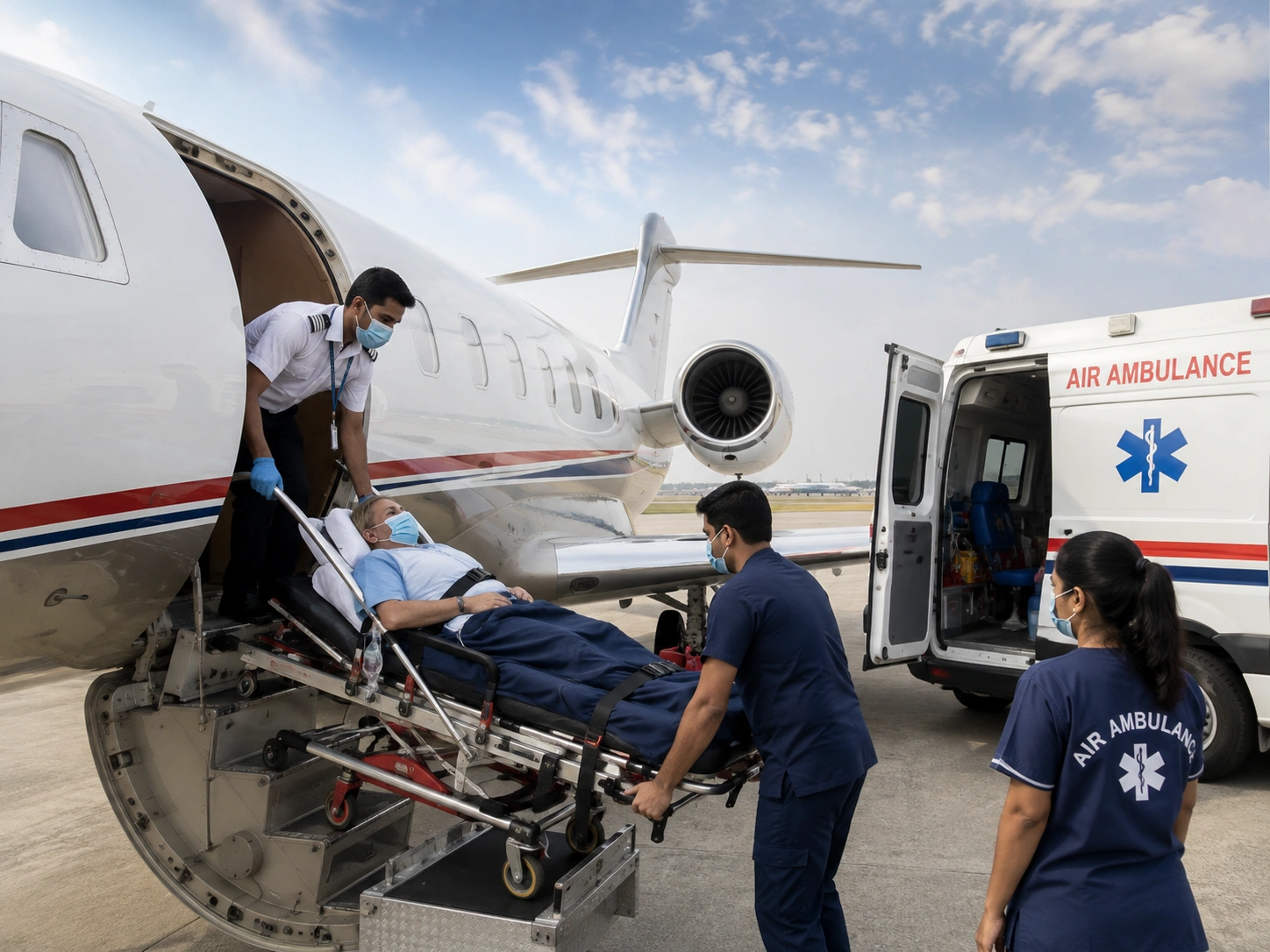
A medically supervised transfer, coordinated end to end
An air ambulance for international patients in India is arranged around the patient's medical condition rather than a standard travel schedule. Some patients need continuous medical monitoring, oxygen, critical care support, or a medically supervised transfer between hospitals — something a regular commercial flight cannot provide.
Not every international patient needs an air ambulance; the decision depends on an assessment by qualified medical professionals. HealthRoop helps coordinate the different parts of the transfer — hospital selection, medical documentation, aircraft and ground ambulance arrangements, and travel support — alongside its existing international patient process of medical report review, hospital and doctor assistance, visa documentation support and airport pickup.
An air ambulance may be considered when a patient cannot safely travel on a normal commercial flight or needs medical supervision throughout the journey. The final decision should always come from the treating physician and medical transport team.
- Critical illness requiring close monitoring
- Serious trauma
- Continuous oxygen support
- Ventilation or other critical care
- Medically fragile after major treatment
- Transfers between healthcare facilities
- Urgent access to specialist treatment
- Conditions unsuitable for commercial travel
There is no universal choice between the two — the patient's condition comes first, followed by route, aircraft availability, and airport or helipad access.
| Transport Type | Typical Use | Distance | Accessibility |
|---|---|---|---|
| Fixed-Wing Air Ambulance | Longer-distance medical transfers | Better suited to longer routes | Requires suitable airports; aircraft configuration planned around medical needs |
| Helicopter Ambulance | Regional and time-sensitive transfers | Generally suited to shorter routes | Can reach locations closer to hospitals where suitable landing facilities exist |
Support is planned around the patient's condition — not every patient needs every service listed here.
- Oxygen support
- Cardiac monitoring
- Airway management
- Ventilation support
- IV medication
- Critical care monitoring
- Trained medical escort
- Other equipment as required
Medical Information Review
The patient's reports, scans, treatment history and current condition are reviewed.
Patient Assessment
Qualified medical professionals determine whether air transport is appropriate and the level of support required.
Transport Planning
The route, aircraft, medical team and equipment are planned around the patient's needs.
Receiving Hospital Confirmation
The receiving hospital and specialist team confirm admission or treatment arrangements.
Aircraft & Medical Team Arrangement
The appropriate aircraft and medical personnel are arranged according to the transport requirements.
Ground Ambulance Coordination
Ground transportation is arranged between the hospital and airport at both ends where required.
Airport Transfer
Airport and airline arrangements are coordinated in advance, in line with DGCA guidance for ambulance passengers.
Medical Handover
After arrival, the patient is transferred to the receiving hospital and medical information is handed over to the treating team.
Exact requirements vary by case, departure country, aircraft operator and receiving hospital.
- Valid passport
- Medical reports & discharge summary
- Diagnostic reports (CT, MRI, etc.)
- Current medication list
- Treating doctor's notes
- Receiving hospital details
- Emergency contact information
- Insurance, travel & visa documents, where applicable
There is no single fixed price. A case-specific quotation should clearly explain what's included — aircraft, medical team, onboard support, ground ambulance and airport coordination.
| Cost Factor | Why It Matters |
|---|---|
| Departure & destination city | Determines route, flight requirements and ground transfer |
| Aircraft type & flight distance | Different aircraft carry different operational costs |
| Patient condition & equipment | Determines the medical support and specialised equipment required |
| Medical team | Staffing depends on the patient's needs |
| Ground ambulance & airport charges | Hospital-to-airport transfers and operational costs vary |
| Urgency | Immediate arrangements may involve additional operational requirements |
An air ambulance is a medically supervised aircraft transfer arranged for a patient who may not be able to travel safely on a regular commercial flight. The aircraft, medical team and equipment depend on the patient's condition.
An air ambulance may be considered for critically ill or medically fragile patients, serious trauma cases, or patients who cannot safely travel by commercial flight. Medical professionals must assess suitability first.
Helicopter ambulances are generally used for regional or time-sensitive transfers where suitable landing facilities are available. Fixed-wing aircraft are generally better suited to longer-distance transfers. The actual choice depends on medical and operational factors.
Some critically ill patients can be transported by air ambulance, but suitability depends on their medical condition and the level of support required. The treating doctor and medical transport team must assess the patient before the transfer is arranged.
There is no standard price. Cost depends on the departure location, destination, aircraft, distance, medical team, equipment, ground ambulance, urgency and other operational requirements. A case-specific quotation is needed.
Documents may include a passport, medical reports, diagnostic scans, discharge summary, medication list, treatment history, doctor's notes and receiving hospital details. Exact requirements vary by case and transport arrangement.
HealthRoop provides international patient coordination, including medical report review, hospital and doctor assistance, travel coordination, visa documentation support, airport transfers and follow-up support. Air ambulance arrangements remain subject to the patient's medical and operational requirements.
The patient's medical information is reviewed first, followed by hospital and specialist selection based on the condition. HealthRoop's current process includes treatment planning and hospital and doctor recommendations before the patient confirms the arrangement.