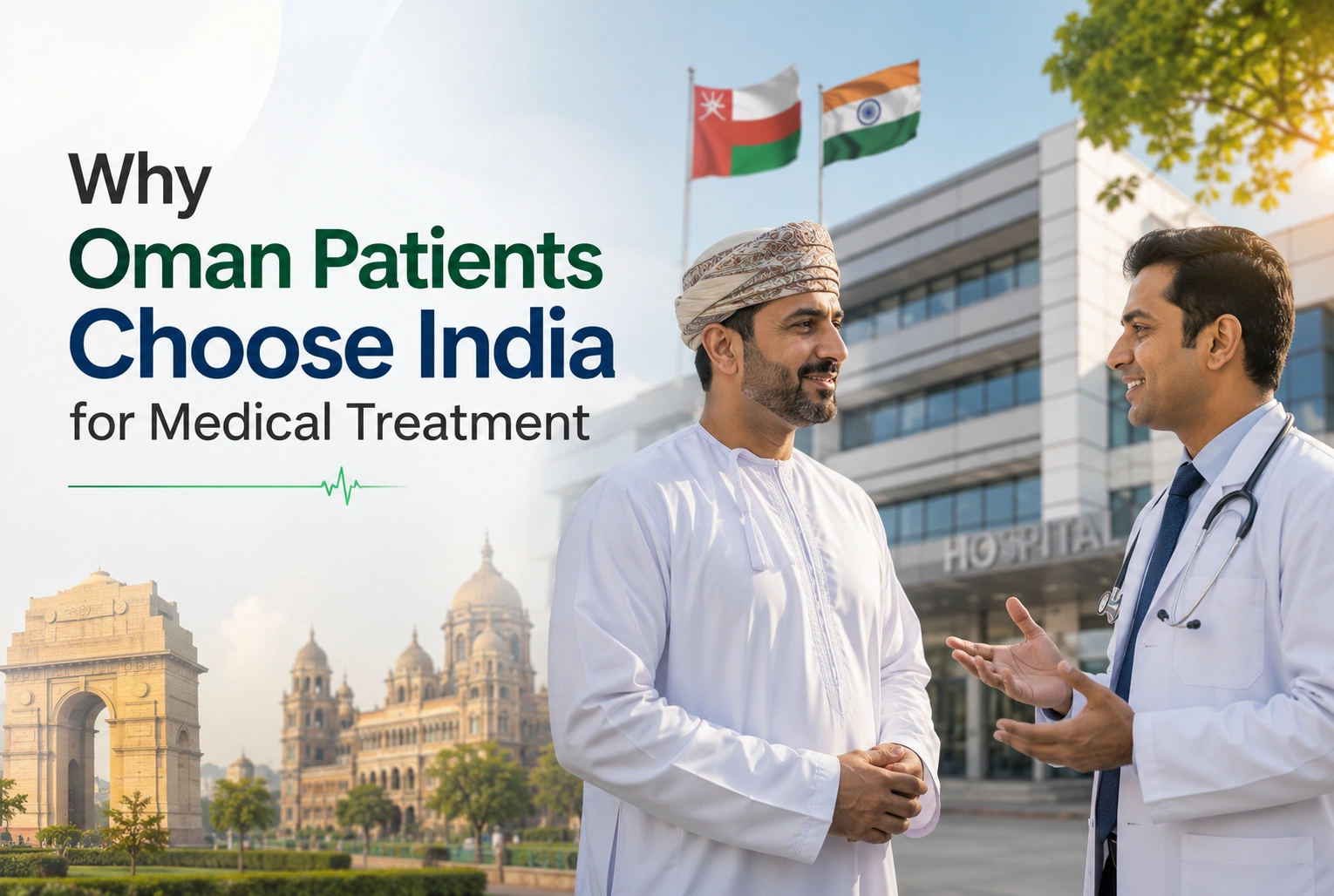
Why Oman Patients Choose India for Medical Treatment
For many families in Oman, travelling abroad for medical treatment is not a decision they make lightly. They usually have a specific reason, such as finding a specialist, accessing advanced treatment, reducing overall costs, or getting care within a reasonable timeframe.
India has become one of the major destinations for patients from Oman. According to Oman Ministry of Health data, India received 82% of the 1,428 patients who travelled abroad for treatment through public hospital referrals during 2022 and 2023.
That figure shows how important India has become for Omani medical travellers. But popularity alone does not explain the decision. Specialist availability, hospital infrastructure, treatment options, cost, travel time and international patient support all play a role.
For patients considering treatment in India, the more useful question is not simply why India is popular. It is whether a particular hospital and specialist are suitable for their condition.
Why Do Oman Patients Choose India for Medical Treatment?
There is no single reason why patients from Oman travel to India. In most cases, several practical factors come together.
Access to Specialist Medical Care
Complex conditions often require doctors from more than one specialty. A patient being evaluated for a liver transplant, for example, may need hepatology, transplant surgery, anaesthesia and critical care teams.
Large Indian hospitals often have several specialised departments under one roof. This can make diagnosis, treatment planning and follow-up easier to coordinate.
The same applies to cancer treatment, cardiac surgery, neurosurgery, transplantation and other complicated procedures.
However, hospital size should not be the only consideration. Patients should also check how much experience the specific doctor and department have with the procedure they need.
Advanced Treatment Options
Some patients travel because they need specialised procedures or treatment programmes that may not be easily available locally.
Oman's Ministry of Health data shows that liver transplantation was the leading reason for overseas treatment among the patients covered by the 2022 and 2023 dataset. Bone marrow transplantation was also among the major procedures.
Retinoblastoma treatment and epilepsy surgery also appeared among the leading reasons for patients travelling abroad.
For these cases, access to a team with specific experience can be more important than simply choosing the nearest country.
Patients looking for specialised care can also review HealthRoop's medical specialties to understand the areas of treatment supported through its network.
Modern Hospital Infrastructure
India has a large number of private hospitals with dedicated departments for areas such as transplantation, oncology, cardiac care, neurology and intensive care.
Major hospital groups including Apollo, Medanta, Narayana Health and Manipal Hospitals also have international patient services for overseas patients. These departments may help with appointments, medical records and other parts of the treatment process.
Facilities vary from one hospital to another, though. A hospital that is strong in cardiac surgery may not necessarily be the best choice for a complex neurological procedure.
This is why patients should compare the actual department and treating specialist rather than choosing only by hospital name.
Is Medical Treatment in India Affordable for Oman Patients?
Cost is an important consideration for many families, but there is no single price for medical treatment in India.
The final amount can depend on:
- Doctor and surgeon fees
- Hospital charges
- Diagnostic tests
- Medicines
- ICU requirements
- Medical devices or implants
- Room category
- Length of hospital stay
- Additional procedures
- Follow-up consultations
- Travel and accommodation
Two hospitals may quote different prices for the same procedure. One estimate may include medicines, room charges and follow-up while another may list them separately.
That is why patients should ask for a written treatment estimate before making travel arrangements. A detailed quotation makes it easier to compare hospitals properly.
For example, a straightforward knee replacement and a complicated revision surgery may both be described as knee replacement treatment, but their costs and hospital requirements can be very different.
Patients should therefore compare the complete treatment plan rather than choosing the lowest starting price.
Short Travel Time From Oman to India
Travel is another factor when choosing a medical destination.
India is relatively close to Oman compared with many European or North American destinations. Direct flights connect Muscat with several major Indian cities, including Mumbai, Delhi, Kochi and Chennai.
Depending on the route, many flights take around three to four hours. Flight schedules can change, so patients should confirm current routes before booking.
Shorter travel can be particularly useful for patients who are already unwell. It can also make things easier for family members travelling with them.
For patients who need repeated consultations, shorter travel between Oman and India may also make future visits more manageable.
Familiarity With Patients From Oman and the Gulf
India and the Gulf region have long-standing professional and cultural connections.
Many Indian doctors have worked or trained in Oman, which has created familiarity between the healthcare communities.
Major Indian hospitals also receive patients from Gulf countries and may have international patient departments.
Depending on the hospital, support can include Arabic-speaking coordinators, food preferences, airport assistance and prayer facilities.
These services are not the same everywhere, so patients should confirm what is available before travelling.
What Treatments Do Oman Patients Seek in India?
The available Ministry of Health data gives a clearer picture of the treatments for which Omani patients travelled abroad.
Liver Transplant
Liver transplantation was the most common reason for overseas treatment in the 2022 to 2023 dataset.
Because transplantation requires long-term care, patients should look beyond the surgery itself. The transplant team's experience, ICU facilities, infection control, post-operative monitoring and follow-up arrangements all matter.
Bone Marrow Transplant
Bone marrow transplantation was also among the leading treatments recorded in the same dataset.
Patients should ask about the hospital's transplant unit, specialist team, infection-control procedures and expected length of stay before making a decision.
Eye Treatment
Penetrating keratoplasty, a type of corneal transplant, appeared among the leading reasons for overseas treatment.
Patients considering eye treatment should compare the ophthalmologist's experience with the specific procedure rather than choosing a hospital based only on its overall reputation.
Pediatric Cancer Treatment
Retinoblastoma treatment was also included among the major reasons for overseas care in the Ministry of Health data.
For children, families should pay particular attention to the hospital's pediatric facilities and the specialist team's experience with the condition.
Neurology and Epilepsy Surgery
Epilepsy surgery also featured among the common reasons for overseas treatment.
Neurological treatment can involve several specialists, diagnostic tests and careful surgical planning. A patient should therefore understand who will manage each part of the treatment before travelling.
Cardiac, Cancer and Orthopedic Treatment
Omani patients also seek treatment in India for cardiac conditions, cancer and orthopedic problems.
This includes areas such as cardiac surgery in India and other specialised procedures.
The suitability of treatment depends on the individual diagnosis, so patients should have their medical records reviewed before choosing a hospital or procedure.
India vs Other Medical Treatment Destinations
India is not automatically the best destination for every patient. Families may also compare countries such as Turkey, Thailand and the UAE.
The decision becomes easier when the comparison focuses on the actual hospital and specialist.
| Factor | India | Other Destinations |
|---|---|---|
| Specialist availability | Strong across many major specialties | Depends on country and specialty |
| Treatment options | Broad range of procedures | Strong in selected areas |
| Treatment cost | Often competitive | Varies considerably |
| Travel from Oman | Relatively short | Depends on destination |
| Hospital choice | Large private hospital network | Varies by country |
| International patient support | Available at major hospitals | Depends on hospital |
| Follow-up options | Available through many hospitals | Varies by provider |
Instead of asking whether India is better than another country, patients should compare Hospital A with Hospital B and Doctor A with Doctor B for the exact treatment required.
How to Choose the Right Hospital in India
Choosing a hospital requires more than comparing prices.
Before making a decision, check:
- Accreditation: Look for recognised accreditation such as NABH or JCI where relevant.
- Doctor qualifications: Check the specialist's training and experience.
- Procedure experience: Ask how frequently the doctor performs the exact procedure.
- Hospital facilities: Review ICU, diagnostic and specialised treatment facilities.
- Patient safety: Ask about infection control and safety systems.
- International patient department: Check what support is available to overseas patients.
- Written estimate: Request a detailed treatment quotation.
- Expected stay: Ask how long the patient may need to remain in India.
- Follow-up: Understand how follow-up will be handled after returning to Oman.
- Emergency support: Ask who to contact if complications occur.
- Medical records: Confirm which reports and scans should be shared before travel.
- Hospital reviews: Look beyond the hospital's own website when researching patient experiences.
Patients can also review HealthRoop's hospital network when comparing available treatment options.
What Should Oman Patients Prepare Before Travelling?
Once the hospital and treatment plan are selected, documentation becomes the next step.
Keep these documents ready:
- Valid passport
- Medical reports
- Previous treatment records
- MRI, CT and X-ray scans
- Pathology reports
- Current medication list
- Doctor referral, where required
- Hospital appointment confirmation
- Written treatment estimate
- Visa documents
- Accommodation details
- Travel information
- Emergency contact details
Send medical records before travelling whenever possible. This gives the treating team a chance to review the case and identify whether further tests or consultations may be needed.
Patients can also review how the treatment process works before making travel arrangements.
Medical Visa for Oman Patients Travelling to India
Patients travelling to India specifically for medical treatment generally use India's medical visa route.
Visa rules and document requirements can change. Before booking travel, confirm the latest information through India's official e-Visa system or the Indian Embassy in Muscat.
The treating hospital may also need to provide specific documents for the visa application, so patients should confirm these requirements in advance.
What About Accommodation and Family Support?
The patient's accommodation can make a noticeable difference during recovery.
Staying close to the hospital reduces daily travel, especially when the patient needs repeated consultations or has limited mobility after surgery.
Families should also consider:
- Hospital transport
- Airport pickup
- Nearby accommodation
- Food requirements
- Language assistance
- Local transportation
- Emergency contacts
- Family accommodation during longer stays
Some Indian hospitals have international patient departments that assist with these arrangements, although the exact services vary between hospitals.
What Happens After Treatment?
Returning home does not mean medical care stops.
Before leaving India, patients should collect their discharge summary, prescriptions, test results, medical reports and follow-up instructions.
Recovery time depends on the procedure. A patient undergoing a routine procedure may return home relatively quickly, while someone recovering from transplantation or major surgery may need a much longer stay.
For some transplant patients, doctors may recommend remaining in the treatment city for around eight weeks or longer before considering air travel, depending on recovery and individual circumstances.
After returning to Oman, communication between the Indian specialist and the local treating doctor can help maintain continuity of care.
Some hospitals may offer remote follow-up consultations, although physical examinations may still be necessary.
How HealthRoop Helps Oman Patients
Arranging treatment abroad involves several separate tasks. Medical records need to be reviewed, hospitals compared, appointments arranged and travel documents prepared.
HealthRoop helps Oman patients coordinate these steps when they are considering treatment in India.
Patients can share their medical reports and scans for review. Based on the case, suitable hospitals and treatment options can then be discussed.
Support can include:
- Medical report review
- Hospital selection
- Doctor coordination
- Treatment estimates
- Visa assistance
- Travel arrangements
- Airport pickup
- Interpreter support
- Case coordination
The aim is to give patients and their families one point of coordination instead of managing every part of the process separately.
Patients considering treatment in India can contact HealthRoop and share their medical reports before finalising travel arrangements.
Questions Oman Patients Should Ask Before Travelling
Before booking a flight, ask the hospital or treatment coordinator:
- Which doctor will treat the patient?
- How often does the doctor perform this procedure?
- What does the treatment estimate include?
- How long is the expected hospital stay?
- How long should the patient remain in India?
- What happens if complications occur?
- What follow-up will be available after returning to Oman?
- Which medical reports should be sent before arrival?
- What visa documents are required?
- Who will coordinate the patient's appointments and travel?
Getting clear answers before travelling can prevent avoidable problems later.
Why India Has Become a Major Choice for Oman Patients
India's popularity among Omani medical travellers is backed by more than general medical tourism claims.
Oman Ministry of Health data shows that India received 82% of the 1,428 patients who travelled abroad for treatment through public hospital referrals during 2022 and 2023.
Specialist availability, advanced hospital facilities, treatment options, competitive costs and relatively short travel times help explain why many patients consider India.
Still, the decision should always be based on the patient's condition.
The most important comparison is between the specialist, hospital, treatment plan, expected recovery and total cost. A proper medical assessment and written estimate should come before booking travel.
For Oman patients considering treatment in India, HealthRoop can help with hospital selection, treatment coordination and travel-related arrangements.
Frequently Asked Questions
Answers on why Oman patients choose India for medical treatment.
Oman patients may choose India because of specialist availability, advanced hospital facilities, treatment options, competitive costs and relatively short travel times. Major Indian hospitals also have experience handling international patients.
According to Oman Ministry of Health data for 2022 and 2023, liver transplantation, bone marrow transplantation, corneal transplant, retinoblastoma treatment and epilepsy surgery were among the leading reasons for overseas treatment.
Treatment can be competitively priced, but the total cost depends on the procedure, hospital, doctor, medicines, room category and length of stay. Patients should compare detailed written estimates.
Check the hospital's accreditation, specialist experience, facilities, international patient services, treatment estimate and follow-up arrangements. Experience with the specific procedure should be one of the main factors.
Patients travelling specifically for medical treatment generally use India's medical visa route. Requirements can change, so current information should be confirmed through India's official visa system or the Indian Embassy in Muscat.
