
Splinter Hemorrhages: Causes, Symptoms, Diagnosis & Treatment
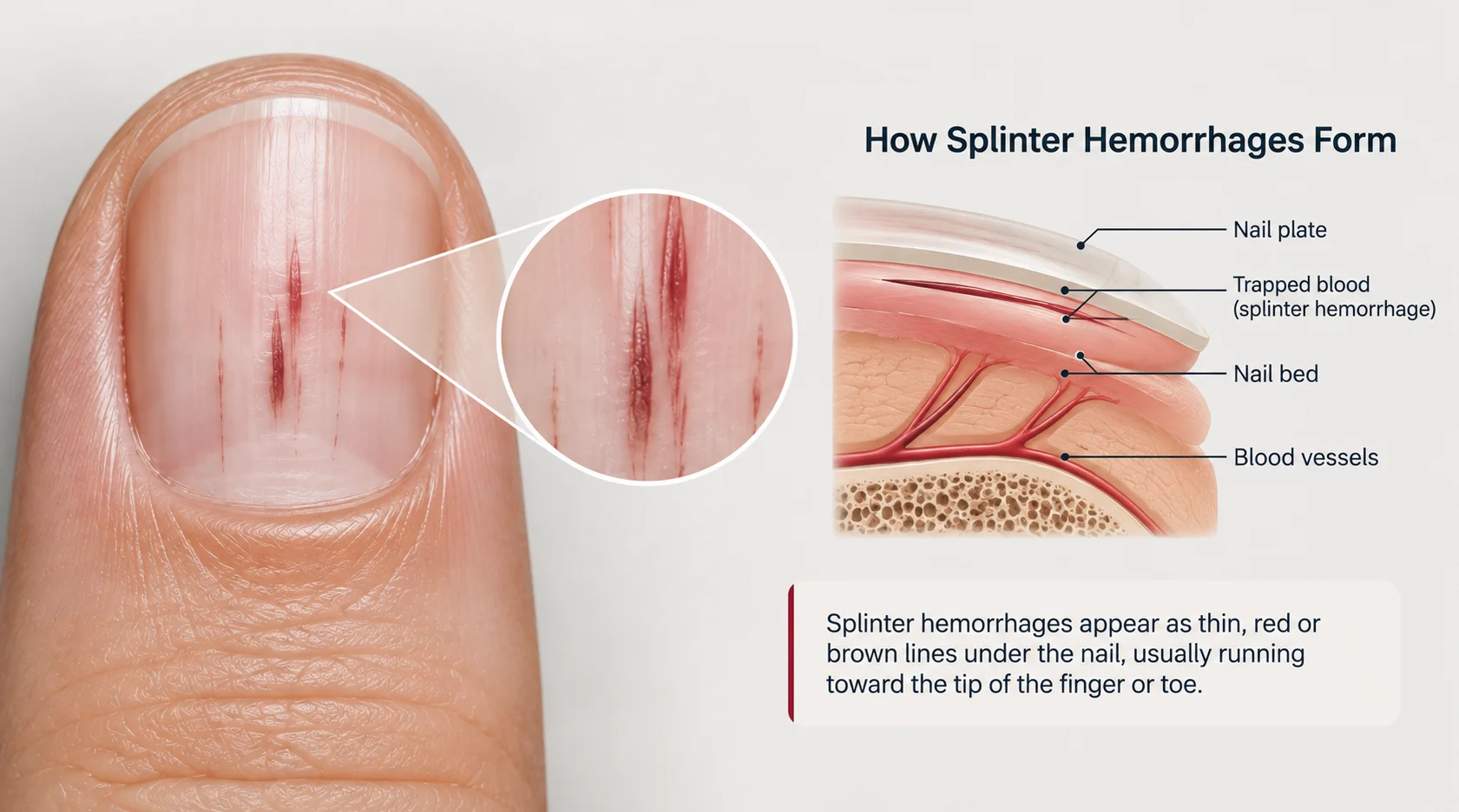
Splinter hemorrhages are tiny areas of bleeding beneath the nail plate. They usually appear as thin red, reddish-brown, purple or dark lines that run in the direction the nail grows.
The name comes from their appearance. Each streak looks like a small wood splinter caught under the nail, even though nothing is actually lodged there.
They can show up under fingernails or toenails. In most cases, a single splinter hemorrhage caused by minor trauma is not a cause for alarm, though a healthcare provider is the right person to confirm that in your specific case.
What Are Splinter Hemorrhages?
A splinter hemorrhage happens when tiny blood vessels running along the nail bed break and leak a small amount of blood. That blood gets trapped between the nail bed and the nail plate above it.
Because the vessels run in narrow, parallel lines under the nail, the blood settles into thin streaks rather than a round bruise. That is why the mark looks linear instead of blotchy.
The streaks typically point toward the fingertip or toe tip, following the same direction the nail itself grows. This pattern is one of the features that helps a clinician recognize a splinter hemorrhage on sight.
They can occur on any nail, and it is common for only one nail to be affected at a time.
What Do Splinter Hemorrhages Look Like?
Fresh splinter hemorrhages tend to look red or reddish-brown. Over the following days, they often darken toward purple or near-black as the blood ages under the nail.
The lines are usually narrow, somewhere between one and three millimeters long, and elongated rather than round. Some sit closer to the base of the nail, while others appear nearer the free edge or tip.
It is possible to have a single streak under one nail, or several streaks under one or more nails at the same time. Neither pattern by itself tells you the cause.
Not every dark mark under a nail is a splinter hemorrhage. Nail discoloration can come from many other sources, including bruising, fungal infection, or pigment changes, so it is worth having any new or unexplained nail mark looked at rather than assuming what it is.
Splinter Hemorrhages in Fingernails
Splinter fingernail hemorrhage cases are common, and everyday hand use is often the reason. A splinter hemorrhage nail mark on a finger frequently traces back to some form of physical impact on that nail.
Hitting a finger against a door frame, pinching it in a drawer, or repetitive pressure from typing, gripping tools, or manual work can all rupture the small vessels under the nail bed.
Nail procedures are another possible trigger. An aggressive manicure, acrylic application, or nail file used too close to the cuticle can occasionally cause minor trauma to the nail bed.
That said, not every manicure leads to a splinter hemorrhage, and most people who get manicures never develop one. When it does happen after a nail procedure, it is usually an isolated, one-off event rather than something that keeps recurring.
Splinter Hemorrhages in Toenails
Splinter hemorrhages in toenails are usually linked to mechanical pressure rather than the kind of impact seen with fingers.
Tight or poorly fitted shoes can press against the toenail repeatedly during walking or running, gradually damaging small vessels under the nail. This is especially common among runners and people who spend long hours on their feet.
Stubbing a toe, dropping something on it, or repetitive stress from sports like soccer, basketball, or hiking can also cause a toenail splinter hemorrhage.
As with fingernails, an underlying condition should not be assumed just because a toenail shows this kind of streak. Trauma from footwear or activity explains a large share of cases.
What Causes Splinter Hemorrhages?
Splinter hemorrhages have a range of possible causes, from simple bumps to, less often, an underlying medical issue. Looking at the pattern and any accompanying symptoms helps a clinician sort out which is more likely.
Trauma and Nail Injury
Physical trauma is the most frequently identified cause. A direct blow, a pinch, repetitive friction, or pressure from tight footwear can all rupture the fine capillaries beneath the nail plate.
Trauma-related splinter hemorrhages are typically limited to one nail, or occasionally two on the same hand or foot that experienced the same impact.
Nail Procedures
Manicures, pedicures, acrylic nails, gel application, and aggressive filing near the cuticle can sometimes injure the nail bed enough to cause a streak. This is uncommon relative to how many people get their nails done regularly, but it does happen.
Inflammatory or Skin Conditions
Certain inflammatory skin conditions have been associated with nail changes, including splinter hemorrhages. Psoriasis affecting the nails and lichen planus are two examples where this has been observed.
In these cases, the nail often shows other changes too, such as pitting, thickening, or ridging, alongside the hemorrhage.
Blood Vessel or Systemic Conditions
Conditions that affect blood vessels more broadly, such as vasculitis, can sometimes be associated with splinter hemorrhages, particularly when several nails are affected at once.
Other systemic conditions have also been linked to this nail finding in medical literature, though the link is an association rather than a guarantee that the condition is present.
Infections
Certain infections, including infective endocarditis, can be associated with splinter hemorrhages. This is the connection many people search for, and it deserves a careful, non-alarming explanation, which is covered in more detail below.
It is important to state clearly here that splinter hemorrhages are nonspecific. Trauma remains a common and often overlooked explanation, and most people who develop one or two streaks after an injury do not have an infection.
Medications
Some medicines have been associated with nail changes, including splinter hemorrhage-like marks. Blood thinners and certain other drug classes are examples that have come up in clinical reports.
If you suspect a medication might be related, do not stop taking it on your own. Bring it up with your prescribing doctor, who can weigh the benefits of the medication against this possible side effect.
Are Splinter Hemorrhages Dangerous?
For most people, the answer is no. Many isolated splinter hemorrhages caused by minor trauma resolve on their own and carry no danger.
That said, unexplained, recurrent, or multiple splinter hemorrhages may deserve medical assessment, particularly when they show up alongside other symptoms like fever, joint pain, or unusual fatigue.
A single streak on one nail after you remember bumping it is very different, clinically, from streaks appearing across several nails with no clear trigger. The second pattern is the one worth discussing with a doctor.
Splinter Hemorrhages and Endocarditis
Infective endocarditis is an infection of the inner lining of the heart, most often affecting one of the heart valves. It happens when bacteria or, less commonly, fungi enter the bloodstream and settle on damaged or abnormal heart tissue.
Splinter hemorrhages have historically been taught as a classic sign of endocarditis, and that association is where a lot of the search interest around this topic comes from. Doctors have long noted these nail streaks in some patients with the infection.
However, splinter hemorrhages alone are not enough to diagnose endocarditis. They are a nonspecific finding, meaning trauma explains the vast majority of cases seen in everyday practice, far more often than infection does.
A clinician diagnosing endocarditis looks at the full picture: fever, new heart murmurs, blood cultures, imaging of the heart valves, and other physical findings, not a nail streak in isolation.
If you have a splinter hemorrhage along with fever, chills, unexplained fatigue, or a known heart valve condition, that combination is worth bringing to a doctor's attention. A splinter hemorrhage by itself, with no other symptoms, is not a reason to assume you have a heart infection.
When Should You See a Doctor for Splinter Hemorrhages?
Medical evaluation is reasonable in a number of situations. None of these guarantee a serious cause, but each one is a fair reason to get checked rather than wait it out.
- There is no obvious injury that explains the mark
- Multiple nails are affected at the same time
- Splinter hemorrhages keep recurring over weeks or months
- The mark does not move outward with nail growth the way you would expect
- Other unexplained symptoms are present alongside the nail changes
- There is fever or you feel significantly unwell
- The area shows signs of infection, such as warmth, swelling, or pus
- The nail has persistent or unusual discoloration beyond a typical streak
- You are simply concerned and want reassurance about an underlying cause
None of these signs mean something serious is definitely happening. They just mean an exam is the more sensible next step than guessing.
How Are Splinter Hemorrhages Diagnosed?
Diagnosis usually starts with a straightforward physical examination of the affected nail or nails. A doctor will look at how many nails are involved, where the streaks sit, and what they look like up close.
Your medical history matters here. The clinician will typically ask about any recent trauma, nail procedures, medications you take, and any other symptoms you have noticed, such as fever or joint pain.
Depending on what the exam and history suggest, a healthcare professional may recommend additional testing to look for an underlying cause. Dermoscopy, a technique using a handheld magnifying device, can sometimes help examine the nail more closely when clinically appropriate.
If there is genuine concern about a systemic cause, blood tests or other investigations may be ordered based on what the rest of the clinical picture points toward.
Do Splinter Hemorrhages Need Treatment?
Treatment depends entirely on the cause. There is no single fix that applies to every case.
If trauma caused the hemorrhage, it often grows out with the nail on its own and may not need any specific treatment at all. Time and normal nail growth usually take care of it.
If an underlying condition is suspected or identified, treatment is directed at that condition rather than at the nail streak itself. Treating the cause resolves the nail finding as a side effect.
It is worth noting what not to do here. Do not attempt to puncture, cut, or drain the nail. This is not how splinter hemorrhages are managed, and doing so risks introducing infection into the nail bed.
How Long Do Splinter Hemorrhages Last?
As the nail grows, the trapped blood tends to move gradually toward the tip of the nail, since it is carried along by the nail plate rather than the nail bed underneath.
Eventually, the visible line reaches the free edge of the nail and gets trimmed away during normal nail care, or simply grows out past the point where it is noticeable.
Timing varies quite a bit from person to person and depends on how fast that particular nail grows, plus whatever caused the hemorrhage in the first place. Fingernails generally grow faster than toenails, so fingernail marks tend to clear sooner.
Can Splinter Hemorrhages Be Prevented?
Some practical steps can lower the chances of a trauma-related splinter hemorrhage, even though not every cause is preventable.
- Protect your nails during manual work, sports, or activities with a risk of impact
- Avoid unnecessary trauma, like using nails as tools to pry things open
- Choose proper, well-fitted footwear, especially for running or long periods on your feet
- Ask for gentler technique during manicures and pedicures, particularly around the cuticle
- Discuss any medication concerns with a healthcare professional instead of stopping on your own
These steps reduce trauma-related risk. They do not prevent every possible cause, since some causes are medical rather than mechanical.
Splinter Hemorrhage vs Other Dark Lines Under the Nail
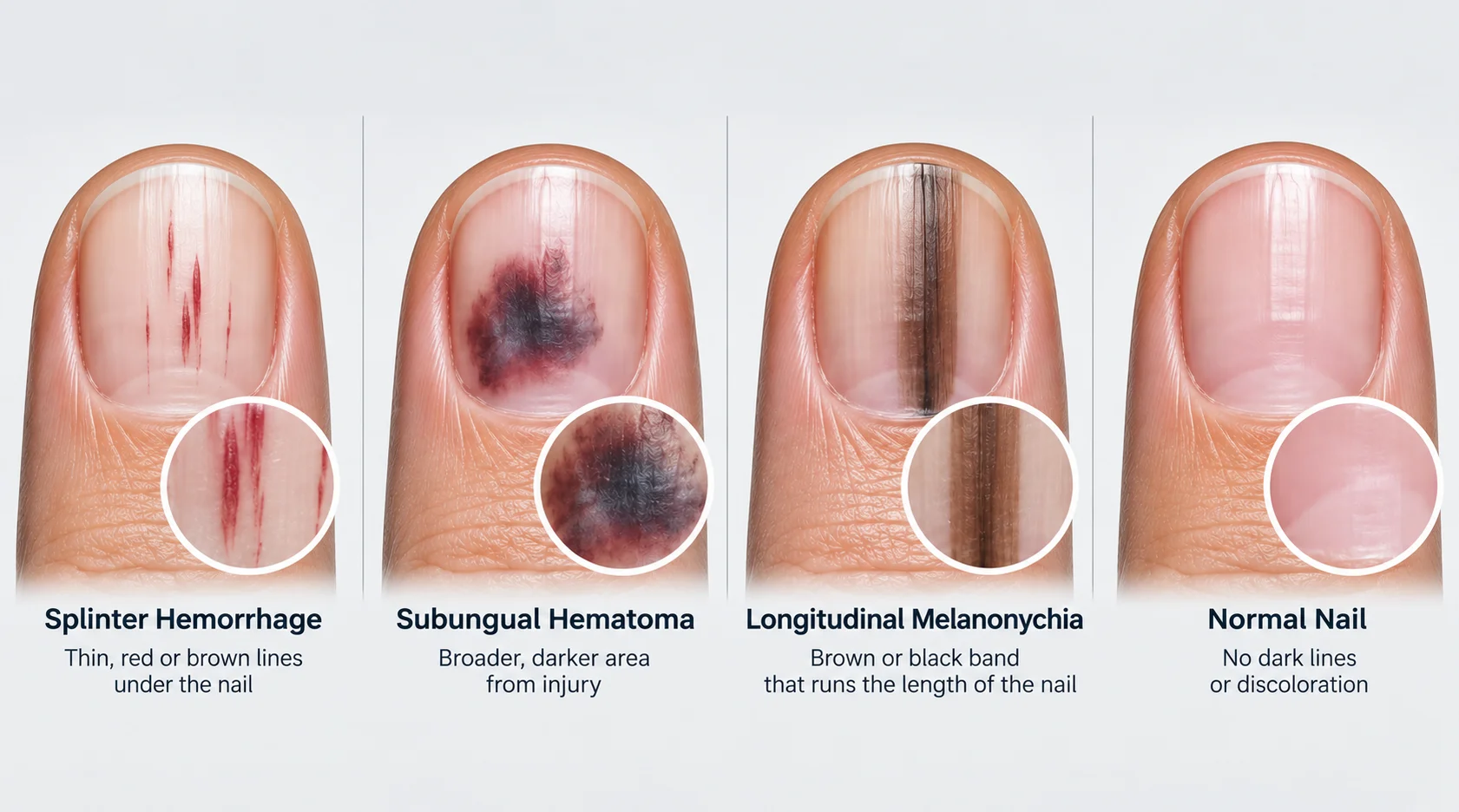
Dark or reddish lines under a nail are not automatically a splinter hemorrhage. A few other conditions can produce marks that look similar at first glance.
A subungual hematoma, or a bruise under the nail from a heavier direct injury, tends to be broader and more blotchy rather than a fine line, though smaller ones can look similar to a splinter hemorrhage.
Longitudinal melanonychia, a pigmented band that can be a normal variant in some people, runs the length of the nail but is usually brown or black and stays a consistent color rather than aging from red toward purple.
Appearance alone is not a reliable way to tell these apart. Persistent or changing pigmentation under a nail should be evaluated by a healthcare professional, because some pigmented nail changes need to be distinguished from more concerning conditions, including rare cases of nail melanoma. This is not meant to cause alarm. It is simply a reason to have any new or changing nail mark checked rather than watched indefinitely at home.
When Splinter Hemorrhages May Need Specialist Evaluation
A patient may benefit from specialist evaluation when the cause of a splinter hemorrhage is not clear, when it keeps recurring, when several nails are involved, or when other symptoms accompany it.
The right specialist depends on the clinical picture rather than being the same for everyone. A dermatologist is often the first point of contact for nail-specific concerns and can evaluate the nail directly, including through dermatology consultations where nail and skin conditions are assessed together.
A primary care physician or internal medicine specialist is usually the right starting point when the picture is less clear or other symptoms are present. A cardiologist becomes relevant only when there is a specific clinical reason to suspect a heart-related cause, not as a routine referral for every patient with a nail streak.
Other specialists may be involved depending on what the initial evaluation points toward, such as a rheumatologist for suspected vasculitis or an infectious disease specialist if infection is suspected.
Seeking Medical Evaluation in India for Splinter Hemorrhages
Patients in the United States, the United Kingdom, Canada, Australia, and across the Gulf region, including the UAE, Oman, Saudi Arabia, Qatar, Kuwait, and Bahrain, sometimes look beyond their home country when they need specialist consultation, diagnostic evaluation, or treatment for an underlying condition linked to nail or vascular symptoms.
India is one option among several that international patients consider for dermatology consultations, cardiology evaluation, and broader diagnostic workups, supported by multi-specialty hospitals with experience treating patients from abroad. You can browse the hospital network HealthRoop works with to compare specialist departments before making a decision.
This is not a claim that India offers better doctors or safer care than a patient's home country, and it is not a promise of specific outcomes or guaranteed savings. Every patient's situation, insurance coverage, and comfort level with travel are different, and those factors should guide the decision as much as anything else.
Patients in the United States who are weighing specialist evaluation elsewhere typically compare a few practical factors: the diagnosis itself, specialist availability and wait time, hospital experience with the relevant condition, expected treatment timeline, total cost, and how follow-up care will be arranged once they return home.
How HealthRoop Helps International Patients Access Care in India
HealthRoop is a medical tourism and patient coordination company. HealthRoop does not diagnose or treat patients directly. That responsibility sits with the doctors and hospitals a patient ultimately chooses to see, working from partner institutions such as those listed on HealthRoop's hospital network page.
What HealthRoop does is help remove the logistical friction that comes with seeking care in another country, so a patient can focus on the medical side of things rather than the paperwork and planning.
- Reviews medical reports and helps coordinate an initial evaluation plan with a suitable specialist
- Assists with comparing hospitals and specialists based on the patient's specific condition
- Helps arrange appointments with dermatologists, cardiologists, or other relevant specialists
- Coordinates second opinions when a patient wants an additional clinical perspective
- Provides preliminary cost coordination so patients have a clearer financial picture before traveling
- Assists with medical visa documentation required for treatment travel to India
- Helps arrange travel logistics and accommodation suited to the length of the visit
- Coordinates airport pickup and local transportation during the stay
- Arranges interpreter support where language assistance is needed
- Supports patients with organizing and sharing medical records and documentation
- Assigns a dedicated patient coordinator to stay in touch throughout the India visit
- Helps coordinate follow-up communication with the treating specialist after the patient returns home, where available
Each of these is a coordination or support service. Clinical decisions, diagnosis, and treatment remain the responsibility of the treating doctors and hospitals a patient chooses to see. For a direct conversation about a specific case, reach out through our contact page to discuss next steps with HealthRoop's patient coordination team.
Medical Disclaimer: This article is for general educational purposes and does not replace examination, diagnosis or treatment by a qualified healthcare professional. Anyone concerned about a nail symptom should consult a doctor for personalized evaluation.
Frequently Asked Questions
Answers on splinter hemorrhage causes, diagnosis, and treatment.
They are small areas of bleeding under the nail plate, appearing as thin red, reddish-brown, or dark lines running in the direction of nail growth. They can occur on fingernails or toenails.
Trauma from bumps, pinches, or repetitive pressure is a common cause, along with occasional nail procedures. Less often, an underlying inflammatory, vascular, or infectious condition may be involved.
Yes. Toenail cases often relate to pressure from footwear, stubbed toes, or repetitive activity like running, though other causes are possible too.
Many isolated cases from minor trauma are not dangerous. Unexplained, recurrent, or multiple splinter hemorrhages, especially with other symptoms, are worth a medical evaluation.
They can be associated with endocarditis in some cases, but they are nonspecific and trauma is far more common. A splinter hemorrhage alone is not enough to diagnose a heart infection.
Yes, trauma is one of the most frequently identified causes, whether from a direct injury, repetitive pressure, or a nail procedure.
Trauma-related ones often grow out with the nail without needing specific treatment. Cases linked to an underlying condition improve once that condition is addressed.
It varies based on nail growth speed and the underlying cause. Fingernails generally grow faster than toenails, so marks on fingers tend to clear sooner.
See a doctor if there is no clear injury, multiple nails are affected, the marks keep recurring, or you notice fever, unusual fatigue, or other unexplained symptoms alongside them.
Treatment targets the cause rather than the nail mark itself. Trauma-related cases usually just need time, while an identified underlying condition is treated directly by a specialist.
