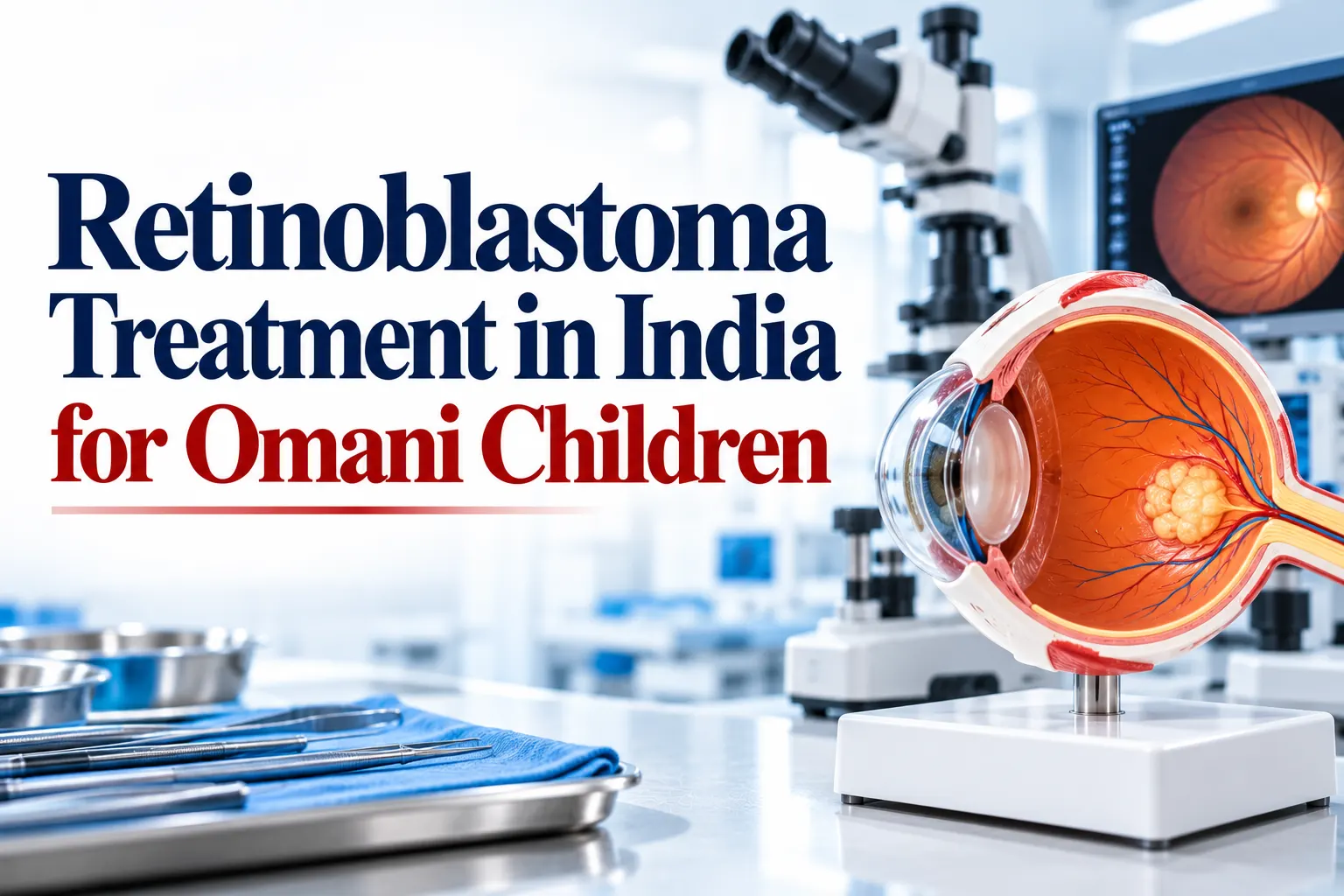
Retinoblastoma Treatment in India for Omani Children
Retinoblastoma treatment in India requires a specialised team because this cancer affects the retina of young children and treatment decisions can involve both cancer control and preservation of the eye and vision. For families travelling from Oman, the process also includes reviewing medical records, confirming the diagnosis, choosing the right specialist centre, estimating treatment costs and planning travel and follow-up care.
Retinoblastoma can progress quickly, so parents should not delay specialist assessment while comparing hospitals or prices. The treatment depends on whether one or both eyes are affected, the size and location of the tumour, whether there are tumour seeds inside the eye, and whether the disease has spread beyond the eye.
Treatment may include chemotherapy, laser or cryotherapy, intra-arterial chemotherapy, intravitreal chemotherapy, plaque brachytherapy or removal of the affected eye when the eye cannot safely be preserved. The main priority is to control the cancer and protect the child's life. When medically possible, doctors then work to preserve the eye and useful vision.
What Is Retinoblastoma?
Retinoblastoma is a cancer that starts in the retina, the light-sensitive tissue at the back of the eye. It occurs mainly in young children and can affect one eye or both eyes.
Some children have hereditary retinoblastoma associated with changes in the RB1 gene, while others develop the disease without a known inherited cause.
The distinction matters because children with hereditary disease may need closer monitoring of both eyes and, in some cases, genetic counselling and testing for family members.
Common Signs of Retinoblastoma
Parents may notice:
- A white reflection in the pupil, sometimes called leukocoria
- A crossed or wandering eye
- Redness or swelling around the eye
- Poor vision
- An enlarged or painful eye in advanced cases
- A change in the appearance of the pupil
A white pupil in a child's photograph or unusual eye alignment does not always mean retinoblastoma. However, these signs need prompt assessment by an ophthalmologist.
Why Is Early Treatment Important?
Retinoblastoma is highly treatable when identified and managed at an experienced centre, but delay can allow the tumour to become more extensive.
Treatment has three connected goals:
- Save the child's life
- Control the cancer inside the eye
- Preserve the eye and useful vision whenever safely possible
These priorities are not always equal in every case. If an eye is severely affected and there is a significant risk of tumour spread, removing the eye may be safer than attempting prolonged eye-preserving treatment.
This is why parents should be cautious about choosing a treatment based only on the desire to save the eye. Cancer control comes first.
How Is Retinoblastoma Diagnosed?
The diagnosis usually requires an examination by an ophthalmologist experienced in childhood eye tumours.
Depending on the child's age and condition, evaluation may include:
Eye Examination Under Anaesthesia
Young children may not cooperate with a detailed retinal examination while awake. An examination under anaesthesia allows the specialist to carefully assess both eyes.
The doctor may document:
- Tumour size
- Tumour location
- Number of tumours
- Retinal involvement
- Vitreous seeds
- Subretinal seeds
- Optic nerve appearance
- Other eye abnormalities
Ocular Imaging
Ultrasound and other imaging techniques may help assess the tumour and confirm findings from the eye examination.
MRI
MRI of the brain and orbits may be recommended to assess the extent of disease and look for features outside the eye.
Genetic Testing
Genetic counselling and RB1 testing may be considered, particularly when both eyes are affected, the child is very young, or there is a family history.
Parents travelling from Oman should send previous examination reports, scans and treatment records to the Indian centre before travelling whenever possible.
What Are the Main Retinoblastoma Treatment Options?
There is no single treatment for every child. The approach depends on tumour stage, eye involvement and whether the eye and vision can be preserved.
1. Chemotherapy
Chemotherapy may be used to shrink tumours and make local treatment more effective.
It can be given through a vein as systemic chemotherapy or delivered more directly to the eye.
Systemic chemotherapy may be considered for certain intraocular cases and is particularly important in some high-risk or extraocular situations.
2. Intra-Arterial Chemotherapy
Intra-arterial chemotherapy, also called ophthalmic artery chemotherapy, delivers chemotherapy directly through the artery supplying the eye.
A specialist places a small catheter into an artery and guides it toward the ophthalmic artery. The medicine is then delivered close to the tumour.
This approach can be used for selected children, particularly when eye preservation is being considered for advanced intraocular disease.
Because the procedure requires specialised interventional radiology and paediatric anaesthesia expertise, it should be performed at experienced centres.
3. Intravitreal Chemotherapy
In this treatment, chemotherapy is injected directly into the eye.
It can be useful in selected cases where tumour cells have spread into the vitreous, known as vitreous seeds.
It may be combined with other treatment rather than used alone.
4. Laser or Thermotherapy
Laser treatment or thermotherapy can be used to destroy suitable residual or smaller tumours.
It is often used as part of a combined eye-preserving treatment plan.
5. Cryotherapy
Cryotherapy uses controlled freezing to destroy selected tumours.
It may be suitable for smaller peripheral tumours and is frequently used as a local treatment alongside chemotherapy.
6. Plaque Brachytherapy
Plaque brachytherapy places a small radioactive source close to the tumour.
It may be considered for selected localised tumours that are not suitable for other focal treatments or that remain after initial therapy.
7. Enucleation
Enucleation means surgical removal of the affected eye.
It may be recommended when:
- The tumour is very large
- The eye has little or no useful visual potential
- The disease has extensive intraocular involvement
- Eye-preserving treatment would create an unacceptable cancer risk
An orbital implant can be placed during surgery, and an ocular prosthesis may be fitted after healing.
Enucleation can be emotionally difficult for parents, but when an eye cannot safely be preserved, it can be an important cancer-control procedure.
Can the Eye Be Saved?
Sometimes, yes.
Eye preservation depends on the extent of the tumour and the child's response to treatment. Children with smaller tumours may be treated with local therapies, while more advanced disease may require chemotherapy with intra-arterial or intravitreal treatment.
The International Classification of Retinoblastoma is commonly used to describe intraocular disease. In general, higher group classifications indicate more advanced disease and can make eye preservation more difficult.
However, parents should not interpret the group alone as a guarantee of the outcome. The child's individual tumour pattern, treatment response and available expertise all matter.
The NCI recommends management by a multidisciplinary team experienced in childhood ocular tumours, particularly when eye and vision preservation is being considered.
Retinoblastoma Treatment Cost in India
The cost of retinoblastoma treatment varies considerably because treatment may involve several procedures rather than one operation.
Published Indian sources report wide cost differences depending on whether a child needs enucleation, intravenous chemotherapy, intra-arterial chemotherapy, intravitreal treatment, laser, cryotherapy or a combination.
A published review of retinoblastoma care in lower-resource settings reported Indian estimates of approximately ₹10,000–₹50,000 for enucleation, ₹5,000–₹20,000 for intravitreal chemotherapy and ₹80,000–₹1.5 lakh for intra-arterial chemotherapy, excluding the fact that a complete treatment plan may require multiple sessions and additional hospital expenses.
Another Indian review reported that intra-arterial chemotherapy could cost approximately ₹50,000–₹1 lakh per procedure in the Indian setting, while intravenous chemotherapy was considerably less expensive. Actual private-hospital pricing can be higher.
Indicative Retinoblastoma Treatment Costs
| Treatment | Indicative INR Cost | Approx. USD Cost |
|---|---|---|
| Enucleation | ₹70,000 – ₹1.2 lakh | $730 – $1,250 |
| Laser / cryotherapy | ₹20,000 – ₹45,000 | $210 – $470 |
| Intravitreal chemotherapy | ₹5,000 – ₹20,000* | $50 – $210* |
| Intra-arterial chemotherapy | ₹80,000 – ₹1.5 lakh* | $830 – $1,560* |
| Radiation / plaque treatment | ₹80,000 – ₹1.5 lakh* | $830 – $1,560* |
*Published figures can exclude medicines, anaesthesia, investigations, hospitalisation and other treatment-related expenses.
Resource: Cost ranges are based on published Indian retinoblastoma treatment literature and Indian eye-care sources. Actual private-hospital prices vary substantially according to the child's condition, treatment protocol, number of sessions, medicines, hospital and complications.
USD conversion: Dollar figures are approximate and intended only for international-patient budgeting. The hospital's INR quotation should be treated as the actual treatment price.
Important: Retinoblastoma is usually treated through a combination of therapies when clinically appropriate. Therefore, the cost of one procedure should not be mistaken for the total cost of treatment.
What Can Increase the Treatment Cost?
The final expense may change because of:
- One eye versus both eyes being affected
- Tumour stage
- Number of tumours
- Need for chemotherapy
- Number of chemotherapy cycles
- Intra-arterial chemotherapy
- Intravitreal chemotherapy
- Laser or cryotherapy sessions
- Enucleation
- Prosthetic eye
- MRI and other imaging
- Genetic testing
- Hospitalisation
- Paediatric anaesthesia
- Treatment of complications
- Follow-up examinations
For an international family, travel, accommodation and the length of stay in India should also be included in the overall budget.
What Is the Treatment for Eye Cancer in Children?
Eye cancer in children treatment India can involve several specialties working together.
A suitable centre may need:
- Paediatric ophthalmology
- Ocular oncology
- Paediatric oncology
- Interventional radiology
- Paediatric anaesthesia
- Radiation oncology
- Diagnostic imaging
- Pathology
- Genetic counselling
This multidisciplinary setup is particularly important for advanced retinoblastoma because treatment may involve repeated examinations and more than one treatment method.
Retinoblastoma Treatment Abroad from Oman
Families considering retinoblastoma treatment abroad from Oman should begin the process by collecting the child's complete medical records.
Useful documents include:
- Passport copy
- Previous ophthalmology reports
- Examination-under-anaesthesia reports
- MRI or ultrasound reports
- Pathology reports, if available
- Genetic test results
- Previous chemotherapy records
- Medication list
- Discharge summaries
- Vaccination and general medical history
Send Reports Before Travelling
Parents should have the case reviewed before booking flights whenever possible.
A specialist can then advise whether the child needs:
- A second opinion
- Repeat imaging
- Examination under anaesthesia
- Immediate treatment
- A specific type of chemotherapy
- Further staging
This is especially important because retinoblastoma treatment can be time-sensitive.
Ask for a Written Treatment Plan
Before travelling, ask the hospital to explain:
- Diagnosis
- Tumour group or stage
- Recommended treatment
- Expected number of sessions
- Approximate hospital stay
- Estimated cost
- What is included
- Possible additional charges
- Follow-up schedule
How Should Omani Parents Choose a Retinoblastoma Hospital in India?
When searching for the best retinoblastoma hospital India, parents should look beyond the hospital's general reputation.
Ask whether the specific centre has experience with childhood eye cancer.
Important Facilities
A suitable centre should ideally have access to:
- Ocular oncology
- Paediatric oncology
- Experienced retinal specialists
- Intra-arterial chemotherapy where appropriate
- Intravitreal chemotherapy
- Laser and cryotherapy
- MRI and paediatric imaging
- Paediatric intensive care
- Paediatric anaesthesia
- Genetic counselling
- Ocular prosthetic services
Ask About Case Volume
Retinoblastoma is relatively uncommon compared with many other childhood cancers. Experience with this specific disease matters.
A hospital treating large numbers of general cancer patients is not automatically the best choice for a child with retinoblastoma.
Ask:
- How many children with retinoblastoma does your team treat each year?
Also ask whether the same centre can manage both cancer treatment and eye-preservation procedures.
Hospitals Listed by Healthroop
The hospitals below are part of Healthroop's current hospital network. This is not a ranking of retinoblastoma outcomes. Parents should confirm the availability of a dedicated retinoblastoma or ocular-oncology programme before making a decision.
Apollo Hospitals
Apollo is listed with oncology, paediatric-related services and international patient support. Its cancer programme specifically describes retinoblastoma treatment options including systemic chemotherapy, ophthalmic artery chemotherapy, intravitreal chemotherapy, cryotherapy, laser treatment, plaque therapy and enucleation.
Fortis Healthcare
Fortis is listed with oncology, paediatric facilities, PICU support and international-patient services. Parents should confirm which Fortis campus has the appropriate ocular-oncology and paediatric retinoblastoma team.
Medanta – The Medicity
Medanta's Gurugram hospital is listed with a Cancer Institute and radiation oncology facilities, along with international-patient services. Families should confirm the availability of the specific paediatric eye-cancer team before travelling.
Narayana Health
Narayana Health is listed with oncology, paediatric surgery and nuclear medicine services and has an international patient desk. The specific hospital and specialist team should be confirmed for a retinoblastoma case.
Manipal Hospitals
Manipal Hospitals is listed with oncology, paediatric services and international-patient support, including travel and medical-visa assistance. Parents should confirm the specific centre's ocular-oncology services.
Max Healthcare
Max Healthcare is listed with oncology, PET-CT, ICU facilities and international-patient services. Before booking, parents should confirm whether the selected Max facility has a paediatric ocular-oncology programme appropriate for retinoblastoma.
HCG Cancer Centre
HCG is listed as a cancer-focused network with medical oncology, radiation therapy, surgical oncology, paediatric oncology, molecular diagnostics and international-patient services. Parents should confirm the availability of dedicated retinoblastoma treatment at the selected centre.
What Is the Treatment Process for Omani Children?
For families travelling from Oman, the process generally starts before the child leaves the country.
Step 1: Medical Record Review
Send scans, eye examination reports, previous treatment records and pathology where available.
Step 2: Specialist Opinion
The Indian team reviews the case and advises whether additional tests or an in-person assessment are required.
Step 3: Treatment Planning
The team determines whether the child may need chemotherapy, local therapy, intra-arterial treatment, enucleation or a combination.
Step 4: Cost Estimate
The hospital provides a preliminary estimate based on the proposed treatment.
Step 5: Travel Preparation
Parents arrange the child's medical travel documents, flights and accommodation.
Step 6: In-Person Evaluation
The child may undergo another examination under anaesthesia, imaging or other tests after arrival.
Step 7: Treatment
Treatment begins after the team confirms the diagnosis and final plan.
Step 8: Follow-Up
The parents receive treatment records and a follow-up schedule before returning to Oman.
How Long Does Treatment Take?
There is no fixed treatment duration for retinoblastoma.
A child receiving local therapy may have a different schedule from a child receiving multiple chemotherapy cycles or intra-arterial chemotherapy.
Treatment can involve several visits over weeks or months.
For international families, it is sensible to ask the treating centre:
- How many visits are expected?
- How frequently are examinations required?
- How many chemotherapy sessions may be needed?
- Will the child need repeated anaesthesia?
- Can some follow-up be completed in Oman?
- When is it safe to travel home?
Do not book a short return trip simply because the first procedure is scheduled for one day.
What Happens After Treatment?
Follow-up is an important part of retinoblastoma care.
Doctors may monitor:
- Tumour regression
- New tumour formation
- Recurrence
- Retinal health
- Vision
- Eye pressure
- Treatment-related effects
- The other eye
- Developmental and general health
Children with hereditary retinoblastoma may require long-term surveillance beyond the eyes.
Parents should keep all treatment records and share them with the child's doctors in Oman.
If the Eye Cannot Be Saved
Parents often find this the most difficult part of retinoblastoma treatment.
When an eye has extensive disease and cannot safely be preserved, enucleation may be recommended.
The purpose is cancer control, not cosmetic treatment.
An orbital implant can be placed during surgery, and a prosthetic eye can later be fitted after healing. The child can continue normal development with appropriate support when the other eye is healthy.
The decision should be explained clearly by the ocular-oncology and paediatric-oncology teams.
How Healthroop Helps Omani Families
Healthroop helps international families coordinate medical treatment in India by assisting with hospital selection, specialist consultations and practical arrangements before and during treatment.
Support may include:
- Medical-record review
- Specialist and hospital matching
- Second-opinion coordination
- Treatment-cost estimates
- Appointment scheduling
- Medical-visa documentation support
- Travel planning
- Airport transfer coordination
- Accommodation assistance
- Interpreter support
- Communication with the hospital
- Follow-up coordination after returning to Oman
For a child with retinoblastoma, the most useful first step is usually a review of the child's existing eye examination, imaging and treatment records before travel.
Final Thoughts
Retinoblastoma is a childhood cancer where timing and specialist experience matter. Parents from Oman considering treatment in India should first have the child's existing reports reviewed by an appropriate paediatric ocular-oncology team.
The treatment may be relatively straightforward in an early-stage case, while advanced disease can require several therapies and repeated examinations. That is why a general price or a hospital's overall reputation cannot tell a family whether a particular centre is right for their child.
When comparing Indian hospitals, ask about specific retinoblastoma experience, ocular-oncology services, paediatric oncology, intra-arterial chemotherapy, local eye treatments and long-term follow-up.
For families travelling from Oman, it is also important to plan beyond the first procedure. The child's treatment may continue for weeks or months, and follow-up arrangements in Oman should be discussed with the Indian team before returning home.
Price Disclaimer: The prices mentioned in this article are based on previously published Indian treatment-cost data and are intended only as indicative figures for planning. Retinoblastoma treatment costs can change according to the child's condition, treatment protocol, hospital, medicines, number of sessions, anaesthesia, investigations and length of stay. The exact current price can only be confirmed after a specialist reviews the child's medical records. For the latest cost and treatment information, please call or email the Healthroop team before making travel arrangements.
Medical Disclaimer: This article is for general educational purposes and does not replace advice from a qualified paediatric oncologist, ocular oncologist or ophthalmologist. Retinoblastoma can be serious and time-sensitive. Parents should seek prompt specialist medical assessment and should not delay treatment based on information in this article.
Frequently Asked Questions
Answers on retinoblastoma treatment, cost, and planning care in India for Omani children.
Parents may notice a white reflection in the pupil (leukocoria), a crossed or wandering eye, redness or swelling around the eye, poor vision, a change in the appearance of the pupil, or an enlarged or painful eye in advanced cases. These signs do not always mean retinoblastoma, but they need prompt assessment by an ophthalmologist.
Treatment may include chemotherapy, intra-arterial chemotherapy, intravitreal chemotherapy, laser or thermotherapy, cryotherapy, plaque brachytherapy or enucleation (removal of the affected eye). There is no single treatment for every child. The approach depends on tumour stage, eye involvement and whether the eye and vision can be preserved.
Sometimes, yes. Eye preservation depends on the extent of the tumour and the child's response to treatment. Smaller tumours may be treated with local therapies, while more advanced disease may need chemotherapy with intra-arterial or intravitreal treatment. The child's life and cancer control come first, so enucleation may be recommended when the eye cannot safely be preserved.
Cost varies considerably because treatment may involve several procedures rather than one operation. Published Indian sources report wide differences depending on whether a child needs enucleation, chemotherapy, intra-arterial or intravitreal treatment, laser, cryotherapy or a combination. Figures in published literature can exclude medicines, anaesthesia, investigations and hospitalisation, so a written hospital estimate is needed.
Families from Oman can seek retinoblastoma treatment in India. They should first send the child's existing eye examination, imaging and treatment records for specialist review, confirm the diagnosis and treatment plan, and arrange medical travel documents before booking flights.
Useful documents include the child's passport copy, previous ophthalmology reports, examination-under-anaesthesia reports, MRI or ultrasound reports, pathology reports if available, genetic test results, previous chemotherapy records, a medication list, discharge summaries and vaccination and general medical history.
Look beyond general reputation. A suitable centre should have ocular oncology, paediatric oncology, experienced retinal specialists, intra-arterial and intravitreal chemotherapy where appropriate, laser and cryotherapy, paediatric imaging, paediatric intensive care and anaesthesia, genetic counselling and ocular prosthetic services. Ask how many children with retinoblastoma the team treats each year.
There is no fixed duration. A child receiving local therapy may have a different schedule from a child receiving multiple chemotherapy cycles or intra-arterial chemotherapy. Treatment can involve several visits over weeks or months, so families should not book a short return trip based only on the date of the first procedure.
Doctors may monitor tumour regression, new tumour formation, recurrence, retinal health, vision, eye pressure, treatment-related effects, the other eye and the child's developmental and general health. Children with hereditary retinoblastoma may need long-term surveillance, and parents should share all treatment records with the child's doctors in Oman.
