IVF Cost in Bangladesh vs India: Packages, Hidden Charges and Why Bangladeshi Patients Choose India
This article is for general informational purposes only and is not a substitute for professional medical advice. Prices mentioned are indicative published estimates, not confirmed HealthRoop package prices, and should be verified with the treating clinic.
If you're searching for IVF cost in Bangladesh, you're probably not looking for one random number from a clinic website. You want to know what the treatment will actually cost from the first consultation to embryo transfer.
That's where IVF pricing gets confusing.
One clinic may quote a low package price and charge separately for medicines. Another may include monitoring but bill ICSI, embryo freezing or genetic testing as add-ons. Two couples can therefore receive very different quotations for what appears to be the same IVF treatment.
For Bangladeshi patients, there is another comparison worth making. IVF treatment in India can cost within a similar broad range, but India gives patients access to a much larger network of fertility centres, specialists and assisted reproductive treatment options. Travel, accommodation and visa-related expenses then become part of the calculation.
For 2026, published estimates for IVF in Bangladesh generally fall around $1,200 to $4,000 per cycle, although some sources quote wider ranges depending on what the package contains. For Bangladeshi patients travelling to India, current published estimates commonly put a basic IVF cycle around $2,500 to $3,500, with IVF plus ICSI around $3,000 to $4,200.
These aren't guaranteed prices.
Your final quotation depends on your fertility diagnosis, medicines, laboratory procedures, the clinic you choose and whether additional treatment is needed.
So, instead of asking only "How much is IVF?", it's more useful to ask: what does the price include, what might be added later, and which option makes sense for my particular case?
What Is the Average IVF Cost in Bangladesh?
There is no single official price for IVF treatment in Bangladesh.
Current published estimates put one IVF cycle broadly between $1,200 and $4,000, while other estimates place standard treatment around $1,300 to $3,600. The difference comes largely from the clinic, medicines, treatment protocol and procedures included in the quotation.
A basic cycle may include the main clinical procedures, but medicines and additional laboratory work can push the final bill higher.
Indicative IVF Costs in Bangladesh
| Treatment or expense | Approximate cost in USD |
|---|---|
| Basic IVF cycle | $1,200 to $4,000 |
| Standard IVF in many published estimates | $1,300 to $3,600 |
| Fertility consultation and investigations | Varies by clinic |
| IVF medicines | Often charged separately |
| ICSI | Additional charge |
| Embryo freezing and storage | Additional charge |
| Genetic testing | Additional charge |
| Donor treatment | Higher than a standard own-egg cycle |
These figures are only for planning. A fertility clinic should provide the actual quotation after reviewing the patient's medical history and treatment requirements.
Why Can Two Clinics Quote Different Prices?
The answer usually comes down to what's sitting behind the package.
Your cost may change because of:
- The ovarian stimulation protocol
- Dose and brand of fertility medicines
- Number of monitoring scans
- Egg retrieval charges
- Embryology laboratory fees
- ICSI
- Embryo culture
- Embryo freezing
- Storage
- Genetic testing
- Donor treatment
- Number of IVF cycles required
This is why a $1,500 package isn't automatically cheaper than a $2,300 package. The second clinic may simply be including things that the first clinic bills separately.
What Is Usually Included in an IVF Package in Bangladesh?
An IVF package in Bangladesh generally covers the core treatment steps, but every clinic structures its package differently.
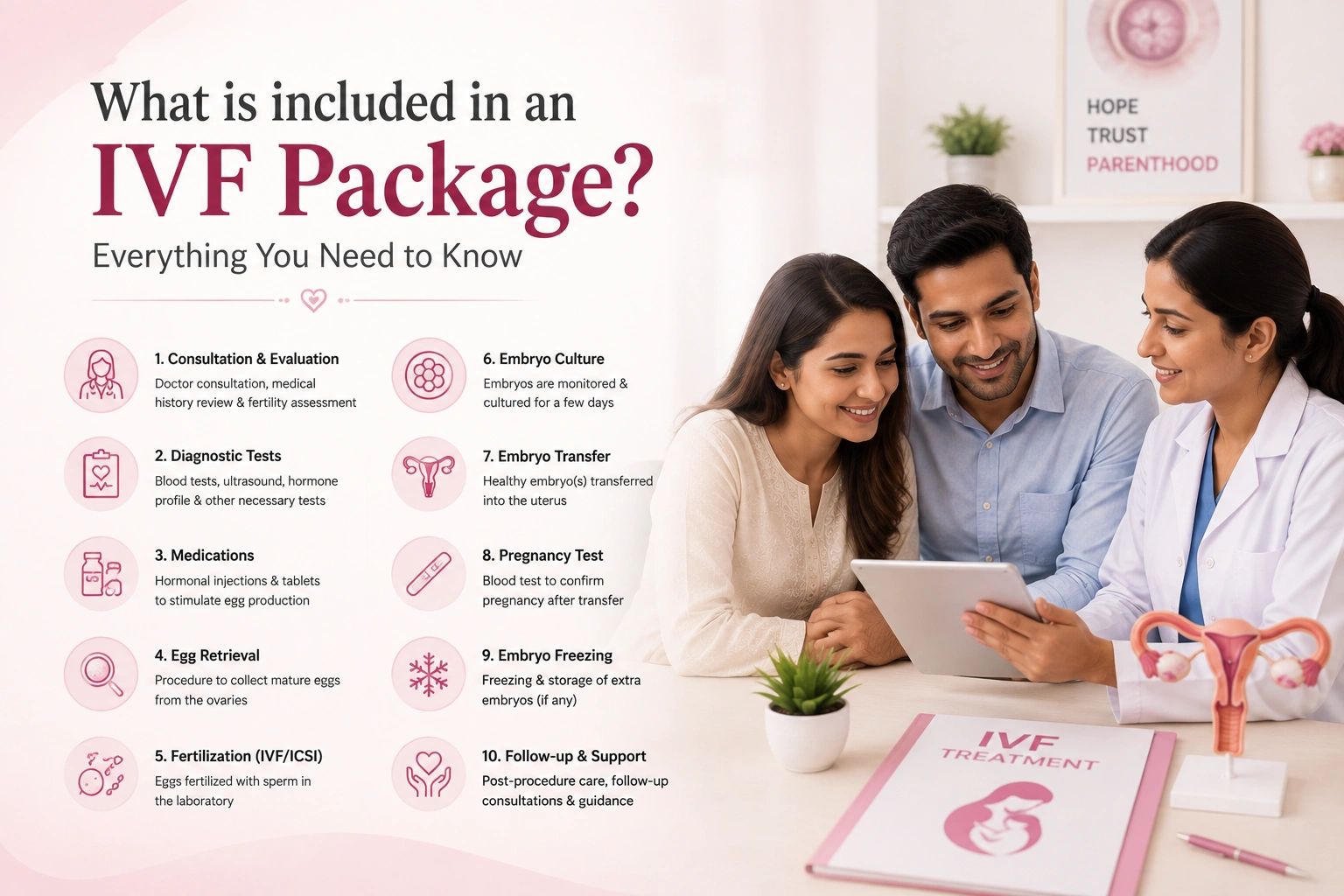
A basic package may include:
- Initial consultation
- Fertility assessment
- Ovarian stimulation monitoring
- Egg retrieval
- Laboratory fertilisation
- Embryo culture
- Embryo transfer
The important part is what happens outside that list.
Medicines are often a significant variable. So are ICSI, additional scans, freezing and genetic testing.
Before making any payment, ask the clinic for an itemised quotation. It should clearly state what is included and what will be charged separately.
Ask These Questions Before Accepting an IVF Package
Are medicines included? This matters because stimulation drugs can make a noticeable difference to the final cost.
Is ICSI included? If ICSI is recommended, find out whether it is already part of the package or will be added later.
Does the package include embryo freezing? If extra embryos are suitable for freezing, there may be a separate vitrification and storage charge.
What happens if fresh transfer isn't performed? Some patients may have a frozen transfer later instead.
What happens if another cycle is required? Don't assume the next cycle will cost the same as the first.
A written quotation is much easier to compare than a price given over the phone.
What Are the Hidden Costs of IVF Treatment?
The word "hidden" can make these charges sound suspicious. Usually, that's not what they are. Most are simply expenses that don't apply to every patient.
Fertility investigations. Blood tests, ultrasound scans, ovarian reserve tests and semen analysis may be needed before treatment.
Medicines. Fertility medicines can represent a sizeable part of an IVF budget. The dose depends on how the patient responds to stimulation.
ICSI. ICSI is a laboratory fertilisation technique that may be recommended in certain cases, particularly where male-factor infertility is involved.
Embryo freezing. If suitable embryos remain after the initial transfer, the couple may choose to freeze them for future use.
Embryo storage. Frozen embryos need ongoing storage, which may have a separate annual fee.
Frozen embryo transfer. A frozen embryo transfer is a separate treatment cycle and should not automatically be assumed to be included in the original IVF package.
PGT or other genetic testing. Where clinically appropriate, genetic testing can add considerably to the total cost.
Repeat IVF cycles. Not every couple gets the result they want from one cycle. That doesn't mean another cycle will definitely be needed, but it's sensible to ask the clinic what another attempt would cost before starting.
The goal isn't to make IVF sound expensive. It's to help you compare quotations properly.
IVF Treatment in Bangladesh vs India
Once you know what drives the price in Bangladesh, the next question becomes more practical: would treatment in India make sense?
India isn't automatically better than Bangladesh. A good fertility centre in Dhaka can be a perfectly reasonable choice for many couples.
But India has a much larger medical tourism and fertility treatment market, giving international patients more centres and specialists to compare.
| Factor | Bangladesh | India |
|---|---|---|
| IVF cost | Generally around $1,200 to $4,000 in published estimates | Common international estimates around $2,500 to $5,000 |
| Fertility specialists | Available in major centres | Large choice across multiple cities |
| IVF laboratories | Varies by clinic | Varies by clinic |
| ICSI | Available at fertility centres offering the service | Widely available at established IVF centres |
| PGT and advanced testing | Depends on centre | Available at selected centres |
| International patient support | Depends on clinic | More common at major hospitals and fertility networks |
| Travel | Not required for local treatment | Flights, accommodation and local transport required |
| Follow-up | Easier locally | Needs advance planning after returning home |
| Language support | Easier for local patients | Bengali support may be available through selected international coordinators |
The comparison isn't about picking a country winner. It's about finding the right fertility centre for the couple.
Why Do Bangladeshi Patients Consider IVF Treatment in India?
This is where India can become particularly interesting for patients from Bangladesh. The decision isn't always driven by price.
More Fertility Centres to Compare
India has a large network of fertility clinics and hospitals across cities such as Delhi NCR, Mumbai, Chennai, Bengaluru, Hyderabad and Kolkata.
That gives patients more choice when comparing specialists, treatment protocols and laboratory facilities.
Access to Different Reproductive Treatment Options
Established fertility centres may offer treatments such as IVF, ICSI, embryo freezing, frozen embryo transfer and, where clinically appropriate, genetic testing.
Not every patient needs these procedures. Having access to them simply gives the specialist more options when building a treatment plan.
Specialist Opinions
Some couples travel because they want another fertility specialist to review previous reports or unsuccessful treatment.
A second opinion doesn't mean the previous doctor was wrong. Sometimes the couple simply wants another clinical perspective before spending money on another cycle.
Established Embryology Laboratories
IVF isn't only about the doctor. The embryology laboratory plays an important role in fertilisation, embryo culture, freezing and other laboratory procedures.
That makes laboratory standards and the embryology team important questions to ask when comparing fertility centres.
International Patient Coordination
Major Indian hospitals and fertility networks often have systems for overseas patients.
That can include appointment scheduling, medical documentation, airport transfers, accommodation and communication support.
Convenient Travel From Bangladesh
India is geographically close to Bangladesh.
For example, flights from Dhaka to Delhi are roughly a few hours, while Kolkata is even closer. That matters because IVF can require multiple appointments rather than one hospital visit.
Treatment Planning Before Travel
For an international patient, one of the biggest advantages is being able to start the discussion before buying a ticket.
Medical reports can be reviewed first. The patient can then ask about the proposed protocol, likely costs and expected stay. That makes the decision less of a gamble.
Why Choose India for IVF Instead of Staying in Bangladesh?
This needs a balanced answer.
India may be worth choosing when:
- You want to compare several fertility specialists
- You need a second opinion
- You are looking for a particular ART option
- You want access to a specific embryology laboratory
- Your previous IVF cycle did not give the expected result
- You need structured support as an international patient
- You want your treatment plan reviewed before travelling
- You are comfortable with the additional travel and accommodation costs
Bangladesh may make more sense when:
- Your local fertility centre can provide the treatment you need
- Travel would create unnecessary financial pressure
- You prefer local follow-up
- Your specialist has already recommended an appropriate treatment plan
That's the honest comparison. India should be considered because it may offer a better fit for your particular treatment needs, not because every Bangladeshi patient should automatically travel there.
IVF Cost in India for Bangladeshi Patients
For Bangladeshi patients, current published estimates put a basic IVF cycle in India at around $2,500 to $3,500.
When ICSI is included, published estimates commonly rise to around $3,000 to $4,200. Other international-patient sources use a wider range of approximately $2,500 to $5,000, depending on the centre and treatment plan.
A separate Indian source currently reports a broader domestic IVF range of approximately ₹1.4 lakh to ₹4.5 lakh per fresh cycle, showing how much pricing can vary by city, clinic tier and package structure.
Indicative IVF Cost in India
| IVF treatment / expense | Approximate cost |
|---|---|
| Basic IVF cycle | $2,500 to $3,500 |
| IVF with ICSI | $3,000 to $4,200 |
| Broader international IVF range | $2,500 to $5,000 |
| Embryo freezing | Additional |
| Embryo storage | Additional |
| Frozen embryo transfer | Additional |
| PGT / genetic testing | Additional |
| Donor treatment | Clinic-specific |
These figures are indicative, not HealthRoop package prices. The fertility centre should confirm the actual amount after reviewing the patient's reports.
What Should a Bangladeshi Couple Budget in Total?
Don't stop at the hospital quotation.
Your overall India budget may include:
Medical treatment: IVF cycle, medicines, ICSI if required, embryo freezing, storage, additional tests, FET if required.
Travel: Flights, visa-related expenses, airport transfers, local transportation.
Stay: Hotel or serviced apartment, food, companion expenses, extra nights if the treatment schedule changes.
So a couple with a $3,000 IVF quotation should not assume the complete trip will cost $3,000.
The actual budget is: treatment + medicines + travel + accommodation + possible add-ons. That's the number worth planning around.
What Does an IVF Treatment Plan in India Usually Include?
The exact plan depends on the patient's diagnosis and medical history. Generally, the process involves several stages.
Initial medical review. The fertility specialist reviews previous reports, medical history and earlier treatment.
Fertility investigations. Additional tests may be requested if existing reports are old or incomplete.
Ovarian stimulation. Medication is used to stimulate the ovaries so multiple follicles can develop.
Monitoring. Ultrasound scans and, when required, blood tests are used to monitor the response.
Egg retrieval. Once the follicles are ready, eggs are collected through a medical procedure.
Fertilisation. Eggs and sperm are combined in the laboratory. ICSI may be used when indicated.
Embryo culture. Embryos are monitored in the embryology laboratory.
Embryo transfer. An embryo may be transferred to the uterus, or suitable embryos may be frozen for later transfer.
Pregnancy testing. The clinic advises when the pregnancy test should be performed.
Follow-up. Follow-up may happen in India or remotely after the patient returns to Bangladesh, depending on the treatment plan.
There is no universal IVF protocol. Age, ovarian reserve, infertility diagnosis, sperm factors, previous IVF history and other clinical findings can all influence the plan.
How Long Does IVF Treatment in India Take for Bangladeshi Patients?
Don't book your return flight around an exact number of days before speaking with the fertility centre.
A fresh IVF cycle may require several weeks of appointments and monitoring. Some international-patient sources estimate roughly 15 to 20 days for a standard cycle, while other cases can require longer depending on the protocol.
The timeline can change if:
- More monitoring is required
- The ovaries respond differently than expected
- Additional tests are needed
- A fresh transfer is changed to a frozen transfer
- The doctor recommends freezing embryos and returning later
Some couples complete treatment during one visit. Others return to Bangladesh and come back later for a frozen embryo transfer.
Your fertility specialist should map out the expected timeline before you finalise travel.
How Can a Patient From Bangladesh Start IVF Treatment in India?
You don't have to begin by booking a flight. Start with the medical records.
Step 1: Collect Your Existing Reports. Gather ultrasound reports, AMH results where available, semen analysis, previous IVF records and current medication details.
Step 2: Send the Reports for Review. The selected fertility centre or international patient coordinator can arrange specialist review.
Step 3: Discuss the Treatment Plan. Ask what the specialist recommends and why.
Step 4: Request a Written Quotation. Make sure the quotation identifies the base IVF cost and possible add-ons.
Step 5: Confirm the Fertility Centre. Compare the doctor, laboratory, package and follow-up plan before paying.
Step 6: Arrange Travel Documents. India's visa requirements can change. Bangladeshi patients should check the latest information with official Indian authorities or the relevant visa application centre before travelling. The official Indian e-Visa site currently lists Bangladesh among eligible nationalities for e-Visa categories, but eligibility and category requirements should always be checked for the specific medical trip.
Step 7: Arrange Accommodation and Transport. Choose accommodation based on the clinic location and expected appointment schedule.
Step 8: Travel to India. Once the medical and practical arrangements are confirmed, travel can be planned around the treatment window.
Step 9: Complete Follow-Up. Before returning to Bangladesh, confirm how the fertility specialist will handle future consultations and reports.
What Documents Should Bangladeshi Patients Prepare?
You don't need a huge file of paperwork. Start with whatever fertility records you already have:
- Previous fertility investigations
- Ultrasound reports
- AMH or ovarian reserve reports
- Semen analysis
- Previous IVF or ICSI records
- Medication history
- Previous surgery records
- Relevant discharge summaries
If a report is several years old, don't assume it is still sufficient. The fertility clinic will tell you which tests need to be repeated.
What Should Bangladeshi Patients Ask Before Choosing an IVF Clinic in India?
Price should be on the list, but it shouldn't be the first and last question.
Ask:
- Who will be my treating fertility specialist?
- How does the clinic handle international patients?
- What exactly is included in the IVF package?
- Are medicines included?
- Is ICSI included?
- What are the embryo freezing charges?
- How much does storage cost?
- What is the FET cost?
- What genetic testing is available if medically indicated?
- What laboratory handles embryo culture?
- What happens if the cycle needs to be changed?
- What happens if another cycle is needed?
- How will follow-up work after returning to Bangladesh?
- Who will coordinate travel and hospital appointments?
- Can I receive the quotation in writing before travelling?
A clinic that gives clear answers is easier to budget and easier to compare.
Is IVF Treatment in India Worth Considering?
For some Bangladeshi patients, yes. For others, treatment at a suitable clinic in Bangladesh may be the simpler option.
India becomes worth considering when the benefits of broader specialist choice, available treatment options, laboratory facilities and international patient coordination outweigh the extra cost and inconvenience of travelling.
The decision should be based on: medical suitability + clinic quality + total cost + travel + follow-up. Not on a country slogan.
And no fertility centre should promise a pregnancy simply because you travel to India. IVF outcomes vary between individuals, and your fertility specialist should explain the factors relevant to your case.
How HealthRoop Supports Bangladeshi Patients Seeking IVF in India
Travelling for IVF involves a lot of small decisions.
Which fertility centre? Which specialist? What reports should be sent? How much will the treatment cost? How long should you stay? Where will you stay? What happens after you return home?
HealthRoop can help coordinate these practical steps for patients coming from Bangladesh to India.
Medical review and specialist coordination. Patients can share their available fertility reports for review. HealthRoop can coordinate consultations with appropriate fertility specialists and help organise communication between the patient and selected healthcare provider.
Choosing a suitable centre. The right clinic depends on the patient's medical requirements. HealthRoop can assist with hospital and fertility-centre selection rather than treating one clinic as the answer for every patient.
Understanding the cost before travelling. A preliminary estimate can help patients understand the likely treatment budget before making travel arrangements. HealthRoop can coordinate cost information and help present the expected expenses clearly, including the difference between the medical package and additional services.
Second medical opinion. If a couple has already undergone IVF or has received a treatment recommendation in Bangladesh, a second specialist opinion can be arranged where appropriate. Sometimes that's exactly what a patient needs before deciding whether to travel.
Visa and documentation assistance. International treatment involves documentation. HealthRoop can assist with medical visa-related coordination and other treatment documentation where applicable. Patients should still verify current visa rules with the relevant Indian authorities.
Travel and accommodation. Once the treatment schedule is known, HealthRoop can help coordinate practical arrangements such as:
- Flight planning
- Accommodation
- Airport pickup
- Local transportation
- Interpreter support where needed
This can be particularly useful for couples visiting an Indian city for the first time.
Support during treatment. The medical team remains responsible for clinical decisions. HealthRoop's role is to help with coordination, communication and practical arrangements around the treatment. Having one point of contact can make things considerably easier when several appointments are involved.
Follow-up after returning to Bangladesh. Treatment doesn't necessarily end when the patient boards the flight home. Where follow-up coordination is available, HealthRoop can help with communication between the patient and treating team, including telemedicine follow-up and medical records.
If you're considering IVF treatment in India, share your medical reports with HealthRoop to discuss your treatment options, specialist consultation and estimated costs before making travel arrangements.
Final Word
Searching for IVF cost in Bangladesh is only the first step.
The number on a clinic's package isn't necessarily what you'll finally pay. Medicines, ICSI, embryo freezing, storage, genetic testing and additional cycles can change the total considerably.
For a Bangladeshi couple considering India, the calculation is slightly different. You need to look at the medical package, then add flights, accommodation, local transport and other travel expenses.
India can make sense when you want to compare more fertility specialists, access particular treatment options, seek another medical opinion or have a more structured international-patient arrangement.
But don't choose India just because someone says it's cheaper or better.
Choose the clinic that makes sense for your medical situation, budget and follow-up needs.
If you are considering IVF treatment in India, HealthRoop can help coordinate medical report review, fertility specialist consultation, treatment planning, cost information, travel arrangements and follow-up support for international patients.
Share your medical reports with HealthRoop to discuss IVF treatment options in India and get a clearer estimate before you make travel plans.
This article is for general information and isn't a substitute for personal medical advice. Prices referenced are indicative published estimates and can change. Anyone considering IVF treatment should confirm current costs, protocols and visa requirements directly with the treating clinic and official authorities.
Frequently Asked Questions
Answers on IVF cost, packages and treatment in Bangladesh and India.
Published 2026 estimates generally place one IVF cycle around $1,200 to $4,000, although the actual amount depends on the clinic, medicines and procedures included.
A standard IVF cycle may fall around $1,300 to $3,600 in published estimates. Additional medicines, ICSI, freezing and genetic testing can increase the final cost.
Dhaka clinics have different pricing structures. Published Bangladesh estimates broadly place IVF within the national range, but you should request a clinic-specific quotation rather than relying on a city-wide average.
A basic package may include consultation, monitoring, egg retrieval, laboratory fertilisation, embryo culture and embryo transfer. Medicines and add-on procedures may be separate.
Medicines, fertility tests, additional scans, ICSI, embryo freezing, storage, FET, genetic testing and repeat cycles can all increase the final amount.
There isn't one answer. A basic cycle in Bangladesh may cost less, while some Indian clinics have competitive package prices. Once you add travel and accommodation, the complete cost needs to be compared rather than just the medical package.
Current published estimates commonly place basic IVF around $2,500 to $3,500, with IVF and ICSI around $3,000 to $4,200. Some international-patient sources use a broader $2,500 to $5,000 range.
Common reasons include a wider choice of fertility centres, specialist opinions, available ART options, established embryology laboratories at selected centres, international patient coordination and relatively convenient travel from Bangladesh.
Not automatically. The quality of care varies by clinic in both countries. India may be a better fit for some patients because of specialist choice, treatment options or international coordination, but the individual fertility centre matters more than the country name.
Yes, subject to current Indian visa and entry requirements. Patients should verify the latest medical travel requirements with official Indian authorities before booking their trip.
It generally starts with medical records and specialist review, followed by treatment planning, cost estimation, travel arrangements, the IVF cycle and a follow-up plan after treatment.
The timeline varies by protocol. Some published international-patient plans estimate around 15 to 20 days for a standard cycle, but the actual stay can be longer or shorter depending on monitoring and whether fresh or frozen transfer is planned.
Yes. Sharing your medical reports before travelling can allow the fertility team to review the case and provide preliminary treatment and cost information. The final quotation comes after clinical assessment.
Previous fertility reports, ultrasound scans, AMH or ovarian reserve results where available, semen analysis, previous IVF records and medication history are useful starting documents.
Compare the actual fertility centres, specialists, treatment options, total cost and follow-up arrangements. India may be worth considering if you need broader specialist choice or international treatment support, but local treatment may remain the better option for some couples.
