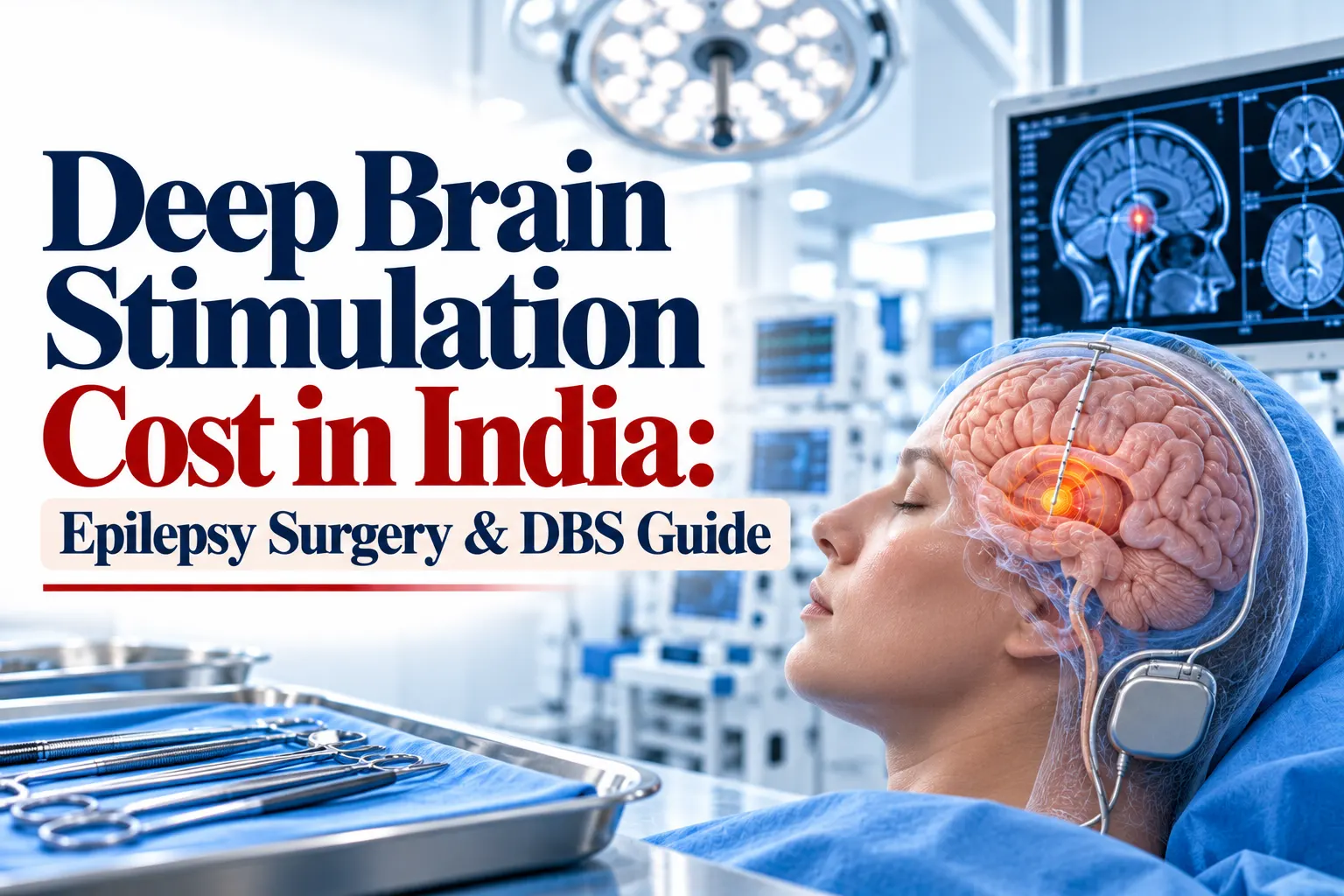
Epilepsy Surgery and Deep Brain Stimulation in India: Cost, Procedures, Hospitals & Recovery
Epilepsy and movement disorders can become difficult to manage when medicines no longer provide adequate control. Epilepsy surgery in India may be considered for selected patients with drug-resistant epilepsy, while deep brain stimulation is mainly used for Parkinson's disease, essential tremor and certain other movement disorders. DBS may also have a role in selected patients with difficult-to-control epilepsy.
These are not interchangeable treatments. Epilepsy surgery may involve removing or disconnecting the brain tissue responsible for seizures, while DBS uses electrical stimulation to influence activity in specific areas of the brain.
For patients considering treatment in India, the process usually begins with detailed neurological testing rather than immediately scheduling surgery. The medical team needs to understand the exact diagnosis, previous treatment history, brain anatomy and likely benefits and risks before recommending a procedure.
India has specialised neurology and neurosurgery centres that treat both Indian and international patients. The final treatment plan and cost depend on the patient's condition, procedure, hospital, device requirements and follow-up needs.
What Is Epilepsy Surgery?
Epilepsy surgery refers to a group of procedures used to reduce or stop seizures in carefully selected patients.
Surgery is generally considered when seizures continue despite appropriate anti-seizure medicines. When a patient continues to have seizures despite trials of two suitable and appropriately selected medications, specialists may classify the epilepsy as drug-resistant.
The purpose of epilepsy surgery is not simply to operate on the brain. The first objective is to identify where the seizures begin and determine whether that area can be safely treated.
Depending on the diagnosis, treatment may involve:
- Removing the seizure-producing area
- Removing a structural lesion
- Disconnecting pathways through which seizures spread
- Laser-based ablation in selected cases
- Neurostimulation when resection is unsuitable
The choice depends entirely on the individual patient's seizure pattern and brain anatomy.
When Should a Patient Consider Epilepsy Surgery?
Not everyone with epilepsy needs surgery.
A surgical evaluation may be appropriate when:
- Seizures continue despite suitable medications
- Seizures interfere with work, education or daily activities
- Seizures create a significant risk of injury
- A structural brain abnormality is present
- Seizures appear to originate from a specific brain region
- Medication side effects are difficult to tolerate
- The patient has frequent or disabling seizures
A referral for surgical evaluation does not mean that an operation will definitely be recommended.
The evaluation helps determine whether surgery, neurostimulation or continued medical treatment is the safest option.
How Is Epilepsy Surgery Evaluated?
A detailed pre-surgical evaluation is one of the most important parts of epilepsy treatment.
MRI Brain
An epilepsy-specific MRI can identify abnormalities such as scar tissue, malformations, tumours or other structural changes that may be related to seizures.
Video EEG
Video EEG records electrical activity in the brain while the patient's physical behaviour is recorded. Doctors can compare the EEG pattern with what happens during an actual seizure.
PET or SPECT
Functional imaging may be used when routine MRI and EEG do not provide enough information.
Neuropsychological Testing
Memory, concentration, language and other cognitive functions may be assessed before surgery.
Functional Brain Mapping
If the suspected seizure-producing region is close to areas responsible for speech, movement, memory or vision, additional testing may be required.
The medical team combines information from different tests before deciding whether surgery is appropriate.
Common Types of Epilepsy Surgery
The procedure depends on where seizures originate and whether the affected area can be safely treated.
Focal Resection
The surgeon removes the brain tissue identified as the source of seizures.
Temporal Lobe Surgery
This may be considered when seizures originate in the temporal lobe and the patient meets the required criteria.
Lesionectomy
A structural abnormality responsible for seizures may be removed when it can be safely accessed.
Corpus Callosotomy
This procedure interrupts connections between the two sides of the brain and may be considered for selected patients with severe seizure disorders.
Laser Ablation
Laser interstitial thermal therapy uses heat to destroy targeted abnormal tissue through a minimally invasive approach in suitable cases.
Neurostimulation
When removing the seizure-producing tissue is not considered safe or practical, a stimulation-based treatment may be discussed.
What Is Deep Brain Stimulation?
Deep brain stimulation, commonly called DBS, is a neurosurgical treatment in which thin electrodes are placed in specific areas of the brain.
The electrodes are connected to a programmable pulse generator. The generator sends controlled electrical impulses to the targeted brain region.
DBS is mainly used for movement disorders, particularly:
- Parkinson's disease
- Essential tremor
- Dystonia
It can also be considered in selected cases of epilepsy, depending on the patient's age, seizure type, treatment history and clinical circumstances.
DBS does not remove brain tissue. Instead, it changes electrical activity within a targeted neural circuit.
How Does DBS Help Parkinson's Disease?
DBS is an established option for selected patients with Parkinson's disease whose symptoms are no longer adequately controlled with medication or who experience significant motor fluctuations.
It may help with:
- Tremor
- Muscle stiffness
- Slowness of movement
- Motor fluctuations
- Certain forms of dyskinesia
DBS does not cure Parkinson's disease and does not stop its underlying progression.
For someone researching Parkinson's treatment India, DBS should therefore be viewed as one part of a broader treatment plan. Medication, physiotherapy, occupational therapy, speech therapy and regular neurological follow-up may continue after implantation.
The decision to proceed with DBS depends on the patient's symptoms, response to medication, cognitive status, general health and suitability for surgery.
Can DBS Be Used for Epilepsy?
Yes, but the situation is different from traditional epilepsy surgery.
In resective epilepsy surgery, the surgeon attempts to remove or disconnect the tissue responsible for seizures when this can be done safely.
DBS does not normally remove the seizure-producing area. Instead, electrical stimulation is delivered to a specific brain structure to help reduce seizure activity.
It may be considered for selected patients with drug-resistant epilepsy when other treatment options are not suitable or have not provided sufficient control.
The patient's seizure type, age, previous treatment and applicable device indications all matter.
This is why a patient should not assume that DBS is the next step simply because several epilepsy medicines have failed.
Deep Brain Stimulation Cost in India
The deep brain stimulation cost in India varies substantially depending on the condition being treated, hospital, surgeon, DBS device, number of electrodes and programming requirements.
The device itself can account for a significant portion of the overall bill.
Published Indian estimates commonly place DBS treatment in a broad range of around ₹8 lakh to ₹20 lakh or more. Some hospitals may quote less, while advanced systems or more complex bilateral procedures can cost considerably more.
Approximate Deep Brain Stimulation Cost in India
| Treatment / Cost Component | Approximate Cost in INR | Approximate Cost in USD |
|---|---|---|
| DBS surgery – standard cases | ₹8,00,000 – ₹15,00,000 | $8,890 – $16,670 |
| Advanced DBS treatment | ₹15,00,000 – ₹20,00,000+ | $16,670 – $22,220+ |
| Bilateral DBS | ₹12,00,000 – ₹25,00,000+ | $13,335 – $27,780+ |
| Pre-surgical evaluation | ₹30,000 – ₹1,00,000+ | $335 – $1,110+ |
| Programming and follow-up | ₹20,000 – ₹75,000+ | $220 – $835+ |
Resource: These are indicative ranges based on previously published Indian healthcare cost data. Actual charges depend on the hospital, surgeon, device, treatment plan, diagnostic requirements and follow-up.
USD calculation: The dollar amounts are approximate, using ₹90 = US$1. Exchange rates can change the final amount payable by international patients.
What Is Included in the Cost?
A hospital package may include some or all of the following:
- Neurosurgeon fees
- Neurologist consultation
- Preoperative assessment
- MRI or CT
- Anaesthesia
- Operating theatre
- Electrodes
- Pulse generator
- Hospital stay
- Medicines
- Initial programming
- Postoperative consultation
Not every hospital includes the same services.
Before confirming surgery, request an itemised quotation.
What Factors Affect DBS Cost?
Several factors can change the final treatment price.
Type of Device
DBS systems differ in features and battery design. Rechargeable systems may have a higher initial cost but can have different long-term financial implications.
One-Sided or Bilateral Treatment
Implanting electrodes on both sides generally increases the cost of the device and surgery.
Hospital and City
Charges for hospital facilities, room categories, specialist consultations and operating theatre services differ between centres.
Diagnostic Testing
Patients may need neurological assessments, imaging, neuropsychological testing and other investigations before surgery.
Programming and Follow-Up
DBS requires programming after implantation. Several adjustments may be necessary to find settings that provide the best balance between symptom control and side effects.
Future Battery Replacement
Patients should also ask about the expected battery life and future replacement costs.
This is particularly important when comparing rechargeable and non-rechargeable systems.
Epilepsy Surgery Cost in India
The cost of epilepsy surgery in India depends heavily on the procedure.
A relatively straightforward resection may cost less than complex surgery that requires prolonged video EEG monitoring, advanced imaging, functional mapping or specialised equipment.
Published Indian estimates place many epilepsy surgery procedures in a broad range of approximately ₹1.5 lakh to ₹15 lakh or more, depending on complexity.
Approximate Epilepsy Surgery Costs
| Procedure | Approximate Cost in INR | Approximate Cost in USD |
|---|---|---|
| Basic resective surgery | ₹1,50,000 – ₹3,50,000 | $1,670 – $3,890 |
| Temporal lobe surgery | ₹3,00,000 – ₹7,00,000 | $3,335 – $7,780 |
| Lesionectomy | ₹3,00,000 – ₹7,00,000 | $3,335 – $7,780 |
| Extratemporal resection | ₹3,00,000 – ₹8,00,000 | $3,335 – $8,890 |
| Corpus callosotomy | ₹3,00,000 – ₹6,00,000 | $3,335 – $6,670 |
| Laser ablation | ₹3,50,000 – ₹10,00,000 | $3,890 – $11,110 |
| Vagus nerve stimulation | ₹4,00,000 – ₹10,50,000+ | $4,445 – $11,670+ |
Resource: These are approximate figures compiled from previously published Indian healthcare cost information. The actual treatment price depends on the patient's diagnosis, investigations, surgical technique, hospital and device requirements.
Epilepsy Surgery vs DBS: What Is the Difference?
| Factor | Epilepsy Surgery | Deep Brain Stimulation |
|---|---|---|
| Main purpose | Reduce or stop seizures | Control neurological symptoms or selected seizures |
| Common use | Drug-resistant epilepsy | Parkinson's, tremor, dystonia and selected epilepsy |
| Brain tissue removed | Sometimes | Usually no |
| Implant required | Not always | Yes |
| Programming | Usually not required after resection | Required |
| Battery | Not required for resection | Required |
| Treatment approach | Removal or disconnection | Electrical stimulation |
| Follow-up | Neurological monitoring | Programming plus neurological follow-up |
The right procedure depends on the disease rather than the cost or popularity of a treatment.
How to Choose the Best DBS Surgeon in India
When searching for the best dbs surgeon india, do not rely only on online ratings.
DBS is a specialised functional neurosurgical procedure, so the experience of the treating team matters.
Before choosing a surgeon, ask about:
- Functional neurosurgery experience
- DBS procedure volume
- Experience treating Parkinson's disease
- Experience with essential tremor
- Experience with epilepsy-related stimulation
- Neurology and neurosurgery collaboration
- DBS programming facilities
- Neurophysiology support
- Rehabilitation services
- Long-term follow-up
It is also useful to ask how the doctor selects the stimulation target and what outcomes are realistically expected in your particular condition.
How Is DBS Surgery Performed?
DBS treatment generally involves several stages.
Step 1: Detailed Assessment
The neurologist and neurosurgeon evaluate the diagnosis, symptoms, medication response and overall health.
Step 2: Brain Imaging
MRI or other imaging is used to plan the position of the electrodes.
Step 3: Electrode Placement
Thin electrodes are inserted into predetermined areas of the brain using specialised stereotactic techniques.
Step 4: Pulse Generator Placement
The neurostimulator is positioned beneath the skin and connected to the electrodes.
Step 5: Programming
After recovery, the device is activated and programmed.
The settings may be adjusted several times as the medical team assesses symptom control and side effects.
Recovery After DBS Surgery
Recovery differs from one patient to another.
Some patients experience temporary:
- Headache
- Incision discomfort
- Fatigue
- Swelling
- Mild soreness
The doctor will provide instructions about wound care, medication, physical activity and follow-up.
The initial hospital stay is only one part of recovery. Device programming and neurological reviews remain important after discharge.
Patients travelling from overseas should allow sufficient time for postoperative assessment before returning home.
Recovery After Epilepsy Surgery
Recovery depends on the procedure performed.
A minimally invasive treatment may have a different recovery period from a larger brain operation.
Follow-up can include:
- Neurological examination
- EEG
- Brain imaging
- Medication review
- Seizure monitoring
- Cognitive assessment
- Rehabilitation
Patients should never stop or reduce anti-seizure medicines without their neurologist's advice, even when seizures improve after surgery.
Hospitals for Epilepsy Surgery and DBS in India
The Healthroop hospital directory includes major Indian hospital groups with neuroscience, neurology or neurosurgical services.
Apollo Hospitals
Apollo Hospitals has a large multi-specialty network with neuroscience services and international patient support.
Fortis Healthcare
Fortis operates several multi-specialty hospitals and has neuroscience departments at selected centres.
Medanta – The Medicity
Medanta in Gurugram has a dedicated neurosciences programme and advanced neurosurgical facilities.
Narayana Health
Narayana Health operates a broad hospital network and provides neurosurgical and neurological services at selected centres.
Manipal Hospitals
Manipal Hospitals has neuroscience departments across its network and treats a wide range of neurological conditions.
Max Healthcare
Max Healthcare operates several hospitals in North India with neuroscience and neurosurgical services.
P.D. Hinduja National Hospital
P.D. Hinduja National Hospital in Mumbai is also included in the hospital network and provides neurology and related specialist services.
Important: The availability of DBS or complex epilepsy surgery can differ between branches. Patients should confirm that the selected hospital currently has the required procedure, specialist team and postoperative programming or rehabilitation services.
Epilepsy and DBS Treatment for International Patients
International patients considering neurological treatment in India should share their medical records before travelling.
Useful documents include:
- Previous neurological reports
- MRI or CT scans
- EEG reports
- Medication history
- List of previous anti-seizure medicines
- Seizure diary, where available
- Parkinson's treatment history
- Previous surgical reports
- Blood test results
- Current medication list
A specialist can review these records and determine which tests may need to be repeated.
What Should International Patients Ask About the Cost?
Request a written estimate that clearly identifies:
- Consultation
- Diagnostic tests
- Surgery
- Device
- Hospitalisation
- Anaesthesia
- Medicines
- Programming
- Follow-up
- Rehabilitation
Travel, accommodation and other personal expenses should also be budgeted separately.
How Healthroop Supports International Patients
Healthroop assists international patients with the practical side of arranging medical treatment in India while the treating hospital remains responsible for clinical decisions.
Support may include:
- Medical report coordination
- Hospital selection assistance
- Specialist appointment scheduling
- Treatment estimate coordination
- Hospital admission assistance
- Medical visa-related support
- Airport transfers
- Accommodation arrangements
- Local transportation
- Interpreter assistance
- Follow-up coordination
Patients should send their medical records in advance whenever possible so that the appropriate specialist and hospital can be identified before travel.
Price Disclaimer
The prices mentioned in this article are indicative and have been taken from previously available healthcare cost data, including data from the previous year. Treatment costs can change depending on the hospital, city, surgeon, procedure, device, diagnostic tests, hospital stay and individual medical requirements. For the latest and exact information, patients should call or email the hospital or medical coordination team and request a case-specific quotation before making travel or treatment arrangements.
Medical Disclaimer: This article is intended for general educational purposes only. It does not replace consultation, diagnosis or treatment from a qualified neurologist or neurosurgeon. The suitability of epilepsy surgery, DBS or any other treatment must be determined after a complete medical evaluation.
Frequently Asked Questions
Answers on DBS cost, epilepsy surgery, and planning care in India.
The deep brain stimulation cost in India can vary considerably depending on the DBS device, hospital, surgeon, number of electrodes and programming requirements. A broad private-sector estimate is around ₹8 lakh to ₹20 lakh or more. Bilateral treatment and advanced device systems may increase the total expense.
Epilepsy surgery may be considered for patients whose seizures remain uncontrolled despite appropriate medication trials, particularly when testing identifies a seizure focus that can potentially be treated safely. A specialist epilepsy centre must complete a detailed evaluation before recommending surgery.
DBS can be used for selected patients with drug-resistant epilepsy, but it is different from resective epilepsy surgery. Instead of removing the seizure-producing brain tissue, DBS uses electrical stimulation of a targeted brain structure to help reduce seizure activity.
No. DBS does not cure Parkinson's disease or stop its underlying progression. It can improve selected symptoms such as tremor, stiffness and movement difficulties in suitable patients. Medication and other forms of neurological care often continue after implantation.
When looking for the best dbs surgeon india, consider experience in functional neurosurgery, DBS procedure volume, expertise with the specific condition, multidisciplinary neurological support and long-term programming facilities. Ask the surgeon about expected benefits, risks, device selection and follow-up before making a decision.
The cost of epilepsy surgery in India varies by procedure and complexity. Published estimates commonly range from approximately ₹1.5 lakh for some basic procedures to ₹15 lakh or more for advanced or complex treatment. Diagnostic testing, hospitalisation and specialised equipment can increase the final bill.
Recovery varies by patient and procedure. Initial healing takes place during the weeks after surgery, while DBS programming may continue for several months as settings are adjusted. Patients should follow their surgeon's instructions regarding activity, wound care, medication and follow-up appointments.
Yes. International patients can seek evaluation and treatment in India. They should send previous MRI, EEG, neurological reports, medication history and other relevant records before travelling. The treating team can then advise which additional tests and consultations are required.
Yes. DBS requires ongoing medical supervision because stimulation settings may need adjustment as symptoms change. Patients also need monitoring of the implanted system and battery. The frequency of follow-up depends on the condition, device, symptoms and response to stimulation.
Not automatically. Some patients may eventually reduce medication after successful epilepsy surgery, but this decision must be made by the treating neurologist. Stopping anti-seizure medication without medical supervision can increase the risk of recurrent seizures and should be avoided.
