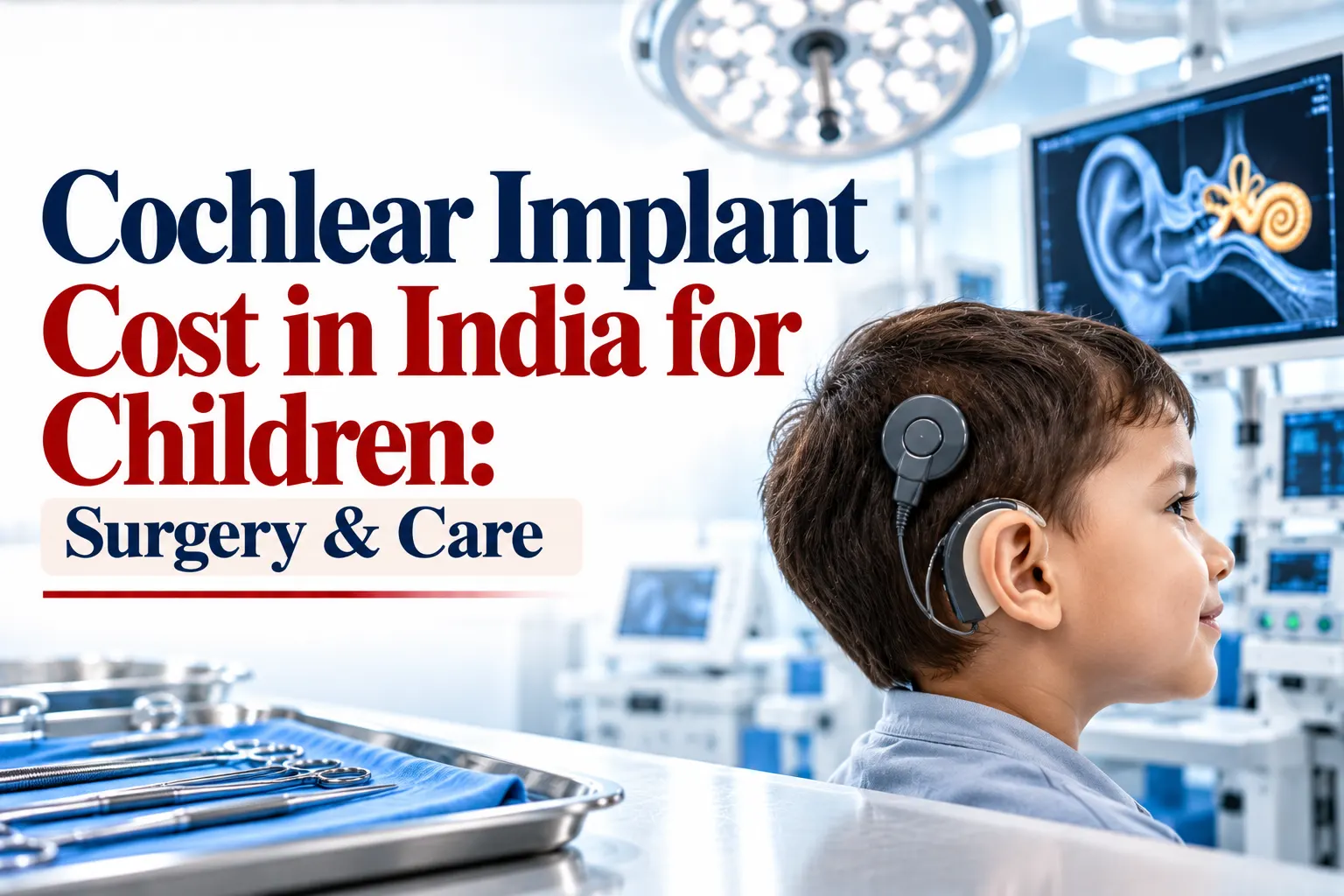
Cochlear Implant Surgery in India for Children: Cost, Procedure, Hospitals and Recovery
Cochlear implant surgery can be considered for children with severe to profound hearing loss who do not receive enough benefit from properly fitted hearing aids. For families looking at ENT surgery in India, cochlear implantation involves much more than the operation itself. The process normally includes hearing tests, medical assessment, imaging, implant selection, surgery, device activation, programming and long-term auditory rehabilitation.
For a child, the timing of treatment is an important part of the discussion. Early identification of significant hearing loss and timely intervention can give a child more opportunity to develop listening, speech and language skills. However, there is no single age at which every child should receive an implant. The decision depends on the type and severity of hearing loss, hearing-aid benefit, medical findings, developmental progress and the recommendations of the implant team.
India has specialised ENT centres and multidisciplinary teams that provide cochlear implant evaluation and treatment. Families travelling from another country can also seek assessment and surgery in India, provided the child meets the medical criteria.
What Is a Cochlear Implant?
A cochlear implant is an electronic hearing device used for selected people with significant sensorineural hearing loss.
A conventional hearing aid mainly makes sounds louder. A cochlear implant works differently. It converts sound into electrical signals and sends those signals to the auditory nerve through an electrode placed inside the cochlea.
The system has two main parts.
External Part
The external component usually contains:
- Microphone
- Sound processor
- Transmitter
- Battery or rechargeable power source
The microphone picks up sounds around the child. The processor analyses those sounds and sends coded information to the implanted component.
Internal Part
The internal component is placed under the skin during surgery. An electrode array is inserted into the cochlea.
The implant does not produce normal natural hearing. Instead, it gives the auditory system access to sound through electrical stimulation. The child then needs time and training to understand what those sounds mean.
That is why rehabilitation is such an important part of pediatric cochlear implant care.
Which Children May Be Considered for a Cochlear Implant?
A cochlear implant is not suitable for every child with hearing loss.
A child may be evaluated for implantation when severe or profound sensorineural hearing loss is present and hearing aids are not providing enough access to speech and environmental sounds.
Doctors may consider:
- Degree of hearing loss
- Type of hearing loss
- Hearing in one or both ears
- Response to appropriately fitted hearing aids
- Age at diagnosis
- Speech and language development
- Auditory development
- Medical history
- Inner-ear anatomy
- Auditory nerve condition
- Family's ability to participate in rehabilitation
The final decision should come from a multidisciplinary cochlear implant team.
Why Does Early Intervention Matter for Children?
Hearing plays an important role in early communication and language development. A child who has limited access to sound may have difficulty developing speech and listening skills without appropriate intervention.
Early evaluation gives doctors and parents more time to consider the available options.
That does not mean every child needs immediate cochlear implantation. Some children may benefit from hearing aids, while others may require additional testing before a decision can be made.
The important point is to avoid unnecessary delays in assessment.
Parents should seek specialist advice if they notice:
- Little or no response to sound
- Delayed speech development
- Difficulty understanding spoken instructions
- Poor response despite using hearing aids
- Lack of progress in auditory skills
- Significant hearing loss identified during screening
Cochlear Implant Evaluation for Children
Before surgery, the child usually undergoes several assessments. These tests help the medical team determine whether implantation is appropriate and whether there are any factors that could affect the procedure.
Hearing Assessment
An audiologist may perform different tests depending on the child's age and ability to respond.
These can include:
- Auditory brainstem response testing
- Otoacoustic emissions
- ASSR
- Pure-tone audiometry when appropriate
- Aided hearing tests
- Tympanometry
The purpose is to understand the child's hearing level and how much benefit is being obtained from hearing aids.
Imaging
Imaging allows the surgeon to examine the inner-ear structures.
CT or MRI may be recommended to assess:
- Cochlear anatomy
- Inner-ear development
- Auditory nerve
- Middle-ear structures
- Possible anatomical variations
Imaging findings can influence surgical planning.
ENT Assessment
A pediatric ENT specialist examines the child and reviews previous medical and hearing records.
The doctor also considers whether there are other ear conditions that need treatment before implantation.
Speech and Language Assessment
If the child has developed some speech or language, the team may assess current communication skills.
This information can help establish realistic rehabilitation goals.
Family Counselling
Parents need to understand that cochlear implantation is a long-term process.
The surgery places the device, but the child's progress depends on several factors, including device programming, listening practice, therapy and family involvement.
How Is Cochlear Implant Surgery Performed?
Cochlear implant surgery is performed under general anaesthesia.
The surgeon makes an incision behind the ear and creates a suitable position for the internal receiver. The electrode array is then carefully placed into the cochlea.
The basic surgical process involves:
- General anaesthesia is administered.
- The area behind the ear is prepared.
- A small incision is made.
- The internal receiver is positioned under the skin.
- The electrode array is inserted into the cochlea.
- The device is checked according to the surgical team's protocol.
- The incision is closed.
- The child is monitored during recovery.
The exact technique can vary according to the child's anatomy, implant system and surgeon's approach.
The external processor is generally not activated immediately after surgery. The surgical area needs time to heal before the device is switched on.
What Happens After Cochlear Implant Surgery?
Surgery is only one stage of the treatment.
After the wound has healed sufficiently, the external sound processor can be fitted and activated.
The first activation is often called a switch-on.
For a child who has never had useful access to sound, the sounds produced by the implant may initially seem unfamiliar. The brain needs time to learn how to interpret these signals.
The audiologist adjusts the device during mapping sessions according to the child's responses and progress.
This process continues after the initial activation.
Cochlear Implant Rehabilitation for Children
Rehabilitation is one of the most important parts of pediatric cochlear implant treatment.
A child does not automatically develop speech simply because the implant has been surgically placed.
Therapy may help the child learn to:
- Notice different sounds
- Identify familiar sounds
- Recognise voices
- Understand spoken words
- Follow spoken instructions
- Build vocabulary
- Develop clearer speech
- Improve listening skills
- Use auditory information in school and daily life
The amount of therapy varies from child to child.
Parents also have an important role outside formal therapy sessions. Talking regularly with the child, reading aloud, naming objects and encouraging listening during everyday activities can provide additional opportunities for auditory learning.
Cochlear Implant Cost in India for Children
The cochlear implant cost in India can vary significantly. Unlike many routine surgical procedures, the implant device itself represents a major part of the total expense.
Published Indian estimates vary considerably depending on the device, hospital, surgical approach and rehabilitation programme.
For private treatment, families may commonly encounter total treatment estimates in the range of several lakh rupees, with some centres quoting considerably higher amounts for advanced implant systems or bilateral treatment.
Approximate Cochlear Implant Cost in India
| Treatment / Cost Component | Approximate Cost in INR | Approximate Cost in USD |
|---|---|---|
| Cochlear implant treatment – one ear | ₹5,00,000 – ₹12,00,000 | $5,560 – $13,335 |
| Higher-end private hospital treatment | ₹12,00,000 – ₹18,00,000 | $13,335 – $20,000 |
| Bilateral cochlear implantation | ₹10,00,000 – ₹24,00,000+ | $11,110 – $26,670+ |
| Pre-implant assessment | ₹20,000 – ₹75,000 | $220 – $835 |
| Initial mapping and rehabilitation | ₹25,000 – ₹1,00,000+ | $280 – $1,110+ |
Resource: The figures above are indicative ranges compiled from previously published Indian healthcare cost information and should not be treated as fixed hospital quotations.
USD calculation: The dollar figures are approximate conversions based on ₹90 = US$1. Actual conversion will depend on the exchange rate at the time of payment.
Why Does the Cost Vary So Much?
The final quotation can depend on:
- Implant manufacturer
- Implant model
- Processor technology
- One-ear or two-ear treatment
- Hospital location
- Surgeon fees
- Anaesthesia
- Operating room charges
- Room category
- Diagnostic testing
- Hospital stay
- Device activation
- Mapping sessions
- Rehabilitation
- Follow-up requirements
Two hospitals may quote very different prices even when both are offering cochlear implantation.
The difference may be caused by the implant model or by services included in the package.
What Is Included in the Cochlear Implant Cost?
Families should never compare quotations based only on the headline amount.
Before choosing a hospital, ask whether the estimate includes:
- Cochlear implant device
- Sound processor
- Implant accessories
- Surgeon fees
- Anaesthesia
- Operation theatre
- Hospital room
- Nursing care
- Preoperative tests
- Imaging
- Device activation
- Initial programming
- Mapping
- Rehabilitation
- Follow-up consultations
Some hospitals include only surgery and hospitalisation in their initial quote. Rehabilitation and long-term mapping may be billed separately.
For this reason, an itemised quotation is much more useful than a simple total price.
Does One Ear or Both Ears Need an Implant?
Cochlear implantation may be performed in one ear or both ears, depending on the child's hearing condition and the recommendation of the specialist team.
Unilateral Implantation
One ear is implanted.
This generally costs less because only one implant system and one surgical procedure are involved.
Bilateral Implantation
Both ears are implanted.
This may be performed during the same treatment period or as separate procedures depending on the child's circumstances and the treatment plan.
Bilateral treatment generally costs substantially more because two implant systems are required.
Parents should ask the specialist why unilateral or bilateral implantation is being recommended.
Is Cochlear Implant Surgery Safe for Children?
Cochlear implant surgery is a specialised procedure and is routinely performed in children who meet appropriate medical criteria.
Like any operation, it has potential risks.
Possible complications can include:
- Infection
- Bleeding
- Anaesthesia-related problems
- Dizziness
- Facial nerve injury
- Device-related complications
- Changes in residual hearing
- Need for revision surgery
Serious complications are uncommon, but parents should receive a clear explanation of the risks before consenting to surgery.
The child's individual anatomy and medical history can influence the level of surgical risk.
What Are the Benefits of Cochlear Implants for Children?
For appropriately selected children, cochlear implants can provide access to sounds that hearing aids may not provide adequately.
Potential benefits include:
- Improved access to speech
- Better awareness of environmental sounds
- Development of listening skills
- Improved communication
- Support for spoken-language development
- Better participation in classroom activities
- Greater independence in daily communication
Results are not identical for every child.
Factors such as age at implantation, duration of hearing loss, previous hearing-aid use, auditory nerve condition, rehabilitation and family participation can influence outcomes.
Parents should discuss realistic expectations with the treating team.
Hearing Aid vs Cochlear Implant
A hearing aid and cochlear implant are different types of hearing technology.
| Feature | Hearing Aid | Cochlear Implant |
|---|---|---|
| Main purpose | Amplifies sound | Converts sound into electrical stimulation |
| Surgery | Not required | Required |
| Internal component | No | Yes |
| External processor | Yes | Yes |
| Suitable for | Many types of hearing loss | Selected severe-to-profound sensorineural hearing loss |
| Rehabilitation | May be required | Usually important |
| Normal hearing restored | No | No |
A cochlear implant should not be considered simply because a child has hearing loss.
The child needs a complete assessment to determine whether hearing aids are providing enough benefit.
How to Choose the Best Cochlear Implant Surgeon in India
Parents searching for the best cochlear implant surgeon India should look beyond hospital advertisements and online ratings.
The surgeon's pediatric experience is particularly important.
Consider:
- Experience with children
- Experience with cochlear implantation
- Number of procedures performed
- Experience with complex anatomy
- Audiology team
- Implant programming services
- Speech and auditory rehabilitation
- Long-term follow-up
- Availability of emergency care
- Experience with international patients
A successful cochlear implant programme is not built around the surgeon alone.
Audiologists, speech and language therapists, rehabilitation professionals and ENT specialists all have roles to play.
Hospitals for Cochlear Implant Surgery in India
Healthroop's hospital directory includes several major multi-specialty hospital groups across India. Families should confirm the availability of pediatric cochlear implant services at the specific hospital and branch before making travel arrangements.
Hospitals listed in the network include:
Apollo Hospitals
Apollo has a large hospital network with multi-specialty services and facilities for international patients.
Fortis Healthcare
Fortis operates multiple hospitals in India and provides specialist and international-patient services.
Medanta – The Medicity
Medanta is a large multi-specialty hospital in Gurugram with extensive specialist departments and services for international patients.
Narayana Health
Narayana Health operates hospitals across several Indian cities and provides pediatric and specialist medical services.
Manipal Hospitals
Manipal Hospitals has a broad network of multi-specialty facilities across India.
Max Healthcare
Max Healthcare operates several hospitals, particularly across North India, with multi-specialty and international patient services.
P.D. Hinduja National Hospital
P.D. Hinduja National Hospital in Mumbai is also listed in the Healthroop hospital network and has ENT services.
Important: The presence of a hospital in a medical tourism directory does not by itself mean that every branch performs pediatric cochlear implantation. Families should confirm the current cochlear implant programme, surgeon availability and rehabilitation services with the hospital before booking treatment.
Cochlear Implant for Foreign Patients: What Should Families Prepare?
Families considering cochlear implant for foreign patients should begin the medical assessment before travelling to India.
Send the hospital copies of the child's relevant medical records.
These may include:
- Previous hearing tests
- Audiograms
- BERA or ABR reports
- OAE reports
- Hearing-aid records
- Speech and language reports
- CT scans
- MRI scans
- Previous ENT consultations
- Previous surgery records
- Current medication information
- Vaccination records
The specialist can review these documents and advise which tests need to be repeated after arrival.
This can make the consultation and treatment planning process more efficient.
What Should Foreign Patients Ask About the Treatment Package?
Before travelling, request a written estimate.
Ask whether the package includes:
- Implant device
- Sound processor
- Surgeon fees
- Anaesthesia
- Hospitalisation
- Preoperative tests
- CT or MRI
- Surgery
- Device activation
- Mapping
- Rehabilitation
- Follow-up appointments
Also ask about costs that are specifically excluded from the package.
This is particularly important when comparing hospitals because two packages with similar prices may cover very different services.
How Long Should a Foreign Family Stay in India?
There is no standard number of days that applies to every child.
The total stay may depend on:
- Initial consultation
- Hearing evaluation
- Imaging
- Medical clearance
- Surgery
- Postoperative observation
- Wound review
- Follow-up
- Activation schedule
The implant is generally activated after the surgical site has had time to heal.
International families should therefore avoid booking a return flight immediately after surgery. The treating hospital should advise when the child is medically fit to travel.
Rehabilitation can often continue in the child's home country if a suitable specialist programme is available.
Government Support for Eligible Children
The cost of cochlear implantation can be a major concern for families. Some government programmes in India provide financial assistance for eligible beneficiaries.
The ADIP scheme, for example, has provisions for cochlear implantation for certain eligible children with pre-lingual hearing loss. The assistance is subject to age, income, medical and other eligibility conditions, and the applicable government rules can change.
Families should check the current requirements and whether the selected hospital is participating in the relevant programme.
Government assistance should not be assumed to apply automatically to every child.
Healthroop Support for International Cochlear Implant Patients
Healthroop helps international families coordinate medical care in India by assisting with hospitals, specialists and practical arrangements related to treatment.
Support may include:
- Medical report coordination
- Hospital selection assistance
- Specialist appointment coordination
- Treatment estimate assistance
- Admission support
- Medical visa assistance
- Airport transfer arrangements
- Accommodation coordination
- Local travel support
- Follow-up coordination
For children undergoing cochlear implantation, families should confirm that the selected hospital has pediatric ENT expertise, audiology services, device programming and access to appropriate rehabilitation.
The final medical decision always rests with the treating specialist after reviewing the child's medical records, examination findings and test results.
Price Disclaimer
The prices mentioned in this article are indicative and have been taken from previously available healthcare cost data, including data from the previous year. Cochlear implant prices can change depending on the implant brand and model, hospital, surgeon, city, diagnostic tests, hospital stay, one-ear or two-ear implantation and rehabilitation requirements. For the latest and exact price, patients should call or email the hospital or medical coordination team and request a case-specific quotation before planning treatment.
Medical Disclaimer: This article is intended for general educational purposes only. It should not replace an examination, diagnosis or treatment recommendation from a qualified pediatric ENT surgeon, audiologist or hearing specialist. Cochlear implant suitability, treatment timing and expected outcomes vary from child to child.
Frequently Asked Questions
Answers on cochlear implant cost, surgery, and planning care in India.
The cochlear implant cost in India can range from several lakh rupees depending on the implant system, hospital, surgery, diagnostic tests and rehabilitation. Private treatment may cost around ₹5 lakh to ₹12 lakh or more for one ear, while advanced systems and bilateral treatment can cost considerably more.
There is no single age that applies to every child. Candidacy depends on hearing loss, hearing-aid benefit, medical findings and developmental factors. Early assessment is important because timely access to sound can support listening and language development. The implant team determines the appropriate timing for each child.
Cochlear implantation is a specialised operation performed in appropriately selected children. Like other surgeries, it has potential risks, including infection, bleeding, anaesthesia complications, facial nerve injury and device-related problems. Parents should discuss the child's individual medical and surgical risks with the treating ENT surgeon.
No. A cochlear implant does not recreate normal natural hearing. It provides electrical access to sound through stimulation of the auditory nerve. Children need time, device programming and rehabilitation to interpret these signals. Outcomes differ according to hearing history, age, anatomy, rehabilitation and other individual factors.
There is no fixed rehabilitation period. Some children may require structured therapy for several months, while others need support for years. Mapping, hearing assessments and auditory or speech therapy may continue as the child's communication skills develop. Family participation is also an important part of long-term progress.
A hearing aid mainly amplifies sound, while a cochlear implant converts sound into electrical signals that stimulate the auditory nerve. Hearing aids do not require surgery. Cochlear implants require an operation and are considered for selected children with significant sensorineural hearing loss who receive inadequate benefit from hearing aids.
When searching for the best cochlear implant surgeon India, check pediatric cochlear implant experience, surgical expertise, audiology support, device programming and rehabilitation services. Parents should ask how frequently the surgeon performs pediatric implantation and whether the hospital can provide long-term follow-up after the child returns home.
Yes, foreign children can be evaluated for cochlear implantation in India if they meet the medical requirements. Families should send hearing reports, imaging and previous treatment records before travelling. The hospital can then advise which consultations, tests, surgery and rehabilitation services may be required.
Not necessarily. Some packages include initial programming or limited follow-up, while long-term auditory and speech therapy may be charged separately. Parents should request an itemised quotation showing the device, surgery, hospital stay, activation, mapping, rehabilitation and follow-up costs before making a decision.
Yes. Bilateral cochlear implantation may be considered for suitable children. The procedures may be performed together or at different times depending on the child's hearing condition and medical plan. Because two implant systems and additional surgical care are involved, bilateral treatment usually costs considerably more than implantation in one ear.
