
Cardiac Treatment in India: Cost, Procedures, Hospitals & Complete Guide
Cardiac Treatment in India covers a wide range of services, from medicines and regular cardiology consultations to angioplasty, bypass surgery, valve replacement, pacemaker implantation and other complex heart procedures. The appropriate treatment depends on the patient's diagnosis, symptoms, test results, age, existing medical conditions and overall cardiac risk.
For people travelling from another country, choosing a hospital is only one part of the process. Patients also need to understand the recommended procedure, expected hospital stay, approximate expenses, recovery period, travel requirements and follow-up care.
India has a large network of hospitals offering cardiology, interventional cardiology, cardiac surgery, electrophysiology and related services. The World Health Organization states that cardiovascular diseases remain the leading cause of death globally and stresses the importance of early detection and appropriate management.
This guide explains the major treatment options, estimated costs, hospital choices and practical considerations for patients planning heart treatment in India, including those travelling from overseas.
What Is Cardiac Treatment?
Cardiac treatment means the diagnosis, management and treatment of diseases affecting the heart and blood vessels. Treatment can range from medicines and lifestyle changes to catheter-based interventions and open-heart surgery.
Common heart conditions treated by cardiology teams include:
- Coronary artery disease
- Heart valve disease
- Abnormal heart rhythms
- Heart failure
- Cardiomyopathy
- Congenital heart defects
- Certain diseases of the aorta
- Complications following a heart attack
The first step is usually a clinical assessment. Depending on the patient's symptoms and medical history, a doctor may recommend an ECG, echocardiogram, stress test, CT scan, coronary angiography, blood tests or other investigations.
Not every patient with heart disease needs an operation. Some conditions can be managed with medicines, blood pressure and cholesterol control, dietary changes, physical activity and regular monitoring. When arteries are severely blocked or a structural problem affects the heart, an intervention or surgery may be required.
Patients who have already been advised an operation can also review the dedicated cardiac surgery information available through HealthRoop before discussing their case with a specialist.
Why Choose Cardiac Treatment in India?
India has established cardiac centres in several major cities, with services covering both routine and complex cardiovascular conditions. Hospitals listed by HealthRoop include facilities offering cardiac sciences, cardiac surgery, catheterization laboratories, cardiac intensive care and international patient support.
For international patients, the decision to seek treatment abroad is often influenced by several practical factors rather than cost alone.
Main factors patients consider
- Availability of experienced cardiac specialists
- Access to diagnostic and interventional facilities
- Cardiac ICU and emergency support
- Different treatment approaches under one hospital network
- International patient coordination
- Availability of teleconsultation
- Accommodation and travel assistance
- Expected treatment and recovery time
- Total estimated treatment expenses
The cost advantage can be relevant for some overseas patients, but it should not be the only selection criterion. A quoted amount needs to be compared carefully with what is included. An apparently low package may exclude investigations, implants, ICU charges, medicines or additional hospital days.
The quality and suitability of care should always be assessed according to the patient's particular medical condition.
Types of Cardiac Treatment Available in India
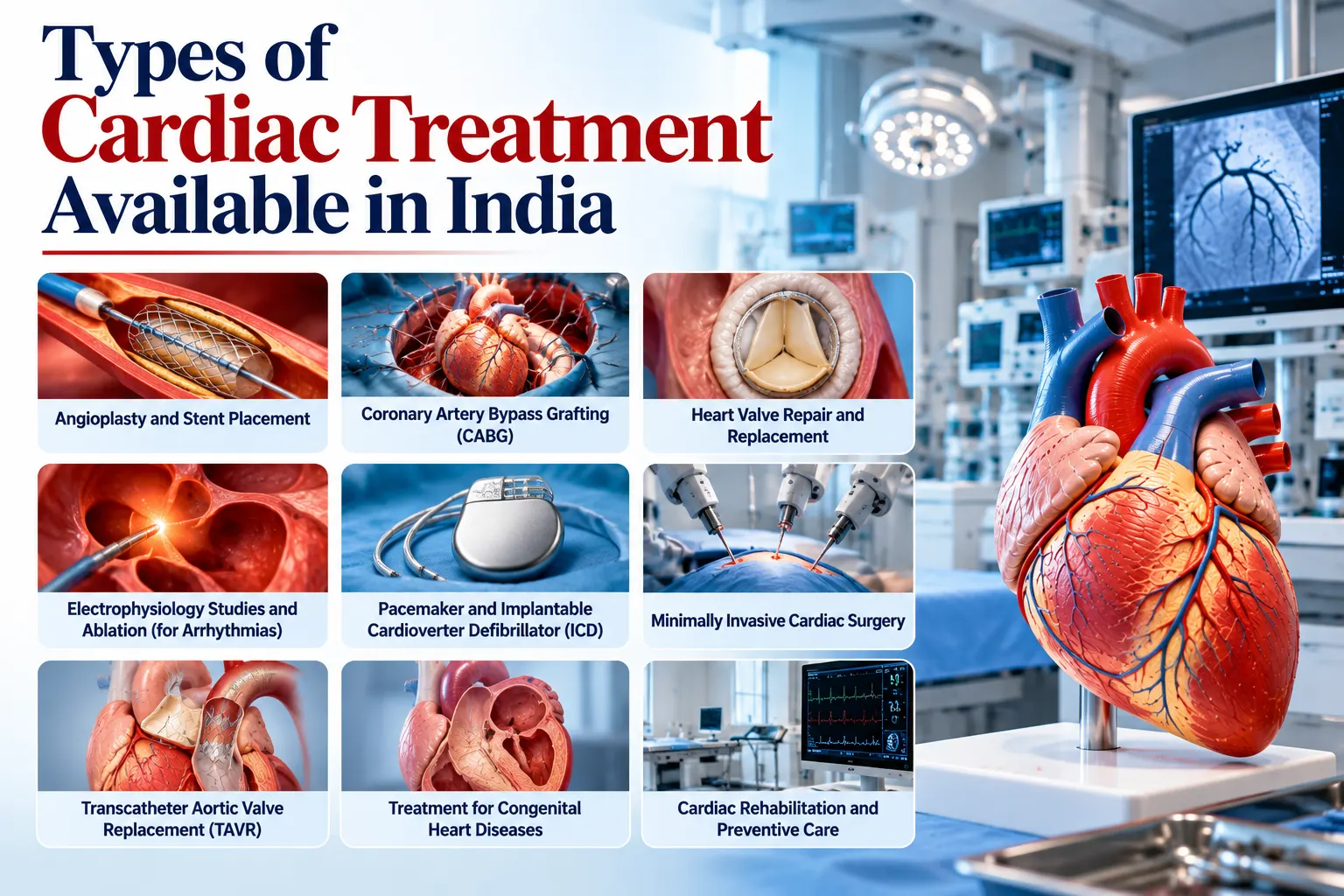
There are several forms of cardiac procedures in India. The right option is selected after reviewing the patient's diagnosis and test results.
Coronary Angioplasty
Angioplasty is a minimally invasive procedure used to improve blood flow through a narrowed coronary artery. A catheter is guided through a blood vessel to the affected artery. A balloon can be used to open the narrowed area, and a stent may be placed when required.
Angioplasty is different from bypass surgery because it does not involve creating a surgical bypass around the blocked artery.
Coronary Artery Bypass Surgery
Coronary artery bypass grafting, commonly called CABG, is a surgical procedure used to create a new route for blood to reach the heart muscle when coronary arteries are significantly narrowed or blocked.
The surgeon uses a healthy blood vessel from another part of the body to create the bypass. CABG may be considered for patients with multiple blockages, complex coronary disease or other clinical circumstances in which surgery is more appropriate.
Valve Repair and Replacement
Heart valves regulate the direction of blood flow through the heart. If a valve becomes severely narrowed or does not close properly, treatment may be necessary.
Depending on the valve and the patient's condition, doctors may recommend:
- Valve repair
- Mechanical valve replacement
- Tissue valve replacement
- Catheter-based valve treatment
The choice depends on factors such as age, valve anatomy, overall health, surgical risk and long-term treatment considerations.
TAVI
Transcatheter aortic valve implantation, commonly known as TAVI or TAVR, is a catheter-based procedure used for selected patients with aortic valve disease.
Instead of conventional open-heart surgery, the replacement valve is delivered through a catheter. Not every patient is suitable for TAVI, so imaging and specialist assessment are essential before treatment.
Pacemaker Implantation
A pacemaker is a small electronic device used to help control certain abnormal heart rhythms. It may be recommended when the heart's natural electrical system cannot maintain an adequate rhythm.
The procedure and recovery period are generally different from major open-heart operations.
Congenital Heart Procedures
Some people are born with structural abnormalities of the heart. Depending on the defect, treatment can include catheter-based closure procedures or surgery.
Treatment may be required for conditions such as selected atrial septal defects, ventricular septal defects and other congenital abnormalities.
Heart Transplantation
Heart transplantation is considered for selected patients with advanced heart failure when other treatment options are no longer sufficient.
It is a complex process involving transplant assessment, donor availability, surgery, intensive monitoring and lifelong medical treatment.
Cardiac Treatment Cost in India
The cardiac treatment cost in India is not fixed. Two patients undergoing the same broad category of treatment may have different final bills because their medical conditions, implants, hospital stays and treatment requirements can differ.
Major factors affecting cost include:
- Type of procedure
- Complexity of the disease
- Hospital and city
- Specialist and surgeon charges
- Type of implant or medical device
- ICU duration
- Room category
- Diagnostic investigations
- Medicines and consumables
- Additional procedures
- Post-operative complications
- Rehabilitation and follow-up
Indicative Cardiac Treatment Cost in India
| Treatment / Procedure | Approximate Cost Range |
|---|---|
| Coronary Angioplasty | ₹1.5 lakh–₹3 lakh |
| CABG / Bypass Surgery | ₹2.5 lakh–₹5.5 lakh |
| Valve Replacement | ₹3 lakh–₹6 lakh |
| Pacemaker Implantation | ₹1.2 lakh–₹4 lakh |
| Heart Transplantation | ₹15 lakh–₹25 lakh+ |
Price resource: These figures are indicative planning ranges based on publicly available healthcare cost information and should not be considered a fixed hospital quotation. Actual prices can vary considerably according to hospital, city, procedure complexity, implant, room category and medical requirements.
Before selecting a package, ask the hospital whether the quoted amount includes:
- Cardiologist and surgeon fees
- Anaesthesia
- Operation theatre charges
- ICU stay
- Room charges
- Medicines
- Medical devices and implants
- Laboratory and imaging tests
- Blood or blood products
- Follow-up consultations
A written estimate is much more useful than a verbal price because it allows the patient to identify exclusions before admission.
Cardiac Treatment Cost in India for International Patients
The cardiac treatment cost for international patients in India can include expenses that domestic patients may not need to consider.
The medical procedure itself is only one part of the total trip budget. International patients may also need to plan for:
- Initial medical consultation
- Diagnostic tests
- Hospital admission
- Surgery or procedure
- ICU and room charges
- Medicines
- Implants or devices
- Visa-related expenses
- Flights
- Accommodation for the patient and attendant
- Local transportation
- Interpreter services, where required
- Follow-up consultations
- Return travel
The best way to receive a realistic estimate is to send the patient's recent medical records to the hospital or medical coordinator before travelling.
Useful documents may include:
- ECG reports
- Echocardiography reports
- Coronary angiography records
- CT or MRI reports where relevant
- Blood-test results
- Previous discharge summaries
- Current medication list
- Details of previous heart procedures
- Allergy information
A preliminary review may help doctors understand the patient's condition before an in-person consultation. However, the final treatment plan may change after physical examination or additional testing.
Best Cardiac Hospitals in India
Choosing among cardiac hospitals in India requires more than looking at a hospital's overall reputation. The relevant question is whether the hospital has the specialist, department, technology and support services needed for the particular heart condition.
HealthRoop's current hospital lists the following facilities with relevant cardiac services:
| Hospital | Location | Cardiac / Relevant Services |
|---|---|---|
| Apollo Hospitals | Chennai and other locations | Cardiac Sciences, cardiac care and international patient services |
| Fortis Healthcare | Gurugram and other locations | Cardiac Sciences and cardiac catheterization facilities |
| Medanta – The Medicity | Gurugram | Heart Institute and cardiac surgery |
| Narayana Health | Bengaluru and other locations | Cardiac Surgery and advanced cardiac facilities |
| Manipal Hospitals | Bengaluru and other locations | Cardiac Sciences and cardiac catheterization facilities |
| Max Healthcare | New Delhi and North India | Cardiac Sciences and intensive care facilities |
| BM Birla Heart Research Centre | Kolkata | Cardiac Surgery, Cardiology, Electrophysiology and Cardiac Rehabilitation |
| P.D. Hinduja National Hospital | Mumbai | Multispecialty care and international patient services |
This list is based on the hospitals currently displayed on HealthRoop's hospital network page and should not be treated as a medical ranking. Hospital facilities and services can change, so patients should confirm the relevant department before travelling.
What Should You Check Before Selecting a Hospital?
A practical hospital comparison should include:
- Does the hospital treat the specific heart condition?
- Is the required procedure performed there?
- Is a cardiac ICU available?
- Does the hospital have emergency support?
- Are the required diagnostic facilities available?
- What type of implant or device is being proposed?
- How long is the expected admission?
- What does the estimated package include?
- Is international patient support available?
- How will follow-up be handled after returning home?
These questions can prevent misunderstandings about both treatment and expenses.
How to Choose the Right Cardiac Specialist in India
A cardiologist and a cardiac surgeon do not perform the same role.
A cardiologist diagnoses and treats heart conditions and may perform catheter-based interventions such as angioplasty.
A cardiac surgeon performs operations such as CABG, valve surgery and selected procedures involving congenital or structural heart conditions.
Some patients need both specialists during different stages of treatment.
When reviewing a specialist, check their experience with the particular procedure rather than focusing only on the number of years they have practised.
Useful questions include:
- How often do you perform this procedure?
- What treatment options are available?
- Why is this procedure being recommended?
- Are there non-surgical alternatives?
- How long is the expected hospital stay?
- What complications should the patient understand?
- What follow-up will be required?
- When can the patient safely travel home?
A clear explanation of the treatment plan is an important part of informed medical decision-making.
Cardiac Treatment Process in India
For international patients, the treatment journey usually involves several stages.
1. Send Medical Records
The patient shares existing reports with the hospital or medical coordinator. This allows the medical team to review the case before travel.
2. Specialist Review
A cardiologist or cardiac surgeon examines the available reports and identifies whether further investigations are likely to be required.
3. Diagnostic Testing
If necessary, additional tests may be performed after arrival. These can include ECG, echocardiography, coronary angiography, CT imaging or laboratory investigations.
4. Final Treatment Plan
After reviewing the complete information, the doctor recommends the appropriate treatment. This may involve medicines, angioplasty, bypass surgery, valve treatment, device implantation or another procedure.
5. Cost Estimate and Scheduling
The hospital provides an estimated cost and discusses admission, procedure scheduling and expected length of stay.
6. Treatment
The procedure is performed by the relevant cardiac team. Patients undergoing major surgery may spend time in a cardiac ICU before moving to a regular room.
7. Discharge and Follow-Up
Before leaving the hospital, the patient should receive discharge documents, prescriptions, test results, activity instructions and follow-up recommendations.
International patients should keep copies of all medical records so that their doctor at home can continue treatment after they return.
Recovery After Cardiac Treatment
Recovery depends on the procedure and the patient's general health.
Someone undergoing angioplasty may have a shorter recovery period than a patient undergoing CABG or valve surgery. Major cardiac operations generally require more time before normal activities can resume.
Post-treatment care may include:
- Taking prescribed medicines correctly
- Monitoring blood pressure
- Managing cholesterol and blood sugar
- Following dietary advice
- Gradually increasing physical activity
- Wound care after surgery
- Attending follow-up appointments
- Cardiac rehabilitation where recommended
- Avoiding tobacco
- Following travel restrictions provided by the doctor
Patients should not arrange international travel immediately after major cardiac surgery without medical advice. The treating team should confirm when flying is medically appropriate.
The expected stay can vary substantially according to the operation and recovery. HealthRoop's cardiac surgery information indicates that international patients may need approximately 15–20 days in India depending on treatment and recovery. The treating hospital should provide the patient's individual timeline.
Why International Patients Choose India for Heart Treatment
International patients considering heart treatment in India often assess medical expertise alongside practical travel considerations.
India has hospitals providing cardiology, cardiac surgery, cardiac rehabilitation and international patient services. HealthRoop's listed hospitals include services such as visa assistance, airport transfers, language support, accommodation coordination, insurance assistance and teleconsultation, although the exact services differ between hospitals.
Other factors worth considering include:
- Availability of direct or convenient flights
- Visa requirements
- Estimated treatment duration
- Accommodation for family members
- Language assistance
- Emergency support
- Medical record access
- Follow-up after returning home
Patients should also remember that cardiac treatment is time-sensitive in many situations. If someone is experiencing symptoms that could indicate a heart attack, they should seek emergency medical care immediately rather than arranging elective medical travel.
The WHO notes that heart attacks can present with chest discomfort, shortness of breath, nausea, sweating, dizziness and pain that may spread to the arm, shoulder, jaw or back. Immediate medical attention is important when these symptoms occur.
How HealthRoop Helps International Patients
HealthRoop assists international patients with the practical coordination involved in arranging medical care in India. Its hospital network and cardiac services allow patients to submit medical information, discuss treatment requirements and coordinate with suitable hospitals and specialists.
Support can include:
- Medical report collection and preliminary coordination
- Hospital selection based on treatment requirements
- Specialist appointment coordination
- Treatment estimate assistance
- Travel and accommodation coordination
- Assistance with hospital admission
- Communication support
- Follow-up coordination
The website also provides an option for patients to submit their details and medical reports for a treatment estimate.
Conclusion
Cardiac Treatment in India includes medicines, interventional cardiology, cardiac surgery, valve treatment, rhythm management and other specialised services. The appropriate treatment depends on the patient's diagnosis and should be decided after evaluation by a qualified cardiac specialist.
For international patients, planning should cover more than the procedure itself. Hospital facilities, specialist expertise, estimated cost, implant requirements, length of stay, recovery and post-treatment follow-up all deserve attention.
The cardiac surgery cost in India can vary significantly because hospital charges, procedure complexity, room category, ICU stay, implants and additional treatment requirements are different from one patient to another.
Before travelling, send recent medical records, request a written estimate, ask what the quoted package includes and confirm the expected recovery and travel timeline.
The safest approach is to select treatment based on medical suitability and clear communication, while using cost as one part of the overall decision.
Price Disclaimer: The prices mentioned in this article are indicative figures based on previous-year publicly available data and are intended only for general planning. Medical costs can change with hospital, city, procedure, patient condition, surgeon fees, implants, room category, ICU stay, medicines and other requirements.
These figures should not be considered a final quotation. For the latest and exact cardiac treatment cost in India, patients should contact the hospital or HealthRoop directly and share their medical reports. A personalised estimate can only be confirmed after the patient's medical requirements have been reviewed.
Frequently Asked Questions
Answers on cardiac treatment cost, hospitals, and recovery.
The cost depends on the treatment required. Angioplasty, bypass surgery, valve procedures and pacemaker implantation all have different pricing. Indicative figures can range from around ₹1.5 lakh for some angioplasty procedures to several lakhs for major cardiac surgery. A hospital-specific quotation is required for an accurate estimate.
Yes. Several Indian hospitals have dedicated international patient departments. Depending on the hospital, services may include appointment coordination, visa assistance, airport transfers, interpreters, accommodation support and teleconsultation. International patients should confirm the available services and treatment arrangements before travelling.
The heart surgery cost in India varies according to the type of operation. CABG and valve surgery generally cost several lakh rupees, while complex procedures may cost more. Hospital location, surgeon fees, ICU duration, implants, medicines and complications can all affect the final bill.
Common procedures include coronary angioplasty, CABG, valve repair or replacement, TAVI, pacemaker implantation, congenital heart procedures and electrophysiology treatments. Heart transplantation is also performed for selected patients with advanced heart failure. The appropriate procedure depends on the patient's diagnosis and clinical assessment.
The required stay varies according to the operation and recovery. Angioplasty may require considerably less time than bypass or valve surgery. International patients should allow enough time for hospital recovery, follow-up and medical clearance before flying home. The treating specialist should confirm the individual travel timeline.
Compare hospitals based on the specific treatment required, cardiac department, specialist experience, ICU facilities, diagnostic services, emergency support, international patient services and written treatment estimate. A hospital should be selected according to the patient's medical needs rather than relying only on general rankings or advertised prices.
Yes, depending on the condition. Some patients can be managed with medicines, lifestyle changes, risk-factor control and regular monitoring. Others may need angioplasty or surgery. The decision depends on the severity and type of heart disease, test results, symptoms and the specialist's assessment.
Patients should provide recent ECGs, echocardiograms, angiography reports, blood tests, imaging reports, discharge summaries, medication lists and records of previous procedures. Sharing complete records helps the treating team understand the case and determine whether additional investigations may be required after arrival.
India has hospitals offering cardiology, cardiac surgery and international patient services. Suitability depends on the patient's condition, the required procedure, hospital facilities and specialist availability. Patients should have their records reviewed and confirm the proposed treatment, estimated cost and follow-up plan before making travel arrangements.
Yes. Patients can generally submit their medical reports for preliminary review and request an estimated treatment plan. The final cost can change if additional tests, implants, ICU care or other treatment becomes necessary. A written estimate should clearly state what is included and excluded.
