Brain Tumor Surgery in India: Cost, Procedure, Best Hospitals & Recovery
A brain tumor diagnosis calls for specialist evaluation, because the right treatment depends on the tumor's type, size, grade, location, growth pattern, symptoms, and the patient's overall health - not on any single factor alone. Brain Tumor Treatment in India may involve surgery, radiation therapy, chemotherapy, targeted therapy, active monitoring, or some combination of these, and which path applies to you is something only a specialist can determine after reviewing your scans.
Surgery tends to be recommended when a tumor can be removed safely, when tissue is needed to confirm a diagnosis, or when the tumor is pressing on the brain and causing symptoms. It's worth knowing upfront that the goal isn't always complete removal. When a tumor sits close to areas that control speech, movement, vision, or other functions, surgeons often aim for maximum safe removal instead, protecting neurological function even if that means leaving a small margin of tissue behind. For a broader look at how neurosurgical cases are handled here, our neuroscience treatment in India page covers the wider specialty this surgery falls under.
For patients coming from abroad, planning can often begin before you even book a flight. Sharing MRI scans, pathology reports, previous treatment records, and other medical documents with the treating team lets a neurosurgeon form an initial opinion well ahead of travel.
What Is Brain Tumor Surgery?
Brain tumor surgery is a neurosurgical procedure performed to remove some or all of a tumor, obtain tissue for diagnosis, relieve pressure on the brain, or ease symptoms that the tumor is causing. It isn't a single standardized operation - the surgical plan is built around the specific tumor in front of the surgeon.
The approach chosen depends on several things working together:
- Tumor type and grade
- Tumor size
- Its exact location in the brain
- How closely it sits against important brain structures
- The patient's current neurological condition
- Any previous treatment already received
- Overall health and fitness for surgery
Depending on how these factors line up, the surgical objective can be complete removal, maximum safe removal, partial removal, a diagnostic biopsy, or decompression to relieve pressure without removing the whole tumor.
When May Brain Tumor Surgery Be Recommended?
A neurosurgeon is likely to consider surgery when:
- The tumor is accessible through a safe surgical route
- It's causing neurological symptoms that are affecting daily life
- A tissue diagnosis is needed to confirm exactly what the tumor is
- The tumor is growing on repeat imaging
- It's putting pressure on surrounding brain tissue
- Removing it is likely to improve symptoms or help control the disease
- Reducing tumor size first would make additional treatment more effective
Not every brain tumor needs surgery, though. Some slow-growing tumors that aren't causing significant symptoms are simply watched through regular check-ups and imaging rather than operated on right away.
Types of Brain Tumors
Brain tumors are generally classified by where they originate and how they behave biologically, and this classification is really what drives every treatment decision that follows.
Benign Brain Tumors
Benign brain tumors are non-cancerous, but "benign" doesn't mean harmless. A slow-growing, non-cancerous tumor can still cause serious problems if it happens to sit near critical brain structures or if it raises pressure inside the skull. Treatment can range from simple observation to surgery or radiation, depending on where the tumor is and what symptoms it's producing.
Malignant Brain Tumors
Malignant brain tumors are cancerous, and they tend to grow more aggressively, sometimes infiltrating the surrounding brain tissue rather than staying neatly contained. Treatment usually involves surgery followed by radiation, chemotherapy, targeted treatment, or a mix of these, depending on the specific diagnosis.
Primary Brain Tumors
A primary brain tumor originates in the brain or central nervous system itself. Gliomas, astrocytomas, glioblastomas, oligodendrogliomas, ependymomas, and meningiomas all fall under this category, and each behaves quite differently in terms of growth rate and treatment response.
Metastatic Brain Tumors
Metastatic, or secondary, brain tumors develop when cancer from elsewhere in the body spreads to the brain. Here, treatment depends on more than just the brain lesion - the number and location of brain metastases, the primary cancer type, any prior treatment, and the patient's overall condition all factor into the plan.
When Is Brain Tumor Surgery Needed?
The decision around Brain Tumor Surgery in India should rest on a specialist's full assessment, not on tumor size by itself. A tumor can be quite small and still need urgent surgery if it's in a dangerous location, while a larger tumor elsewhere in the brain might be managed more conservatively.
Factors that genuinely shape this decision include:
- Tumor location
- Tumor type and grade
- Symptoms the patient is experiencing
- How quickly the tumor is growing
- How accessible it is surgically
- The neurological risks involved in operating
- General health and ability to tolerate surgery
- Any previous treatment
- Whether non-surgical alternatives are realistic options
Why Early Evaluation Matters
Getting evaluated early helps establish a clear diagnosis and settle whether surgery, biopsy, radiation, monitoring, or another approach makes the most sense. Waiting doesn't just delay treatment - it can also narrow the options available by the time you do see a specialist.
Symptoms worth getting checked include persistent or worsening headaches, seizures, vision changes, weakness on one side of the body, speech difficulties, balance problems, confusion, or any other new neurological symptom that doesn't have an obvious explanation.
Brain Tumor Surgery Cost in India
The Brain Tumor Surgery Cost in India varies according to the surgical procedure itself, the hospital, tumor complexity, the surgeon's fees, diagnostic investigations, ICU stay, medicines, and postoperative care. There's no single number that applies across the board, which is exactly why a written, case-specific estimate matters more than any figure you find in a general search.
Published Indian hospital estimates commonly fall in a broad range of approximately ₹1.5 lakh to ₹7.5 lakh, though complex procedures involving advanced technology or longer ICU stays can cost more. Treat these figures as a starting point for budgeting, not a final quotation.
| Treatment / Expense | Indicative Cost |
|---|---|
| Brain tumor surgery | ₹1,50,000 – ₹7,50,000 |
| Craniotomy for tumor | ₹1,50,000 – ₹3,00,000 |
| Endoscopic surgery | ₹2,00,000 – ₹5,00,000 |
| Diagnostic investigations | Varies by the tests ordered |
| ICU stay | Varies by duration required |
| Radiation therapy | Varies by treatment plan |
| Chemotherapy | Varies by medicines used |
| Rehabilitation | Varies by patient's needs |
Resource: The figures above are based on previously published Indian hospital cost references and are intended for general budgeting only.
Important Price Disclaimer: The price information in this article is based on previous-year data and may change, since hospital charges, surgeon fees, investigations, medicines, ICU requirements, and treatment protocols can all shift over time. For the latest and exact Cost of Brain Tumor Surgery in India, patients should contact the hospital or medical coordination team directly for a case-specific estimate.
What Is Included in Brain Tumor Surgery Cost?
Depending on the hospital and the specific package, costs typically include:
- Surgeon's fees
- Anaesthesia
- Operating room charges
- Hospital room stay
- ICU or critical-care monitoring
- Nursing care
- Medicines administered during the stay
- Surgical supplies
- Pathology
- Routine postoperative care
What May Be Excluded?
Costs that often sit outside the base package include:
- Advanced MRI or CT scans done separately
- Specialized pathology or molecular testing
- Extended ICU stay beyond what's typical
- Management of any complications
- Radiation therapy
- Chemotherapy
- Targeted medicines
- Rehabilitation
- Accommodation outside the hospital
- Travel expenses
Always ask for a written estimate that clearly separates what's included from what isn't - this single step avoids most of the billing surprises international patients run into.
Brain Tumor Surgery Procedure in India
The Brain Tumor Surgery Procedure generally moves through several distinct stages, and knowing what happens at each one goes a long way toward reducing the anxiety of the whole experience, especially when you're traveling from another country.
1. Initial Consultation
The neurosurgeon starts by reviewing symptoms, medical history, any previous treatment, existing imaging, pathology reports, and current medications. This first conversation shapes everything that follows.
2. Diagnostic Tests and Brain Imaging
MRI is the standard tool for detailed evaluation of most brain tumors. Depending on the specific case, doctors may also request CT scans, functional imaging, blood tests, a biopsy, or additional pathology and molecular testing to understand the tumor more precisely.
3. Surgical Planning
The surgical team maps out the tumor's location, its boundaries, its relationship to nearby critical structures, and the safest possible access route. For tumors sitting close to speech or movement areas, specialized functional mapping or neurological monitoring is often built into the plan.
4. Brain Tumor Surgery
The surgeon accesses the tumor using whichever technique fits the case best. Depending on what was decided during planning, the objective may be complete removal, maximum safe removal, partial removal, or simply a biopsy.
5. Post-Surgery Monitoring
After the operation, the team closely tracks neurological function, vital signs, pain levels, seizure activity, swelling, and how the surgical wound is healing.
6. Discharge and Follow-Up
Before discharge, patients are given clear instructions on medicines, wound care, activity restrictions, and any follow-up imaging or additional treatment that's been planned.
Types of Brain Tumor Surgery
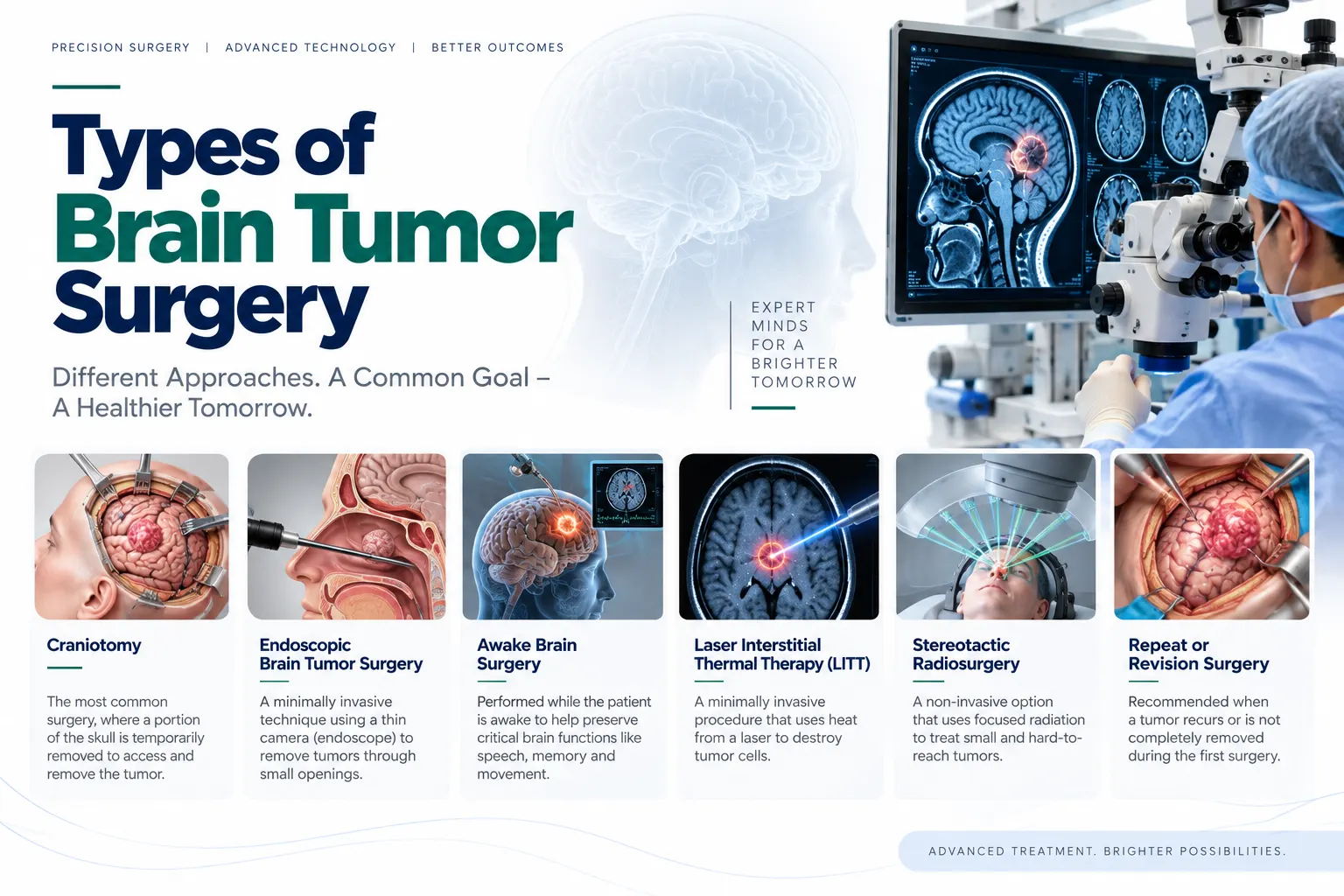
There's no one-size-fits-all technique here. Surgeons choose from several types of brain tumor surgery based on the tumor's location, size, and how accessible it is.
Craniotomy
A craniotomy involves temporarily removing a section of the skull to reach the brain directly. It remains the go-to approach for tumors that need direct, wide surgical access.
Biopsy
A biopsy removes a small amount of tumor tissue for laboratory analysis. Surgeons choose this route when getting an accurate diagnosis matters more, at that stage, than attempting to remove the tumor entirely.
Endoscopic Surgery
Endoscopic techniques rely on specialized cameras and instruments passed through a carefully planned, minimally invasive route. This approach only suits certain tumors in certain locations - it isn't a universal option.
Minimally Invasive Approaches
These use specialized surgical corridors designed to limit disruption to the surrounding brain tissue, and they're reserved for cases where the tumor's position genuinely allows for it.
Awake Craniotomy
An awake craniotomy may come into play when a tumor sits near areas that control speech, movement, or other important functions. During specific stages of the operation, the patient stays awake and may answer questions or perform small tasks so the surgical team can pinpoint exactly which areas are functional - and avoid them.
Advanced Technologies Used in Brain Tumor Surgery
Depending on the hospital and the patient's specific condition, neurosurgical teams may draw on:
- Neuronavigation
- Intraoperative imaging
- Functional brain mapping
- Intraoperative MRI
- Neurophysiological monitoring
- Surgical microscopes
- Endoscopic systems
- Fluorescence-guided techniques, in selected tumor types
Not every case calls for all of these tools. What gets used depends entirely on the tumor and the procedure planned around it.
Best Hospitals for Brain Tumor Surgery in India
Best hospitals for brain tumor surgery in India are generally large, multi-specialty centers with dedicated Neurosciences or Neurosurgery departments, oncology support for malignant cases, and structured international-patient services. From our own verified hospital network, the following stand out for neuro and oncology-related care:
- Medanta – The Medicity (Gurugram, Lucknow, Patna) - a large multi-specialty hospital with a dedicated Neurosciences division, JCI and NABH accredited
- Manipal Hospitals (Bangalore and 29+ centres) - an established Neurosurgery department spread across multiple cities
- Apollo Hospitals (Chennai, Delhi, Hyderabad and 70+ cities) - one of India's largest hospital networks, with robotic surgery capability that extends into complex neurosurgical cases
- HCG Cancer Centre (Bangalore and 24+ centres) - focused on Medical Oncology and Radiation Therapy, relevant when a brain tumor is malignant and needs combined treatment
- Narayana Health (Bangalore, Kolkata and 19+ cities) - a large network with oncology services suited to cancer-related brain tumor cases
This is not a ranking, and it isn't the full list either. Other major Indian chains such as Fortis Healthcare and Max Healthcare are well known for neurosurgery nationally, though we haven't independently confirmed their current listing in our own network at the time of writing - for the complete, verified list of partner hospitals with accreditation and specialty details, check our hospital directly before making a decision.
How to Choose the Right Hospital for Brain Tumor Treatment?
Before settling on a hospital, it's worth checking:
- The neurosurgeon's specific experience with your tumor type
- Availability of a neurosurgical ICU
- Neuro-oncology services on site
- MRI and advanced diagnostic facilities
- Pathology and molecular testing capability
- Radiation oncology and medical oncology, if your case may need it
- Rehabilitation support
- Whether care is genuinely multidisciplinary
- International patient services
- Whether a second opinion is easy to arrange
- The estimated total treatment cost, in writing
The treating team's experience with your particular tumor type usually matters more than the hospital's general brand reputation - a well-known name doesn't automatically mean the best fit for every case.
Brain Tumor Surgeons in India
Brain tumor surgeons in India are neurosurgeons who specialize in diagnosing and surgically managing tumors of the brain and central nervous system. Complex cases rarely rest on one surgeon alone - they typically involve a multidisciplinary team that can include:
- Neurosurgeon
- Neuro-oncologist
- Radiation oncologist
- Medical oncologist
- Neuroradiologist
- Neuropathologist
- Neuro-anesthetist
- Rehabilitation specialists
Before agreeing to surgery, it's reasonable to ask the surgeon directly about the proposed procedure, the realistic surgical objective, potential neurological risks, expected hospital stay, and whether further treatment is likely to follow.
Brain Tumor Treatment Options Besides Surgery
Surgery isn't the only option on the table for brain tumors. Depending on the diagnosis and individual circumstances, treatment can include the following.
Radiation Therapy
Radiation therapy may be used after surgery to target any remaining cells, instead of surgery in selected cases, or to manage recurrent or metastatic disease.
Chemotherapy
Chemotherapy is used for specific types of brain tumors and often forms part of a broader, combined treatment plan alongside surgery or radiation.
Targeted Therapy
Targeted medicines act on specific molecular characteristics of certain tumors. Whether this is a suitable option depends entirely on the tumor's molecular profile, which is why molecular testing matters so much in modern treatment planning.
Immunotherapy, Where Appropriate
Immunotherapy may be considered for selected cancers, though its role varies significantly depending on tumor type and the patient's individual situation - it isn't a default option for every case.
Active Monitoring
Some slow-growing tumors that aren't causing significant symptoms are simply monitored through neurological examinations and periodic imaging rather than treated immediately.
Brain Tumor Surgery Recovery Time
Brain Tumor Surgery Recovery Time depends on the tumor's location, the surgical technique used, the patient's neurological condition, any complications, age, general health, and whether further treatment is needed afterward.
Immediately After Surgery
In the hours right after surgery, patients are closely watched for neurological changes, bleeding, swelling, seizures, pain, and any other postoperative concerns.
Hospital Recovery
Many patients stay in hospital for several days following uncomplicated surgery. Complex procedures, or any complications along the way, can extend that stay considerably.
Returning to Daily Activities
When it's safe to return to work, driving, exercise, and other normal activities should be based on the surgeon's advice, not a fixed calendar date. Recovery tends to take longer when patients are dealing with weakness, speech difficulties, balance problems, seizures, vision changes, memory difficulties, or significant fatigue.
Physiotherapy and Rehabilitation
Rehabilitation, where needed, may involve physiotherapy, occupational therapy, speech therapy, cognitive rehabilitation, and balance or mobility training - often in combination rather than just one of these.
Follow-Up Appointments
Follow-up typically includes neurological examinations, MRI scans, pathology review, oncology consultations where relevant, medication adjustments, and continued rehabilitation as needed.
Risks and Possible Complications of Brain Tumor Surgery
Brain surgery carries real risks, and how significant they are depends heavily on the individual patient and where exactly the tumor sits. Possible complications include bleeding, infection, brain swelling, seizures, blood clots, weakness, speech or language problems, vision changes, balance difficulties, memory or cognitive changes, cerebrospinal fluid leakage, anaesthesia-related complications, residual or recurrent tumor, and the possible need for additional treatment afterward.
General statistics only go so far here. It's far more useful to ask your surgeon directly about the specific risks tied to your tumor's location and type, rather than relying on broad averages that may not apply to your case at all.
Brain Tumor Surgery for International Patients
Brain tumor surgery for international patients is well established in India, with several hospitals running dedicated international-patient services that make planning from abroad genuinely workable.
Sharing Medical Reports
Before travel, it helps to prepare MRI and CT scans, radiology reports, biopsy and pathology reports, previous discharge summaries, treatment records, blood tests, current prescriptions, and a passport copy where required.
Getting a Medical Opinion
A specialist reviews the available medical records and determines whether surgery, biopsy, radiation, monitoring, or another approach fits your specific situation.
Hospital and Surgeon Coordination
Once a treatment plan is in place, coordination typically covers specialist appointments, hospital admission, diagnostic tests, surgery dates, and the follow-up consultations that come after.
Treatment Cost Estimate
It's worth obtaining a written estimate that covers doctor fees, surgery, hospital stay, ICU, investigations, medicines, pathology, follow-up, and any additional treatment that may apply.
Medical Visa Assistance
International patients generally need a medical visa along with supporting hospital documentation. Since requirements can vary by nationality and change with current Indian regulations, it's worth confirming the latest requirements shortly before you travel rather than relying on older information.
Airport Pickup & Accommodation
For major neurosurgery, it makes sense to plan accommodation close to the hospital and think through transportation, accommodation for accompanying family, accessibility, and the length of the expected recovery period.
Interpreter Assistance
Interpreter support helps patients fully understand medical consultations, consent documents, medication instructions, and follow-up recommendations - an area where miscommunication really shouldn't happen.
Follow-Up Coordination
Follow-up after returning home can include MRI scans, medication review, rehabilitation guidance, oncology consultations, and remote consultations conducted over video call.
Documents Required for Brain Tumor Treatment in India
Medical documents:
- MRI/CT reports and scans
- Biopsy reports
- Pathology reports
- Previous treatment records
- Discharge summaries
- Blood test reports
- Current medication list
- Previous surgical records, if any
Travel documents (depending on current visa requirements):
- Valid passport
- Medical visa documents
- Hospital appointment confirmation
- Medical invitation letter, where applicable
- Passport-size photographs
- Accompanying person's documents
How International Patients Can Plan Brain Tumor Treatment in India
A practical sequence looks like this: collect medical records and imaging, share the reports for specialist review, get a medical opinion and understand the treatment options on the table, compare hospitals and specialists based on the actual diagnosis, request a written cost estimate, arrange the medical visa and travel, complete the specialist consultation in India, follow the recommended treatment and rehabilitation plan, and confirm postoperative follow-up before heading home. Skipping the early steps - particularly the specialist review before travel - is the most common reason plans fall apart later.
How Long Should International Patients Stay in India?
There's no fixed number here, because the required stay depends entirely on the diagnosis and treatment plan. It's shaped by the type of surgery, hospital recovery time, any complications, pathology results, whether rehabilitation is needed, radiation therapy, chemotherapy, follow-up imaging, and the doctor's clearance for travel. As a general guide, straightforward cases without additional radiation or chemotherapy often need 3 to 4 weeks in India; cases requiring further treatment will need longer. Avoid booking a fixed return flight right after surgery without first discussing the expected recovery timeline with your treating team.
Why Choose HealthRoop for Brain Tumor Treatment in India?
Coordinating brain tumor treatment from another country is rarely just about picking a hospital name off a search result. It means getting an honest medical opinion on your reports, understanding which hospital and surgeon genuinely suit your specific tumor, and having someone manage the practical side of travel, visas, and follow-up so you can focus on the treatment itself. HealthRoop works as that coordination point between international patients and India's neurosurgery hospitals, reviewing reports and connecting patients with the right specialists rather than stepping back once a booking is made.
- Medical report review before you commit to any hospital
- Specialist consultation coordination
- Hospital selection support based on your actual diagnosis
- Second-opinion coordination where you want one
- Treatment estimate assistance in writing
- Medical visa documentation guidance
- Airport pickup and local transportation
- Accommodation coordination
- Interpreter support for patients who need it
- Post-treatment follow-up after you're back home
The medical treatment itself is always determined by the qualified treating specialists based on your diagnosis and clinical condition - our role is coordination and support around that decision, not a substitute for it. If you're exploring brain tumor surgery in India, reviewing your case with our team is the most reliable way to get realistic costs, timelines, and hospital options for your specific situation. You can read more about our step-by-step process or get in touch to start a case review.
Final Thoughts
Treatment for a brain tumor should be planned around the individual diagnosis, not around cost or hospital name alone. Tumor location, pathology, neurological function, surgical accessibility, and the experience of the treating team all shape the right approach far more than any single factor on its own.
For international patients, arranging a medical evaluation before travelling tends to make the entire process more organized, clarifying treatment options, realistic costs, hospital requirements, and how long the stay is likely to be. Because every brain tumor is different, it's worth getting a specialist opinion and a current, case-specific cost estimate before making any treatment or travel decisions.
Frequently Asked Questions
Answers on brain tumor surgery cost, procedure and recovery in India.
The Brain Tumor Surgery Cost in India varies according to tumor type, location, surgical complexity, hospital, surgeon, ICU stay, investigations, medicines, and recovery requirements. Published estimates range from roughly ₹1.5 lakh to ₹7.5 lakh, though complex cases may cost more. Always request a current written estimate for accurate budgeting.
Yes. Several Indian hospitals offer international-patient services for neurosurgical treatment, including medical record review, specialist consultations, visa documentation support, airport transportation, accommodation, interpreter assistance, and follow-up coordination before and after treatment.
Surgery duration depends on the tumor's size, location, type, and the surgical approach used. Some procedures take a few hours; more complicated operations can run longer. The operating surgeon gives a more reliable estimate after reviewing your MRI scans and the planned technique.
Recovery varies significantly from patient to patient. Many stay in hospital for several days after uncomplicated surgery, though full recovery can take weeks or longer. Weakness, speech problems, balance difficulties, seizures, or the need for rehabilitation can all extend the timeline.
Hospitals with dedicated neurosciences or oncology departments include Medanta – The Medicity, Manipal Hospitals, Apollo Hospitals, HCG Cancer Centre, and Narayana Health, among others in our verified network. The right choice depends on tumor type, required treatment, and specialist expertise.
Brain tumor surgery is performed by a qualified neurosurgeon, often supported by neuro-oncology, neuroradiology, neuropathology, radiation oncology, medical oncology, anaesthesia, and rehabilitation specialists. Complex cases usually need multidisciplinary planning to coordinate surgery with radiation or medicines.
Preoperative evaluation commonly includes MRI or CT imaging, a neurological examination, blood tests, and review of any previous pathology. Some patients also need functional imaging, molecular testing, or a biopsy, depending on the suspected tumor and its location.
Common approaches include craniotomy, biopsy, endoscopic surgery, minimally invasive procedures, and awake craniotomy in selected cases. The surgeon chooses based on tumor location, size, accessibility, and the need to protect important neurological functions.
Yes. Some brain tumors can be managed with active monitoring, radiation therapy, chemotherapy, or targeted therapy instead of surgery. The right approach depends on tumor type, grade, molecular characteristics, symptoms, and overall health, decided after detailed imaging and specialist evaluation.
Patients can start by collecting MRI scans, pathology reports, prescriptions, and previous treatment records, then sharing these for specialist review before travel. Once assessed, the hospital, surgeon, cost estimate, visa documentation, accommodation, and follow-up can all be coordinated.
