Best Cancer Hospital in India for Ethiopian Patients
Ethiopia recorded roughly 80,334 new cancer cases in 2022, according to GLOBOCAN data from the WHO's cancer observatory. Specialized oncology infrastructure hasn't kept pace with that number.
That gap is why thousands of Ethiopian patients now travel to India for cancer care every year. Ethiopia to India cancer treatment has become a well established path at this point, not a niche one, and Indian cancer hospitals have built entire departments around treating international patients.
Getting from a confusing diagnosis at home to a full, coordinated treatment plan in India takes real planning. No family should have to figure out hospital selection, visas, and logistics alone while also managing a cancer diagnosis.
Here's what actually matters: treatment costs, the Indian hospitals equipped for complex oncology cases, flight and visa logistics from Addis Ababa, and what happens after treatment ends. This covers medical tourism India for cancer from every angle an Ethiopian family actually needs.
Why Ethiopian Patients Choose India for Cancer Treatment
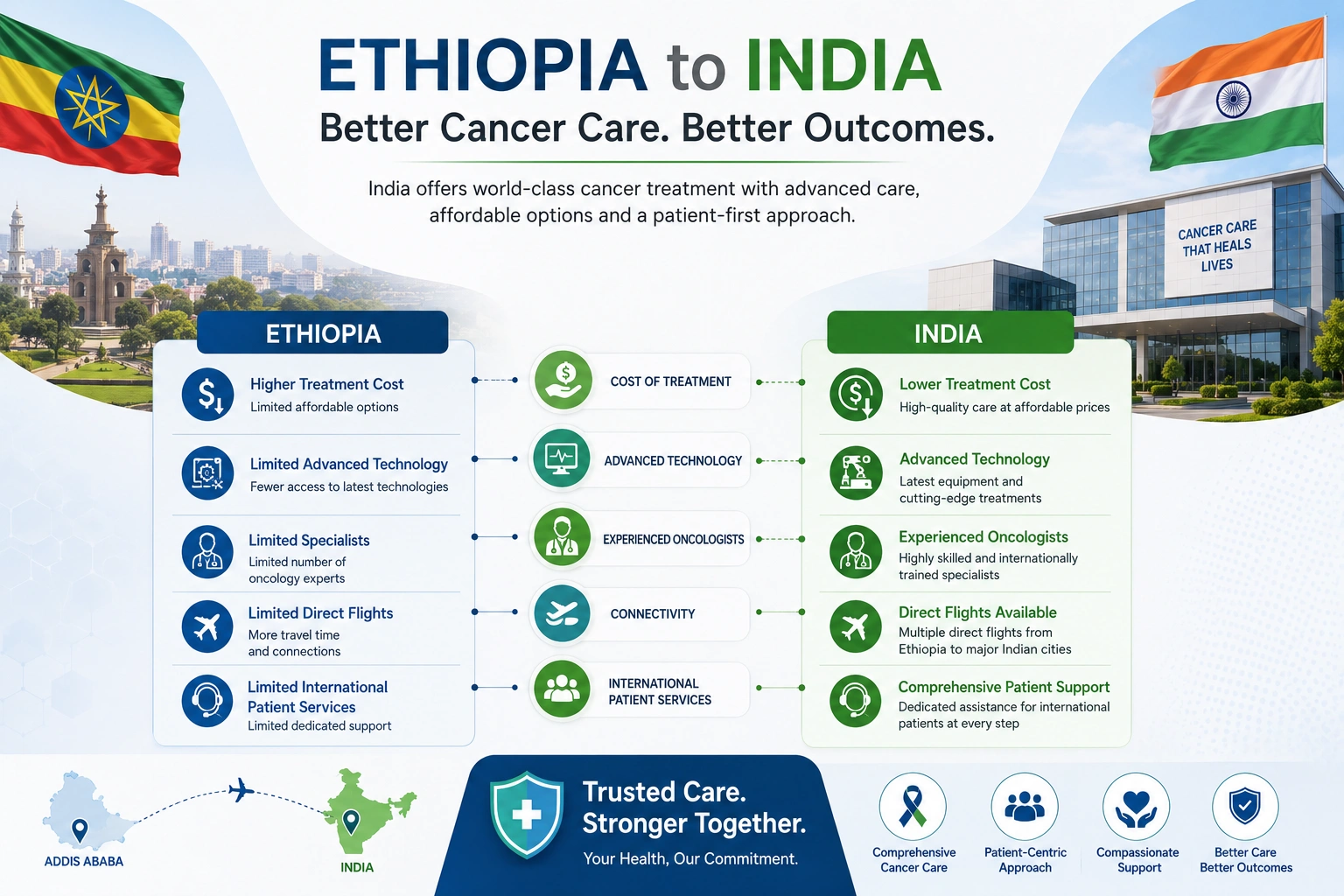
Cost is the first reason. Treatment in India runs 60 to 80 percent lower than the US, UK, or Middle East for comparable care, without cutting corners on drugs or monitoring.
Direct flights from Addis Ababa cut travel time significantly, which matters when someone is undergoing active treatment. English is the standard language of Indian medical practice, so communication rarely becomes a barrier.
India also offers the full range of oncology care under one roof: diagnosis, surgery, chemotherapy, radiation, immunotherapy, and transplant. Its larger oncology hospitals in India already treat patients from dozens of countries and have built systems around that.
Choosing India doesn't mean choosing between quality and what a family can afford. Affordable cancer treatment in India comes from matching each patient to the hospital and specialist that actually fits their cancer type, not the hospital that happens to be best known. That's the difference between generic cancer care in India and a plan built around one specific diagnosis.
Cancer Statistics in Ethiopia
- Breast cancer: ~16,904 new cases in 2022, about 21% of all diagnoses and nearly a third of cancers among women
- Cervical cancer: ~8,168 cases, largely linked to limited HPV screening access
- Colorectal cancer: ~6,551 cases
- Leukemia and blood cancers: ~4,721 cases
- Non-Hodgkin lymphoma: ~3,568 cases
- Stomach and liver cancer also appear frequently, often diagnosed later than in countries with routine screening
These numbers, from GLOBOCAN 2022, explain why demand for advanced oncology care keeps rising from Ethiopia year over year.
Oncology Treatment Options Available in India
Medical oncology covers chemotherapy, targeted therapy, hormone therapy, and immunotherapy. Precision oncology in India, where treatment is matched to a tumor's genetic markers, is now standard at larger cancer centers, and personalized cancer treatment India programs increasingly build the drug combination around that genetic profile rather than a one-size protocol. CAR-T cell therapy for certain blood cancers is available at a handful of specialized institutes.
Surgical oncology includes tumor removal and organ-preserving procedures. Robotic surgery and laparoscopic cancer surgery are now standard at most major centers, meaning smaller incisions and faster recovery than open surgery.
Radiation oncology includes IMRT, IGRT, SBRT, CyberKnife treatment, and Gamma Knife treatment for radiosurgery. Proton therapy in India is available at a small number of hospitals for cases where sparing healthy tissue is critical.
Bone marrow and stem cell transplant programs handle leukemia, lymphoma, and multiple myeloma, covering autologous, allogeneic, haploidentical, and pediatric transplant types. Bone marrow transplant hospitals in India with high case volume tend to have the best-calibrated protocols, since experience matters more here than almost anywhere else in oncology.
Best Cancer Hospitals in India for Ethiopian Patients
Volume matters more than brand name for chemotherapy specifically. The best hospital for chemotherapy in India is usually one running it daily, with better calibrated dosing protocols and faster reaction to side effects. The same logic applies when looking for the best hospital for radiation therapy in India or the best hospital for immunotherapy in India: ask about case volume for that exact treatment type, not just the hospital's general size.
Here are five of the top cancer hospitals in India and cancer specialist hospitals in India that Ethiopian patients most often end up choosing, several of them also known for robotic cancer surgery in India:
| Hospital | City | Beds | Rating | Known For |
|---|---|---|---|---|
| HCG Cancer Centre | Bangalore (HQ) | 2,000+ | 4.6 | Dedicated oncology-only chain |
| Apollo Hospitals | Chennai (HQ) | 10,000+ | 4.7 | Wide international patient network |
| Max Healthcare | New Delhi (HQ) | 3,400+ | 4.6 | Comprehensive cancer institute |
| Fortis Healthcare | Gurugram (HQ) | 4,000+ | 4.6 | Robotic surgery, bone marrow transplant |
| Manipal Hospitals | Bangalore (HQ) | 7,600+ | 4.6 | Multi-city oncology access |
HCG is the only hospital here built entirely around cancer care. The rest run dedicated cancer institutes inside larger multi-specialty hospitals, which helps if a patient also needs cardiology or nephrology support. All five are cancer hospitals with international patient services built specifically for cases like this.
The right choice depends on the specific cancer type, not the hospital's overall size. There's no single best oncology hospital India-wide for every cancer, since a patient's pathology report should guide the hospital choice, not the biggest name on a list.
Why India Beats Other Treatment Destinations
Ethiopian patients usually weigh three alternatives against India: staying home, the Middle East, or Europe/US. Each has a real tradeoff.
Local treatment in Ethiopia is limited by how many oncologists and radiation machines are available. That often means longer waits between diagnosis and the start of treatment, and delay can change the stage at which treatment begins.
The Middle East is closer but costs significantly more than India for comparable care. Case volumes at many Gulf hospitals are also lower for complex oncology work.
Europe and the US offer excellent care, but at a cost that puts full treatment out of reach for most families paying out of pocket. Visa timelines there also tend to be longer and less predictable.
India sits in between: NABH and JCI accredited hospitals, physicians often trained in the US, UK, or Europe, English as the medical language, direct flights from Addis Ababa, and cost that funds a complete course of treatment instead of a partial one. Medical tourism from Ethiopia to India has grown for exactly these reasons, and the same hospitals that built cancer hospitals for African patients from Nigeria, Kenya, and Sudan apply the same coordination for Ethiopian families. Several are also counted among the best hospitals in India for African patients broadly, not just Ethiopian ones.
Cancer Treatment Cost in India for Ethiopian Patients
| Treatment | Cost Range (USD) |
|---|---|
| Chemotherapy, per cycle | $400 to $2,500 |
| Radiation therapy, full course | $1,200 to $4,800 |
| Tumor removal surgery | $1,800 to $6,000 |
| Robotic cancer surgery | $3,600 to $12,000 |
| Bone marrow transplant | $9,600 to $48,000 |
| PET-CT scan | $150 to $300 |
Disclaimer: These are indicative ranges based on published 2026 medical tourism cost data. Actual cost depends on cancer stage, treatment combination, and hospital. Always get a written quote before booking travel.
A single chemotherapy cycle in the US or Europe can cost more than an entire treatment course in India. Several Indian hospitals also offer EMI and financing for treatment packages, worth asking about if the full amount isn't available upfront.
Every cost estimate should be reviewed line by line before travel is booked. That way there's no confusion later about what the original quote actually covered.
Cancer Treatment in India by Cancer Type
Breast cancer starts with biopsy and hormone receptor testing, then surgery, chemotherapy, and sometimes radiation depending on stage. Breast-conserving surgery is available at most major centers, not just full mastectomy.
Cervical cancer involves surgery for early stages, or radiation plus chemotherapy for advanced cases. This is one of the most requested paths for Ethiopian patients specifically, given how common it is at home.
Colorectal cancer combines surgical removal, often laparoscopic, with chemotherapy when lymph nodes are involved. Indian hospitals report strong outcomes here due to high case volume.
Leukemia and broader blood cancers rely on chemotherapy protocols and, for eligible cases, bone marrow transplant. Pediatric leukemia has its own dedicated protocols and hospital units.
Liver and stomach cancer often combines surgery with targeted ablation or chemotherapy. Endoscopic evaluation before treatment is critical for accurate staging.
Prostate, kidney, and brain tumors each have their own path: active surveillance or surgery for prostate cancer, robotic surgery for kidney cancer, and a combination of surgery with precisely targeted radiation like Gamma Knife for many brain tumors.
Each case needs an oncologist who treats that specific cancer type regularly, not a general referral that happens to have an opening.
Other Well-Known Cancer Hospitals in India
A few other names come up often in this search:
- Fortis Memorial Research Institute cancer treatment, Gurugram: robotic surgery, precision oncology
- Medanta cancer hospital, Gurugram: dedicated cancer institute inside a large multi-specialty campus
- Max Super Speciality Hospital cancer care and BLK-Max Super Speciality Hospital oncology: BLK-Max is known for a large bone marrow transplant unit
- Artemis Hospital cancer center: multidisciplinary treatment with international protocols
Consultations can be arranged at any of these too, not just the hospitals in the main table, depending on diagnosis and budget.
What Affects Treatment Success
Success depends far more on stage at diagnosis and how quickly treatment starts than on which country provides the care. Cancer treatment success in India for early-stage breast or cervical cancer is generally very good regardless of where it's treated.
Cancer treatment packages in India typically bundle consultation, diagnostics, core treatment, and a set number of follow-up visits into one price. Ask what happens if extra chemotherapy cycles or a longer stay become necessary, since that's where costs shift.
No hospital or facilitator can honestly promise a specific outcome. What they can offer is an honest, stage-specific assessment before a family commits to travel.
Flights from Ethiopia to India
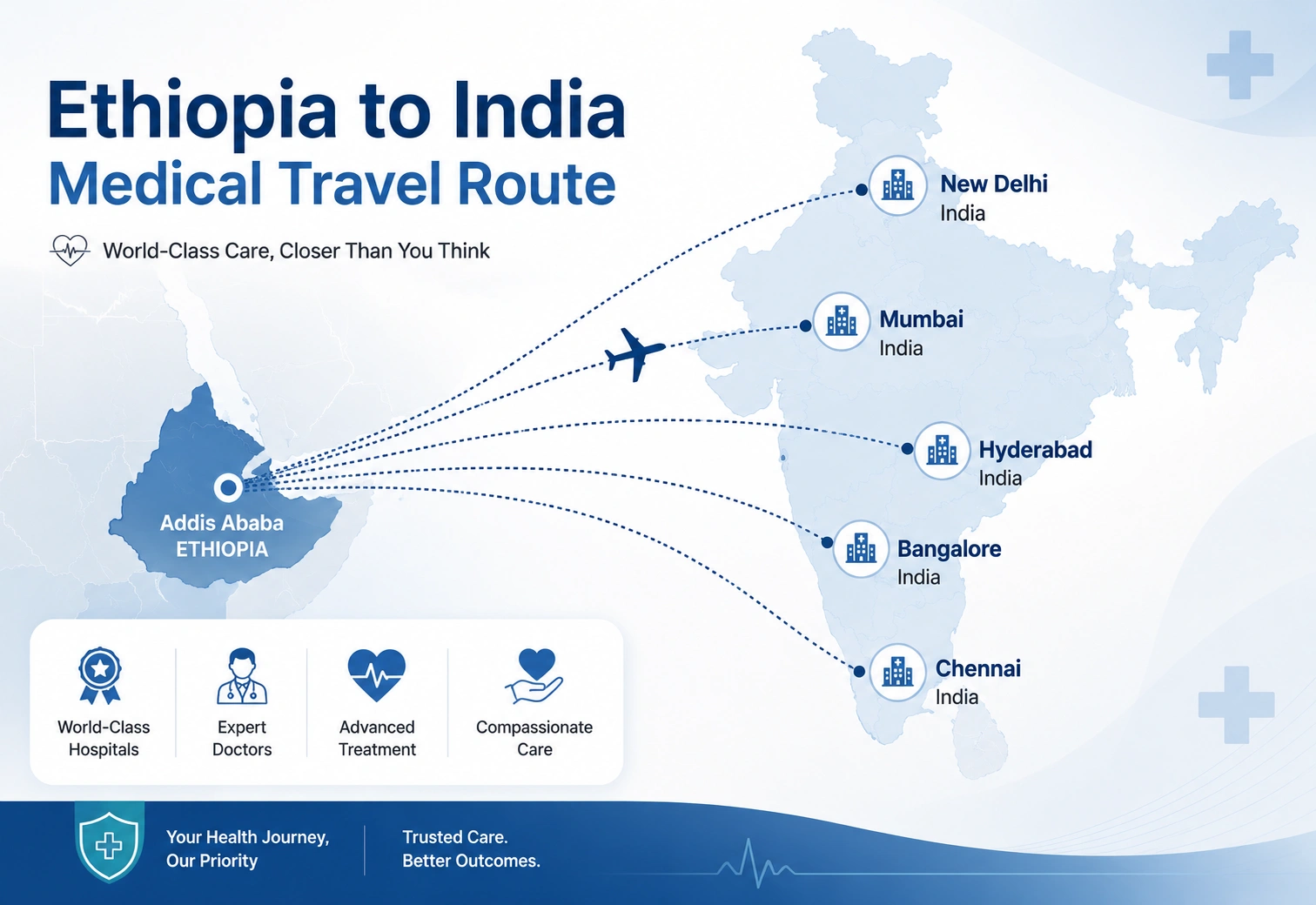
Ethiopian Airlines runs daily direct flights from Addis Ababa Bole International Airport to Delhi, taking around 6 hours 25 minutes. Direct routes to Mumbai and Hyderabad are also available.
That direct connection matters more than it seems. A patient undergoing chemotherapy or recovering from surgery benefits a lot from skipping a layover.
Medical Visa for India from Ethiopia
Medical travel to India starts on paper long before anyone boards a flight. The process, step by step:
- Gather medical reports, biopsy results, pathology reports, and imaging (CT, MRI, PET scans)
- Get an initial opinion from an Indian oncologist, along with a treatment plan and cost estimate
- Receive a medical visa invitation letter from the treating hospital
- Apply for the Indian medical visa with passport, photos, reports, and the invitation letter
- Attend the visa appointment at the Indian embassy or visa center
- Travel to India, typically with up to two attendants on the same visa category
Processing usually takes about a week once documents are complete. Delays almost always come from incomplete paperwork, not the embassy.
Getting the invitation letter requested early and having someone review the visa documents before submission avoids most of the delays that trip up patients applying on their own. Hospital visa assistance India programs exist specifically for this, and an Indian medical visa for Ethiopian patients moves fastest when the invitation letter and reports are submitted together.
What's Usually Included in a Treatment Package
Usually included:
- Surgeon or oncologist fee
- Standard hospital stay
- Basic pre-treatment diagnostics
- Airport pickup and hospital coordination (when a facilitator is involved)
Usually billed separately:
- Flights
- Extended ICU stay if complications arise
- Advanced imaging beyond the initial workup
- Long-term follow-up medication after returning home
Always ask for a full itemized breakdown before committing to travel, and confirm it in writing before booking flights.
Cancer Diagnosis: The First Steps
Cancer diagnosis and treatment India protocols both start the same way for every incoming patient. Diagnosis usually starts with imaging, a PET CT scan, MRI scan, or CT scan, followed by a biopsy to confirm the cancer type. The biopsy report and pathology report shape everything that follows.
NABH accredited hospitals follow standardized protocols. That matters when a patient's existing Ethiopian biopsy or imaging report needs re-evaluation before treatment begins, and it's usually the first medical consultation a patient has once reports reach India.
Multidisciplinary cancer care, called a tumor board, is standard at India's larger centers. Oncology specialists, surgeons, medical oncologists, and radiation oncologists review the case together, which catches things a single specialist might miss.
A personalized treatment plan should come out of this treatment planning process, built around the specific pathology report and stage, not a generic protocol applied the same way to every patient. Advanced oncology technology, from PET-CT scanners to robotic surgical platforms, tends to concentrate at the hospitals doing this kind of multidisciplinary review well.
Nutrition and Daily Life During Treatment
Chemotherapy commonly brings fatigue, nausea, appetite changes, and a weaker immune system. Most Indian oncology centers pair every cycle with a nutrition consultation focused on protein intake and maintaining weight.
Radiation therapy brings its own skin and localized side effects depending on the treated area. The treating team usually walks patients through what to expect before the course starts.
Family members traveling along play a bigger role than expected, from managing medication schedules to simply being present on long treatment days. Accommodation near the treating hospital matters a lot here, since daily sessions become a real burden if the hotel is an hour away in traffic, and that kind of cancer recovery support often makes the difference in how a family holds up through a long treatment course.
After Treatment: Survivorship and Follow-Up Care
Finishing active treatment isn't the end of the process. Most cancer types need a structured schedule of scans and blood work for years afterward to catch any recurrence early.
The harder part is keeping that schedule once a patient is back in Ethiopia, far from the treating oncologist. This is where ongoing coordination matters most.
Staying connected to the treating team well past discharge makes the biggest difference here, through a regular follow-up consultation schedule, tracking when the next scan is due, and getting results interpreted before they're sent back to India for review.
What HealthRoop Actually Does for Patients
International patient services India vary a lot in quality between providers, and not every medical facilitator in India goes beyond airport pickup. HealthRoop works as an international patient coordinator across the full journey, connecting families to an English speaking medical team at every stage.
Before travel:
- Free review of existing medical reports and imaging
- Case routed to an oncologist who treats that specific cancer type
- Hospital and specialist selection based on diagnosis, not a fixed referral deal
- Second medical opinion where it would genuinely help the decision
- Written cost estimate covering the full treatment plan, not just the headline procedure
Visa and travel:
- Medical visa invitation letter and document review
- Travel planning and flight guidance
- Airport pickup and local transport
- Accommodation booked close to the treating hospital
During treatment:
- Interpreter support, including Amharic-speaking coordination where needed
- One dedicated case manager for the entire journey, so the patient's history doesn't get repeated at every step
- FRRO registration where required, and visa extension assistance if treatment runs long
- Currency exchange guidance and a local SIM card on arrival
- 24x7 emergency support
After returning home:
- Teleconsultation follow-ups with the treating doctors
- Tracking of scan and blood test schedules
- Support until the patient has genuinely recovered and returned to normal life
Cancer treatment often runs for months, across multiple chemotherapy cycles and follow-up scans, sometimes a second treatment phase. HealthRoop stays involved through all of it, not just the airport pickup and the first hospital admission.
Conclusion
A cancer diagnosis is overwhelming enough without also figuring out which hospital abroad can handle a specific case, how to get a visa quickly, or how to budget for months of treatment. India gives Ethiopian patients accredited hospitals, experienced oncology teams, and cost that keeps complete treatment within reach.
That doesn't remove the difficulty of the diagnosis itself. But the logistics around it don't have to become a second crisis on top of the medical one.
With the right coordination in place for hospital selection, visas, travel, and follow-up care, a family can spend its energy on the patient instead of the paperwork. The simplest next step is getting the existing medical reports reviewed.
Sources: Cancer statistics from GLOBOCAN 2022 (Global Cancer Observatory, WHO/IARC). Cost data compiled from published 2026 medical tourism cost data across accredited Indian hospitals. Flight details based on Ethiopian Airlines' published schedules. Figures are indicative only; confirm current pricing directly with the treating hospital.
Frequently Asked Questions
Answers on cancer treatment cost, hospitals, and visa steps for Ethiopian patients.
HCG Cancer Centre, Apollo Hospitals, Max Healthcare, Fortis Healthcare, and Manipal Hospitals are among the most established options, each with distinct strengths depending on the specific cancer type.
Costs range from $400 per chemotherapy cycle to $48,000 for a bone marrow transplant, depending on cancer type, stage, and hospital.
Typically about a week once documents, reports, and the hospital invitation letter are ready.
Yes, most Indian medical visas allow up to two attendants, usually close family, to accompany the patient.
Yes, Ethiopian Airlines flies direct from Addis Ababa to Delhi in about 6 hours 25 minutes, with additional direct routes to Mumbai and Hyderabad.
Breast, cervical, colorectal, and blood cancers make up the largest share, matching the most common cancer diagnoses reported in Ethiopia.
Yes, at a small number of specialized hospitals, typically reserved for cases where sparing healthy tissue is critical.
Rarely for treatment performed abroad. Most patients budget for this as self-pay, though some hospitals offer EMI or financing, and some international policies offer partial reimbursement.
Most cancer types need a structured follow-up schedule of scans and blood work for years afterward. HealthRoop helps coordinate teleconsultations and tracks when follow-up tests are due.
A medical facilitator coordinates hospital selection, visa paperwork, travel, and accommodation. It's not mandatory, but it removes a lot of the logistics burden, and the right one stays involved well past the first hospital admission.
Not in quality. Indian hospitals for Ethiopian patients and other international arrivals run the same protocols used for local patients, with added services like visa support, interpreters, and coordinated follow-up.
It depends on the cancer type. HCG works well for pure oncology cases, while Apollo, Max, Fortis, or Manipal suit patients who may need other specialties alongside cancer care.
Yes. Cancer treatment for foreigners in India spans patients from across Africa, the Middle East, and beyond, and the best cancer doctor for a given case is usually found by matching sub-specialty to diagnosis rather than picking a name off a general list.
